

Banks once kept almost every mission-critical system inside their own data centers. Now, a growing share of banking operations runs on cloud platforms built by Microsoft Corporation’s (MSFT) Azure, Alphabet's (GOOG) (GOOGL) Google Cloud, and Amazon.com's (AMZN) Amazon Web Services (AWS).
These companies handle everything from customer databases and payment processing to fraud detection and artificial intelligence (AI) workloads. Yet, that dependence has also raised the stakes. A prolonged outage or a successful cyberattack on any one of these platforms would not stop at a single bank's doorstep.
More Top Stocks Daily: Go behind Wall Street’s hottest headlines with Barchart’s Active Investor newsletter.
It could quickly ripple across several financial institutions at once. U.K. regulators saw that risk coming and decided to tackle it at the source. On Friday, July 10, the U.K. government designated Microsoft, Google Cloud, AWS, and Oracle Corporation (ORCL) as critical third-party providers to the country's financial sector.
For the first time, these technology companies now fall under direct regulatory oversight as authorities move to strengthen the resilience of essential financial services. The new designation takes effect today, July 13. It covers Microsoft Ireland Operations Limited, Google Cloud EMEA Limited, Amazon Web Services EMEA SARL, and Oracle Corporation U.K. Limited.
The Bank of England, the Prudential Regulation Authority, and the Financial Conduct Authority will jointly oversee these companies. Each provider must complete resilience testing, carry out regular self-assessments, and report any major incidents to regulators. The government introduced this framework under the Financial Services and Markets Act 2023 to reinforce the stability of the U.K.'s financial system.
Notably, officials made one thing clear. This list may not stay exclusive forever. Any additional technology provider that becomes critical to the financial sector could also face the same level of regulatory scrutiny in the future. Now, the obvious question is whether this fresh regulatory spotlight changes the outlook for Microsoft’s shares.
About Microsoft Stock
Headquartered in Redmond, Washington, Microsoft ranks among the world's largest technology companies and has built an ecosystem that spans almost every corner of modern computing. The company operates across cloud computing, workplace software, AI, gaming, search, and professional networking, giving it one of the broadest technology portfolios anywhere.
Commanding a market cap of $2.86 trillion, its product portfolio includes Windows, Azure, Microsoft 365, Xbox, LinkedIn, GitHub, and Copilot. Millions of consumers and businesses rely on these platforms every single day, making Microsoft deeply woven into both personal and enterprise technology.
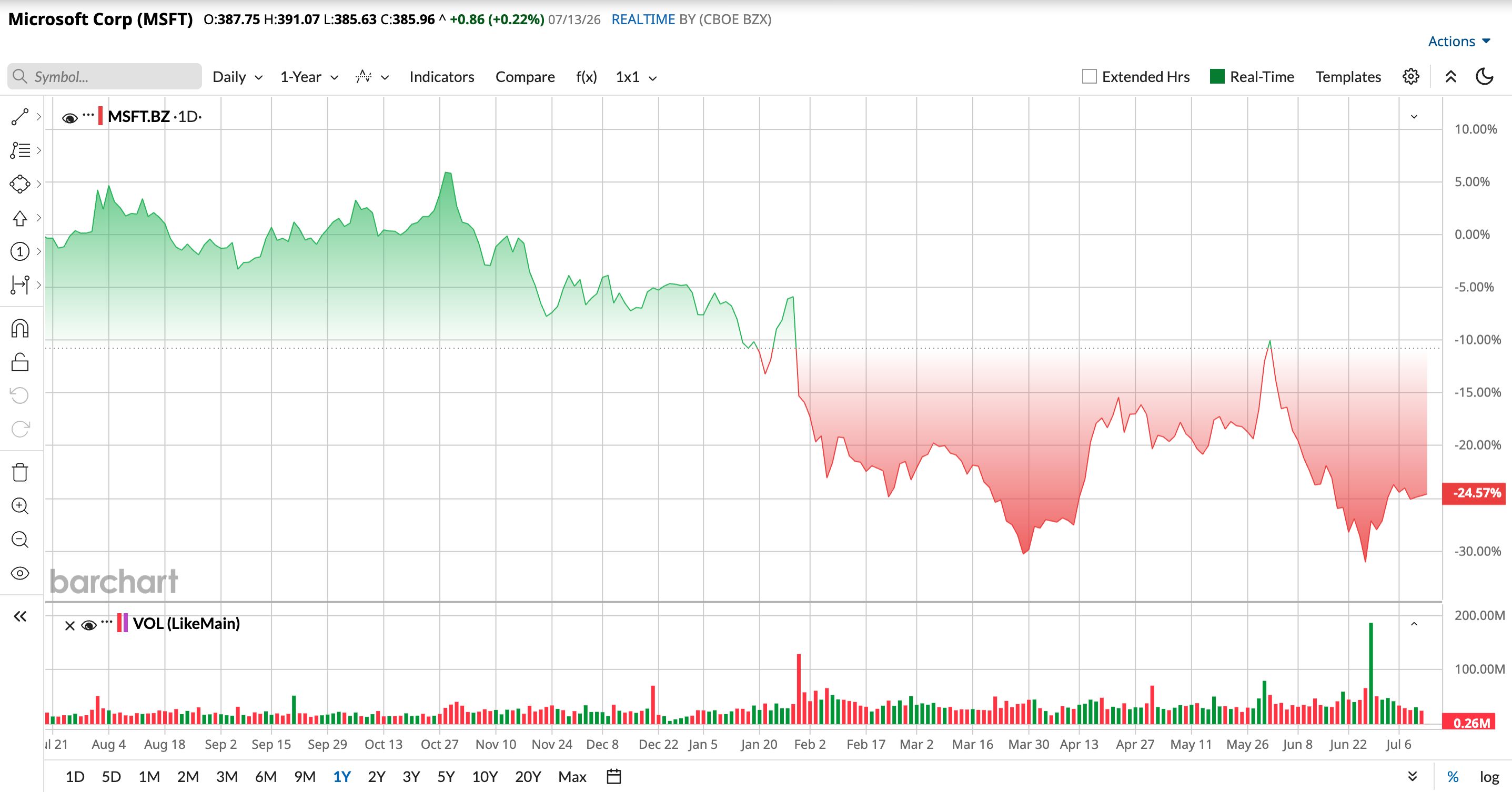
Even companies of this size cannot dodge every market sell-off. MSFT stock declined nearly 23.1% over the past 52 weeks. The weakness continued into 2026, with the stock falling another 20% so far this year. Recent trading has offered little comfort either, as shares have slipped marginally 0.89% during the past month, owing to the volatile technology industry backdrop.
 www.barchart.com
 On the valuation front, MSFT stock is currently trading at 19.93 times forward adjusted price-to-earnings, which sits below the industry benchmark and the company's own five-year average multiple. Investors hunting for value might see that discount as a welcome silver lining after the recent pullback.
And, Microsoft keeps its income investors happy. The company has increased its dividend for 21 consecutive years and now pays an annual dividend of $3.64 per share, translating to a yield of 0.95%. The next payment of $0.91 per share is scheduled to go out on Sept. 10 to shareholders of record as of Aug. 20.
Microsoft Surpasses Q3 Earnings
Microsoft walked into earnings season on April 29 with plenty of expectations hanging over its head. Q3 FY2026 revenue climbed 18.3% year-over-year (YOY) to $82.89 billion, beating analyst estimates of $81.39 billion. EPS jumped 23.4% from the year-ago value to $4.27, topping the Street's $4.06 forecast.
The deeper numbers looked equally impressive. Microsoft Cloud generated more than $54 billion in revenue after posting YOY growth of 29%. The company's AI business stole the spotlight as its annual revenue run rate surged past $37 billion, up 123% YOY.
Growth of that magnitude never comes free. Microsoft poured enormous sums into expanding its AI infrastructure, and those investments showed up in profitability. Gross margin slipped to 68% during the quarter.
Rising usage of AI products also added fresh pressure. However, stronger efficiency across Azure and Microsoft 365 Commercial cloud helped offset part of that squeeze and prevented margins from taking a heavier hit.
Furthermore, capital expenditures, together with finance leases, reached $31.9 billion during the quarter. However, the spending spree is far from over. Management expects Q4 FY2026 revenue to land between $86.7 billion and $87.8 billion, representing growth of 13% to 15%.
That investment cycle stretches well beyond one quarter. Microsoft expects capital expenditures during CY2026 to reach roughly $190 billion. Rising memory costs account for a meaningful slice of that total. Nearly $25 billion is directly attributable to higher component pricing.
Wall Street expects earnings growth to remain intact despite that aggressive investment pace. Analysts project Q4 FY2026 EPS of $4.21, representing YOY growth of 15.3%. Full-year FY2026 EPS could climb 22.9% from the prior year to $16.76, while FY2027 EPS is projected to rise 15% to $19.29.
What Do Analysts Expect for Microsoft Stock?
Wall Street has not backed away from Microsoft despite the recent slide in the stock. If anything, several analysts still believe the company's long-term story remains firmly intact, thanks to its dominant position in cloud computing and its relentless push into AI.
Goldman Sachs has rated MSFT stock a “Buy” and set a price target of $610. Bernstein analyst Chad Dillard also remains bullish on MSFT stock, maintaining a “Buy” rating and setting a price target of $646.
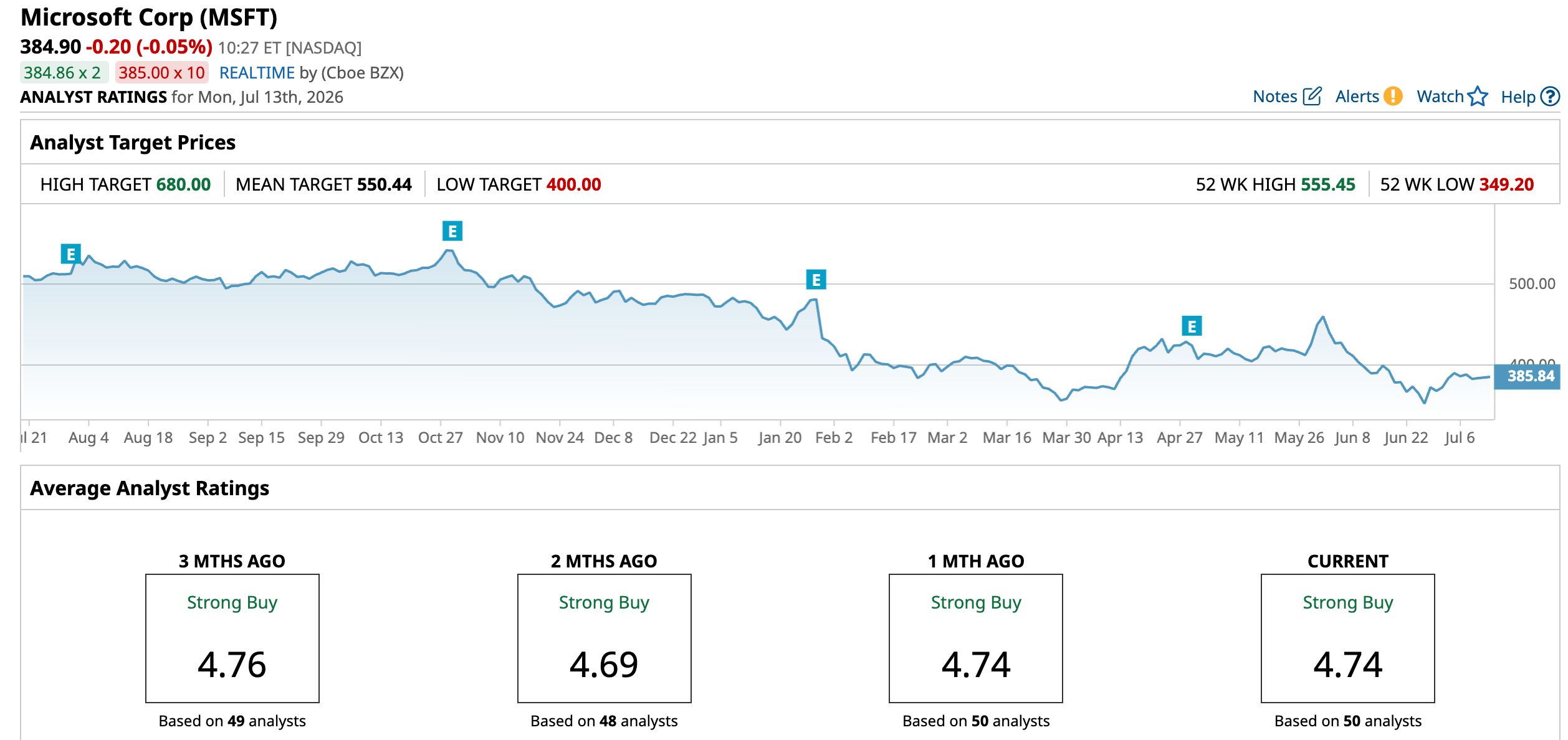
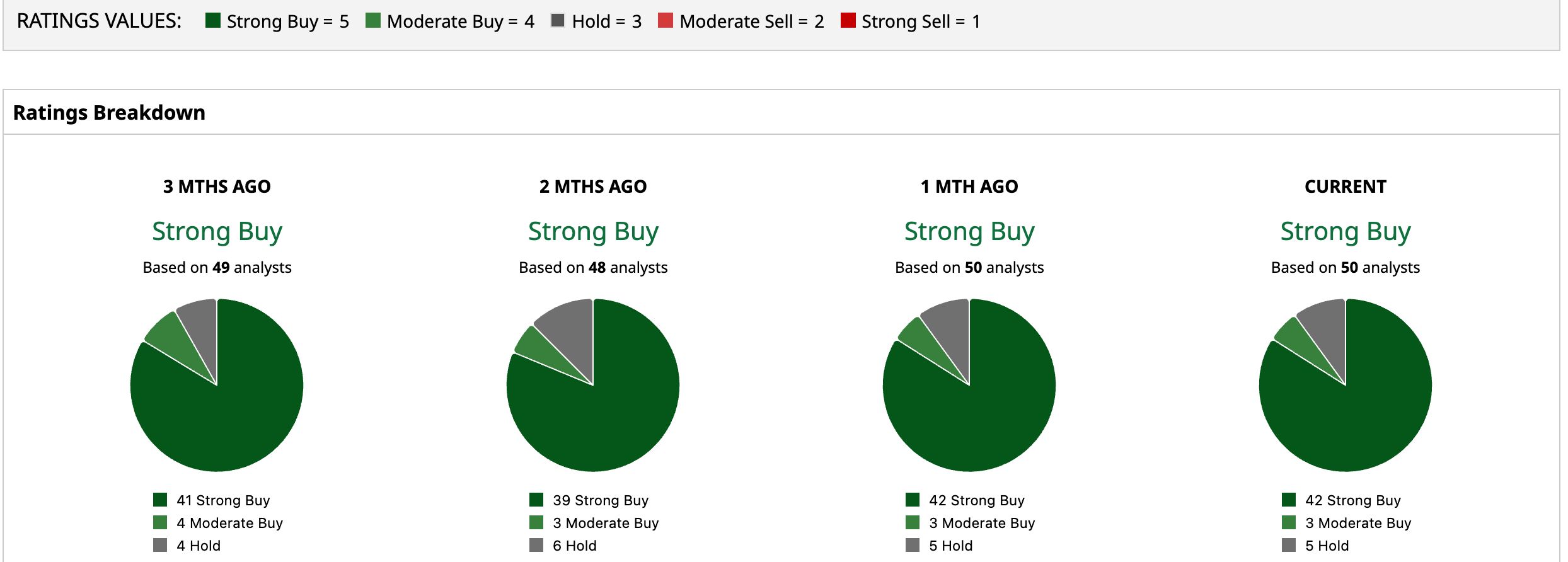
Nevertheless, MSFT stock carries an overall rating of "Strong Buy." Among 50 analysts covering the name, 42 rate it a "Strong Buy," three call it a "Moderate Buy," and five prefer to sit with a "Hold."
The average price target of $550.44 represents potential upside of 43%. Meanwhile, the Street-High target of $680 implies a 76.7% gain from current levels.
 www.barchart.com
  www.barchart.com
 On the date of publication, Aanchal Sugandh did not have (either directly or indirectly) positions in any of the securities mentioned in this article. All information and data in this article is solely for informational purposes. For more information please view the Barchart Disclosure Policy here.
More news from Barchart
SK Hynix Just Sent a Huge AI Demand Signal With Historic U.S. Listing for SKHY Stock Dear Microsoft Stock Fans, Mark Your Calendars for July 13 Thanks to Escalating Iran Tensions, Delta Air Lines Stock Could Face Turbulence. How to Trade It Here. AMD Is Following Nvidia’s Playbook. Here’s Why Investors Should Pay Attention.