


It’s not too far of a stretch to say that Microchip Technology (MCHP) may not be on most investors’ radar. Although MCHP stock is up almost 23% on a year-to-date basis, its recent performance has been lackluster. For example, in the trailing month, the ticker is down nearly 3%. Further, the volatility has triggered the Barchart Technical Opinion indicator, which rates Microchip as a 24% Weak Sell.
Fundamentally, the pessimism appears justified. According to Google Finance’s summary, MCHP stock has faded due to broader macroeconomic pressures and yield concerns. Worryingly, this downturn occurred despite solid earnings performances and a strong forward guidance.
Can’t Get Enough Options?: Join the list for Barchart’s daily unusual options report, delivered free.
Still, not everything is negative. Per Google, “[a]nalysts project a cyclical recovery next quarter, expecting performance to be anchored by strong artificial intelligence demand in data centers.” And that’s ultimately what I want to tap into — given the underlying relevancy, there’s a credible reason to believe Microchip stock may be viewed as a discounted opportunity.
Quantitatively, MCHP stock has only managed to print three positive weekly candlesticks over the past 10 weeks, thereby leading to a negative slope from the open of the period to the close. Historically, under this sequence, traders have witnessed a median performance lift of about 8.71% over the next four to five weeks following the signal flashing.
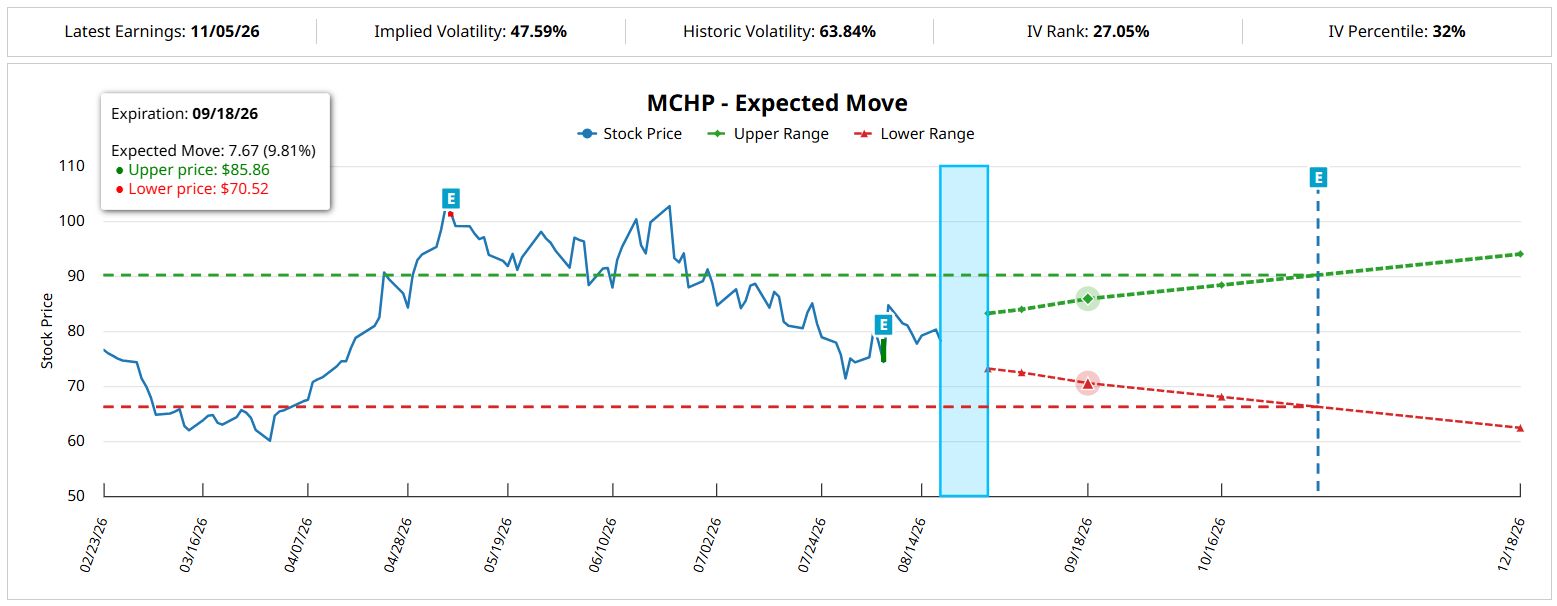
That would put Microchip stock at around $85 as a median endpoint expectation at the Sep. 18 expiration date. Since we’re talking about a near-term expiry, buying a Sep. 18 call outright may be too much of a risk for some folks. As such, the bull call spread — which lowers the net debit required due to the simultaneous sale of a higher-strike call option — may be effective.
Specifically, I’m looking at the Sep. 18 82.50/85 bull spread. However, there are immediate risks that must be acknowledged.
MCHP Stock Represents a War of Presuppositions
Currently, the breakeven price of the aforementioned call spread stands at $83.55. Therefore, you don’t need Microchip stock to hit $85 at expiration to make a profit. If it rises above the breakeven threshold, the spread would be in the money. But there’s a big problem here and it has to do with the odds.
Using the Black-Scholes family of option pricing models, Wall Street’s derivative valuation protocol calculates a probability of profit (breakeven) of only 31.6%. What’s worse, when reverse engineering the implications of Barchart’s Expected Move calculator, the chances of MCHP stock actually hitting the second-leg strike are extremely modest at 23.21%.
Invariably, since the maximum payout of the 82.50/85 bull spread is only 138.10%, the wager would suffer from negative expected value (EV) over the theoretical long run. I don’t need to tell you why that’s a bad move.
Nevertheless, since we’re dealing with the unknown future, we must acknowledge that the probabilities that are provided represent a presupposition; specifically, that MCHP stock will undergo a random walk from the current spot to the expiration date, assuming the current implied volatility (IV) as the initial fuel, so to speak.
That’s an arguably reasonable presupposition but it’s not exclusive. My argument is this: what if MCHP stock were to undergo a nonrandom walk?
Essentially, I want to approach the equities market as a science experiment. We have a test group in the aforementioned 3-7-D sequence (3 up weeks, 7 down weeks, downward slope). We also have a control group, in this case, how Microchip stock performs under random conditions over the next 10 weeks.
As it turns out from an analysis of historical data, Microchip has routinely outperformed the random baseline following the flashing of the above quant signal. No, it’s not guaranteed that MCHP stock will react the same way over these coming weeks — I have to be clear about this risk.
Still, I would argue there’s compelling evidence that under negative order flow imbalances, the market historically bids up MCHP.
What Exactly are the Presupposed Odds?
I also want to be clear that my interpretation of Microchip stock is also presuppositional. In other words, I don’t have a way to absolutely guarantee that MCHP will undergo a nonrandom walk. I also don’t know if any actual nonrandom behavior will align with past empirical behavior.
Honestly, I’m just looking at the conditioned odds. And that is that since January 2019, MCHP stock has flashed the 3-7-D quant sequence 37 times. Out of this total, MCHP has exceeded the equivalent of the $85 strike at roughly the Sep. 18 expiration date a total of 20 times. If this assumption can be relied upon, you’re looking at a success ratio of 54.1%.
Suddenly, with this inductive presupposition, the EV calculation changes to a positive figure. In other words, you’re going to win — under this model — the max payout of $145 more times than you would lose the $105 net debit paid over the theoretical long run.
Again, there are no guarantees with this framework. Just because something consistent happened in the past does not mean it will repeat in the future. But in the absence of another empirical method, I would argue that Microchip stock looks intriguing.
On the date of publication, Josh Enomoto did not have (either directly or indirectly) positions in any of the securities mentioned in this article. All information and data in this article is solely for informational purposes. For more information please view the Barchart Disclosure Policy here.
More news from Barchart
Deflated Microchip Technology Stock Could Target a Contrarian Move to $85 The AI Boom Has a New Chip Shortage. Intel Is Ready. S&P Futures Steady as Bonds Stabilize After Selloff, FOMC Minutes on Tap This Safe Dividend Stock Is Beating the S&P 500 in 2026. How to Play It for the Next Year and Beyond.