

Tesla (TSLA) is a global leader in electric vehicles, energy storage, and artificial intelligence, headquartered in Austin, Texas. Led by CEO Elon Musk, Tesla designs and manufactures EVs, energy storage systems, and solar products while aggressively expanding into autonomous driving, robotics, and AI infrastructure through its Full Self-Driving (FSD) software, Robotaxi network, and Optimus humanoid robot program. The company operates through two primary segments: Automotive, and Energy Generation and Storage. As Tesla transitions from a pure-play automaker into a broader AI and robotics powerhouse, it continues to invest heavily in manufacturing capacity, battery technology, and next-generation autonomous systems worldwide.
Tesla Stumbles in 2026
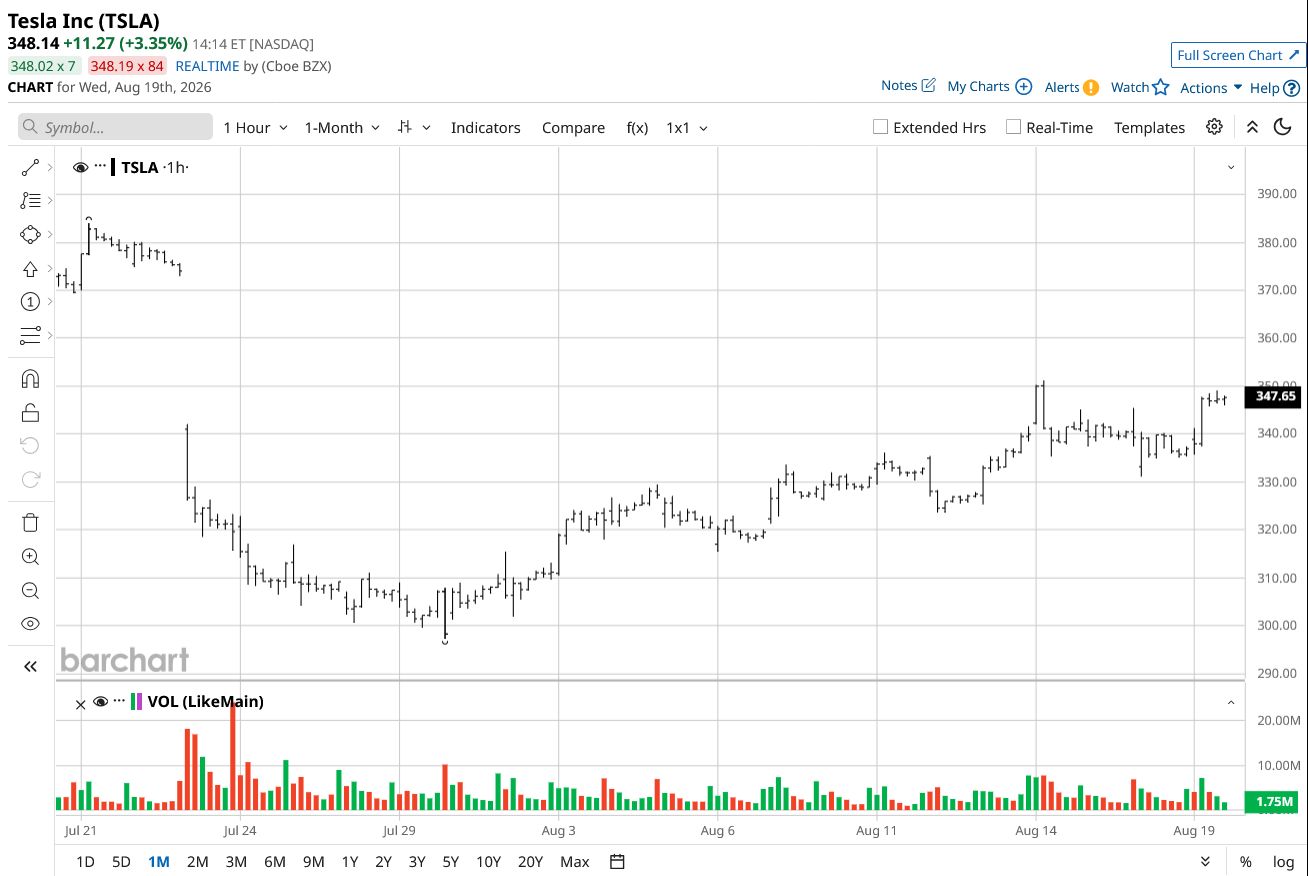
Tesla's stock has struggled in 2026, trading near the bottom of its 52-week range and below its 200-day moving average. Shares recently closed around $336.87, down sharply from a 52-week high of $498.83 set in June, though still above the 52-week low of $297.38 touched in late July. The stock has been pressured by margin compression, a negative free cash flow quarter, and investor anxiety over Tesla's massive AI and robotics capital spending, even as anticipation builds around the upcoming public Cybercab robotaxi launch in Austin and continued progress on Optimus humanoid robot production.
More Top Stocks Daily: Go behind Wall Street’s hottest headlines with Barchart’s Active Investor newsletter.
By contrast, the S&P 500 Information Technology Sector Index ($SRIT) has surged roughly 21% year-to-date (YTD) in 2026, powered by the broader AI boom. TSLA stock has significantly underperformed its own sector this year, reflecting investor concerns over collapsing margins and heavy AI-related spending overshadowing the company's record delivery growth.
 www.barchart.com
 Tesla Posted Record Results
Tesla's second-quarter 2026 results showed record revenue of $28.24 billion, up 26% year-over-year (YoY) and comfortably beating the roughly $26.4 billion analyst consensus, driven by a Q2-record 480,126 vehicle deliveries. However, non-GAAP earnings per share came in at just $0.33, missing the $0.53 consensus estimate by nearly 39%, marking one of Tesla's steepest earnings misses in recent memory despite the strong top-line performance.
Operating income plunged 57% YoY to $398 million, compressing operating margin to just 1.4%, as operating expenses surged 47% to $4.35 billion on AI infrastructure and R&D spending. Automotive gross margin excluding regulatory credits fell to 16.3% from 19.2% in Q1, while free cash flow turned negative at roughly $1.1 billion as capital expenditures more than doubled to $5.79 billion. Energy storage deployments still rose to 13.5 GWh, and services revenue climbed 50% to a record $4.58 billion.
Management said Tesla remains in an aggressive investment phase, with full-year 2026 capital expenditures expected to exceed $25 billion to fund Robotaxi expansion, Optimus production, and AI chip manufacturing, backed by up to $30 billion in new debt facilities. Musk described the buildout as the "fastest industrial scale-up since WWII," highlighting weekly Robotaxi mileage growth and an accelerating Optimus ramp as key catalysts expected to diversify Tesla's revenue streams beyond traditional vehicle sales.
Advances in Robotaxi Research
Tesla is pushing forward with its Cybercab robotaxi rollout, with CEO Elon Musk and CFO Vaibhav Taneja confirming during the company's Q2 earnings call that production has begun and the vehicle is already being used for rides within Tesla's Austin factory. The next phase reportedly includes a soft public launch featuring test drives, employee rides on private roads, and coordinated training with local first responders, though full-scale volume production isn't expected until later.
Musk emphasized that Tesla still needs to gather Cybercab-specific driving data before scaling deployment significantly. The Cybercab itself is a compact, two-seat electric vehicle built exclusively for autonomous ride-hailing, notably lacking a steering wheel or pedals, and reportedly featuring a single 219-horsepower motor, a roughly 48-kWh battery, and a curb weight near 3,113 pounds. The news rattled ride-hailing rivals, with Uber (UBER) and Lyft (LYFT) shares dipping slightly as investors weighed Tesla's growing robotaxi ambitions.
Should You Buy TSLA Stock?
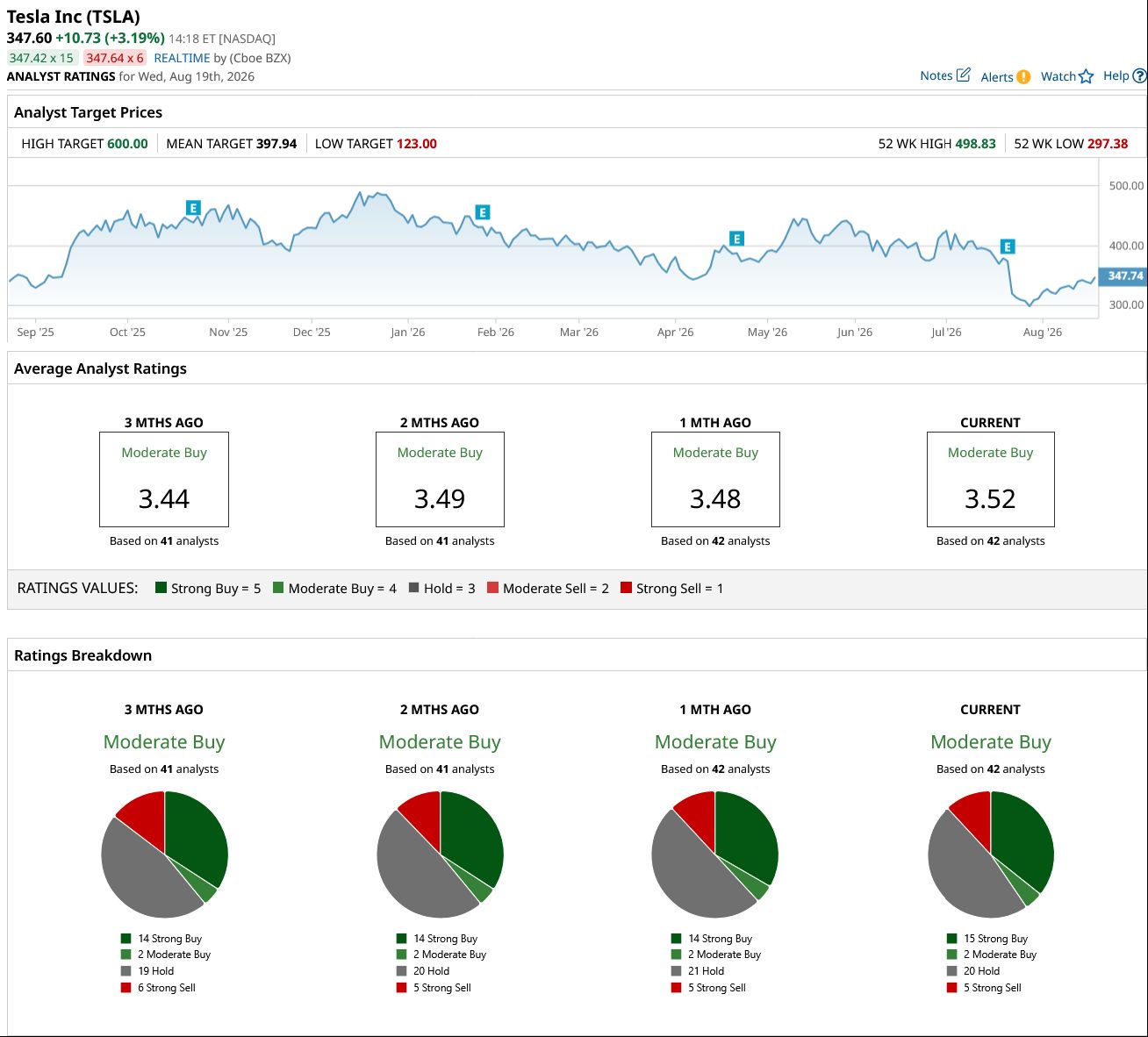
Tesla's Cybercab progress adds a fresh layer of optimism to the long-term robotaxi story, even as full-scale production remains years away and near-term profitability stays under pressure. Wall Street's take reflects that tension: TSLA carries a consensus "Moderate Buy" rating from 42 analysts, split between 15 "Strong Buy" and two "Moderate Buy" calls versus 20 "Hold" and five "Strong Sell" ratings. The average price target of $397.94 implies roughly 14% upside from current levels, suggesting cautious optimism that Tesla's AI, robotics, and autonomy bets could eventually offset its ongoing margin challenges.
 www.barchart.com
 On the date of publication, Ruchi Gupta did not have (either directly or indirectly) positions in any of the securities mentioned in this article. All information and data in this article is solely for informational purposes. For more information please view the Barchart Disclosure Policy here.
More news from Barchart
MRVL Stock Alert: What to Know as Marvell Technology Expands Chip Deal With Google Bridgewater Dramatically Trimmed Its Position in Micron During Q2. What This Means for MU Stock. Here Is How to Play Tesla Stock After Its Robotaxi Breakthrough Morgan Stanley Just Upgraded Honeywell Aerospace Stock. Here's Why.