


Now that the space dust, er, the dust from the SpaceX (SPCX) initial public offering (IPO) has settled, I decided to take another look at the IPO space at large. What did I find? Even in a strong period for stocks, like the past 52 weeks, IPOs are a crapshoot. That’s based on the current holdings of the Renaissance IPO ETF (IPO), which have been public for at least 12 months.
With OpenAI and Anthropic thought of as the “next big thing” in IPO land, given their expected offerings, it should be noted that the last two headline-grabbing launches are not exactly posting stellar numbers out of the gate. Cerebras (CBRS) debuted in May of this year, and after hitting an intraday high of $386 just hours after its debut, it closed Wednesday at around $216.
More Yield, Less Trap: Sign up free to get Barchart’s daily Dividend Investor newsletter straight to your inbox.
And SPCX, the biggest of the big in terms of hype, drama, and press coverage, ventured up to $225 almost immediately. It closed this past Wednesday at around $140. The time gap between those two price levels? About nine weeks.
A Closer Look at the IPO ETF
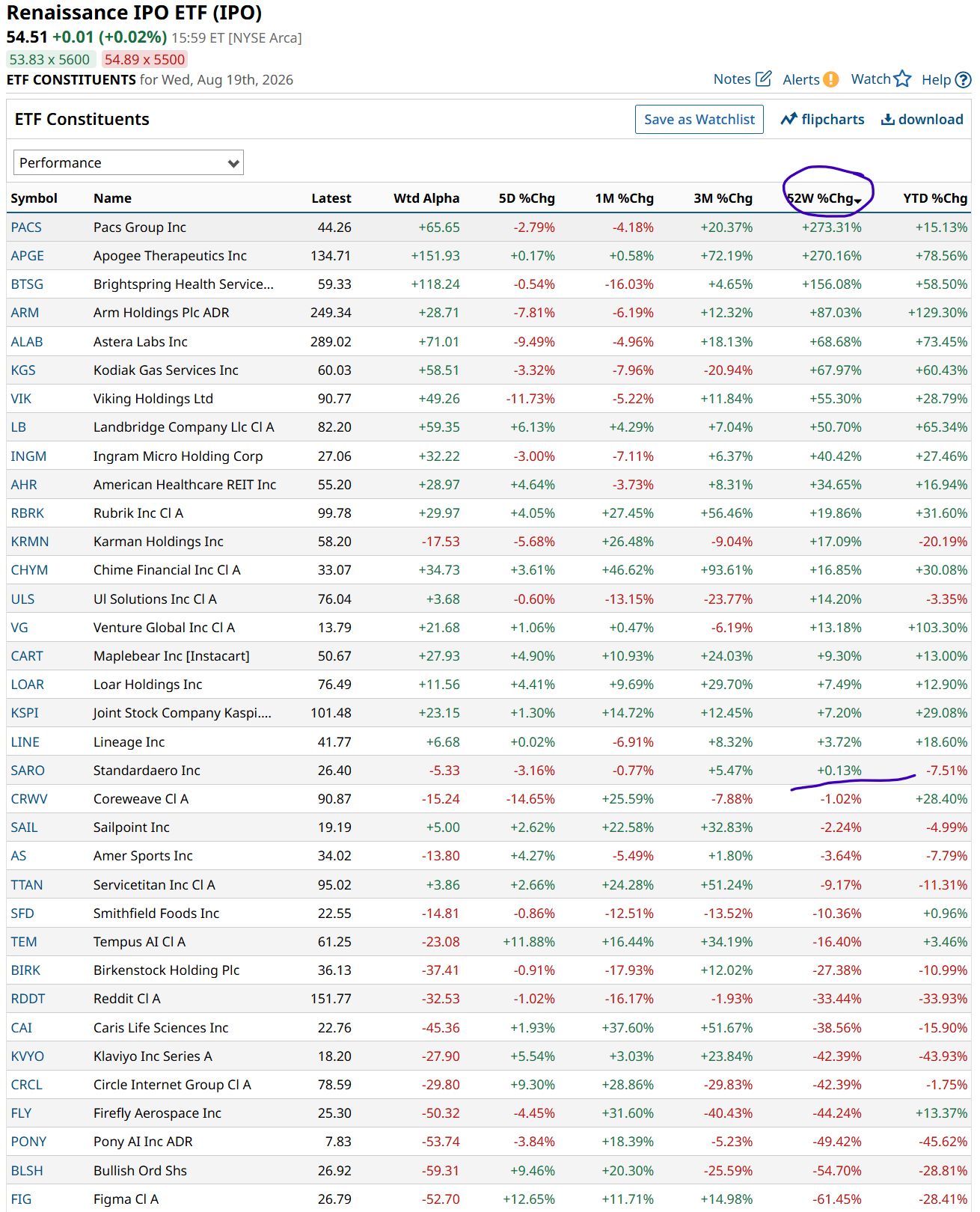
This chart shows all of the IPO ETF’s holdings, which have all been public for at least 52 weeks. CBRS is in the portfolio but not shown since it is too new to qualify, and SPCX is not yet in the portfolio, but will be added at the next quarterly reconstitution of the index that governs this fund. That is also when any stock that has been public for two years will be sold out of the ETF, as per its index rules.
 www.barchart.com
 I drew a purple line where the winners and losers separate. There have been 20 winners and 15 losers. So close to an even draw. There has been a wide range of returns, which includes nine names up more than 40%, and six that have lost at least 40%. That means that out of 35 stocks tracked here, 15 of them have moved 40% in one direction or the other. Remember, this is during an above-average period of returns for the broader stock market. Investing in newly public companies has become a high-stakes coin flip.
Why IPO Investing Is Such a Coin Flip
This extreme dispersion stems from how the market for new listings is structured. Companies time their public debuts to coincide with peak sector enthusiasm and maximum private valuation multiples. Once the initial marketing campaign ends and quarterly financial reporting begins, reality sets in quickly. Companies that deliver on high growth expectations attract aggressive institutional accumulation, while those that miss targets face immediate, brutal valuation resets.
The traditional six-month insider lockup expiration acts as a major hurdle. But in this short-attention-span environment, once the company is public, one has to imagine the urgency to keep the stock price up is not nearly as strong as it was going into the offering. I’m speaking from the standpoint of the bankers. And even if that is not the case in terms of intention, the numbers tell the story here.
As early venture capital investors and company executives gain permission to sell, massive share supply hits the secondary market. If underlying buyer demand isn't strong enough to absorb that overhead selling pressure, share prices often break down.
A common trap for investors is assuming that the largest, most publicized mega-cap listings offer the best upside. In reality, mega-debuts enter the public market fully valued, leaving little margin of safety or room for explosive percentage growth.
The true multi-baggers frequently emerge from quality mid-sized companies that debut under the radar. Because they start from a smaller valuation base with lower initial institutional coverage, a string of solid quarterly earnings can drive massive percentage gains as institutional funds discover and build positions in the stock.
Case in point: what I show here. These are five of the better performers in the table above.
 www.barchart.com
 Even after those big initial post-IPO gains, they are all between $6 billion and $12 billion in market cap. That might provide some direction going forward, in terms of paying more attention to smaller, under-the-radar IPOs, rather than the ones everyone knows about and wants in on.
I have documented here, before and after the event, the mayhem, misdirection, and, ultimately, misallocation that was the SPCX IPO. With two artificial intelligence (AI) kings preparing to make their own debut at some point in the next several months, a long memory is helpful.
Rob Isbitts is a semi-retired CIO, former fiduciary investment advisor, and Barchart columnist. Check out his other work at ETFYourself.com (featuring the Fresh Charts weekly trading post), and ROAR.PiTrade.com, helping investors to better-manage their own portfolios.
On the date of publication, Rob Isbitts did not have (either directly or indirectly) positions in any of the securities mentioned in this article. All information and data in this article is solely for informational purposes. For more information please view the Barchart Disclosure Policy here.
More news from Barchart
Why Investing in IPOs Has Become a High-Stakes Coin Flip Most Tech Stocks Are More Correlated Than You Think. Don’t Let That Wreck Your Trading Plan. The Bond King Goes Bananas Over Nvidia's $500 Billion Move. How It May Be Affecting Your Portfolio. ‘There’s Only One Way I Know to Avoid Leverage’ – But Should You? In Defense of Leverage with Our ETF Expert