

Microsoft (MSFT) gave Wall Street what it wanted, leaving investors to decide what that performance is worth. The company’s latest quarterly revenue rose 18.8% to $92.28 billion, beating expectations, while adjusted earnings of $4.89 per share also came in ahead of estimates.
Still, a good quarter does not automatically make a stock a good buy. What matters next is whether Microsoft can build on those results and deliver enough growth to reward investors buying at today’s price. That is where the conversation moves beyond the earnings headlines and into the expectations attached to the shares.
More Top Stocks Daily: Go behind Wall Street’s hottest headlines with Barchart’s Active Investor newsletter.
The harder question is whether there is enough opportunity left for investors who have yet to buy. Does the latest report strengthen the case for owning MSFT now, or does the price demand more patience? Let’s find out.
About Microsoft Stock
Microsoft builds software, operates cloud infrastructure, and sells computing devices from its headquarters in Redmond, Washington, with a market value of approximately $3.9 trillion. Its operations include Azure, Microsoft 365, Windows, and Xbox, serving businesses and consumers through subscriptions, software licenses, hardware sales, and a global cloud platform.
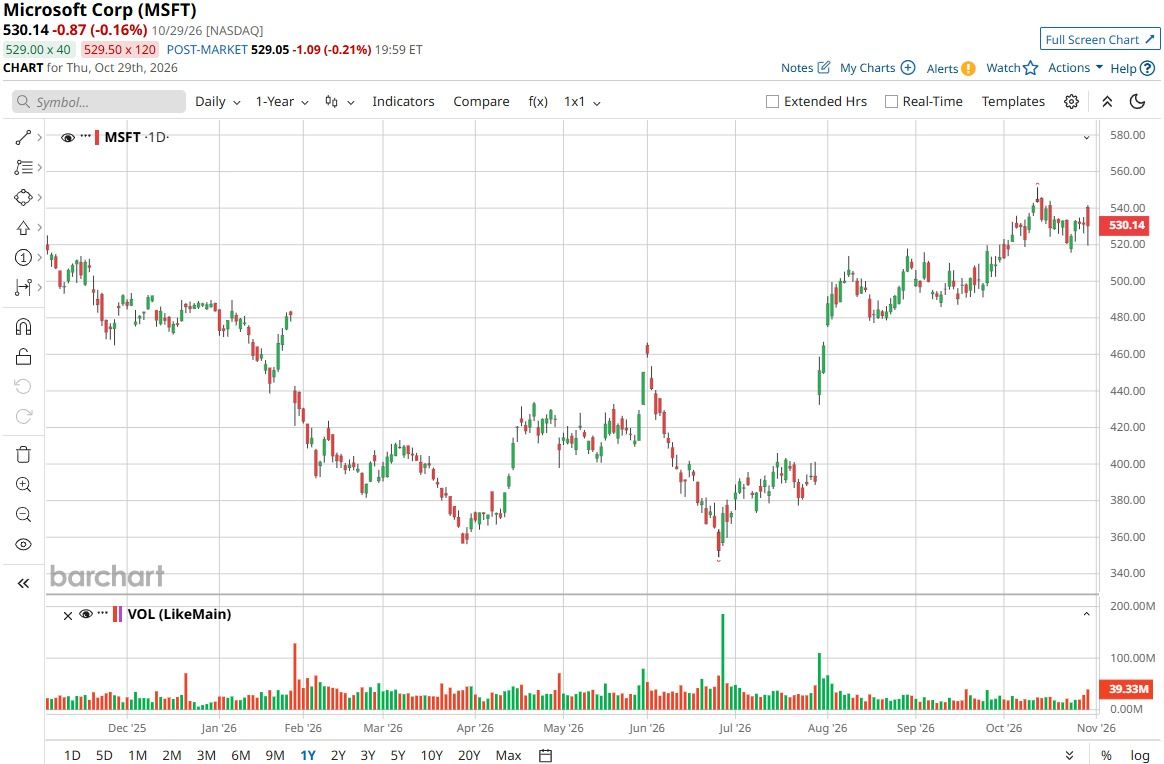
Microsoft’s shares closed at $530.14 on October 29, gaining 9.62% year to date but losing 2.11% over the past 52 weeks.
 www.barchart.com
MSFT’s forward P/E of 27.03x trails the sector median of 29.85x, but its higher PEG ratio of 1.67x versus 1.19x suggests that the discount disappears when expected growth is considered. The company returned $10.2 billion through dividends and share repurchases, while its annualized dividend of $3.64 per share offers a 0.69% yield.
What Microsoft’s Latest Numbers Show
Microsoft reported fiscal Q1 2027 results on October 28, with revenue climbing 18.8% to $92.28 billion, exceeding the $90.64 billion consensus by 1.8%. Its GAAP EPS figure reached $4.92 against expectations of $4.72, a 4.3% beat, while quarterly net income totaled $36.63 billion.
This performance extends a longer expansion, with annual revenue increasing from $176.3 billion five years earlier to $346.4 billion, representing 14.5% annualized growth. MSFT generated $76.8 billion from Agents and Infra, up 25%, while Microsoft Cloud revenue advanced 30% to $63.9 billion, or 31% in constant currency.
Its Azure business grew 48%, while commercial remaining performance obligations increased 73% to $677 billion, expanding the company’s contracted future revenue. The Microsoft 365 commercial cloud business grew 17% as reported and 18% after normalizing a prior revenue recognition benefit.
Microsoft recorded Devices and Consumer revenue of $15.5 billion, down 3%, although search and advertising revenue excluding traffic acquisition costs grew 12%.
Where Microsoft Could Improve AI Returns
Microsoft’s next opportunity is to improve the economics of its AI business. Azure President Girish Bablani reportedly asked managers overseeing roughly 11,500 employees to identify cost cuts of at least 20%. However, Microsoft denied directing teams to develop those plans, so investors should not count on those savings yet.
A more concrete development is Microsoft-Decision-1, a model designed for tasks such as routing requests, classifying information, and checking outputs. It costs $0.042 per million input tokens, with responses free. Testing cited in the report showed it running 35 times faster than GPT-6 Sol. That pricing could make repeated automated decisions cheaper for business customers.
Microsoft is targeting the hardware bill through Maia 300. Deployment is planned at a multi-gigawatt scale beginning in 2027. The company expects 40% more tokens per megawatt than leading GPU-based systems, meaning more AI processing from the same electricity supply. Microsoft intends Maia to become its primary inference hardware for internal products. It reportedly seeks capacity exceeding one million chips but has not confirmed production targets.
The opportunity for Microsoft is to turn those lower costs into stronger margins as AI usage grows. But the reported Azure cuts remain disputed, and Maia 300’s planned 2027 rollout means the hardware benefits will take time.
Wall Street’s Outlook On Microsoft
Microsoft’s earnings are expected to reach $4.84 per share for the quarter ending December 2026, up 16.91% from $4.14 a year earlier. That outlook follows bullish brokerage changes ahead of the latest earnings report. Stifel upgraded MSFT from “Hold” to “Buy” and raised its target from $530 to $575, implying approximately 8.46% upside.
Michael Burry is less comfortable with the spending behind that growth. He said companies such as Microsoft “are spending as if their lives depended on it when their lives clearly do not.” He also questioned whether Microsoft uses its financial figures “as a lever to get what it wants.” His broader warning concerned roughly $3 trillion in AI data center obligations kept off balance sheets across major technology companies, not Microsoft alone.
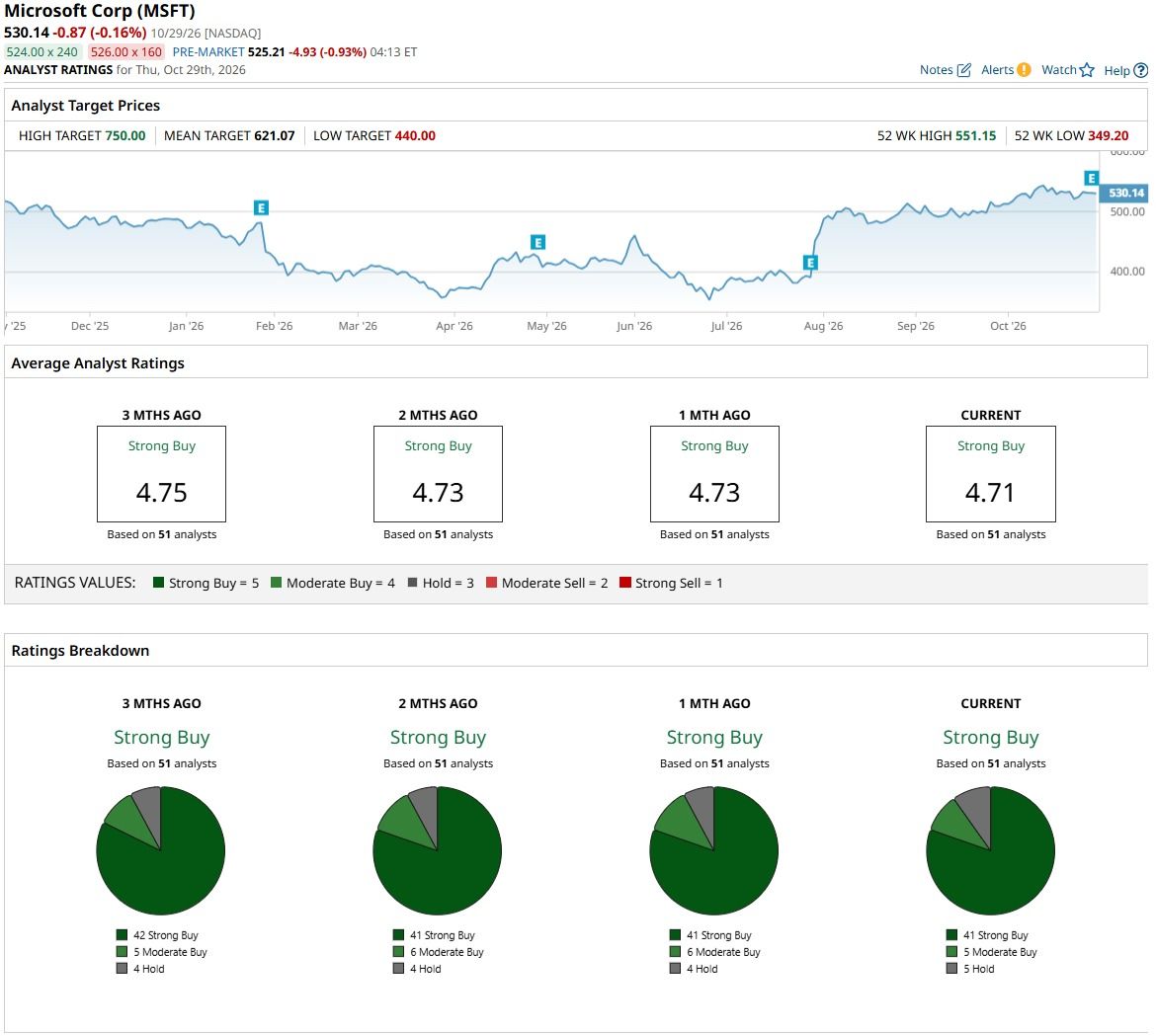
Despite those concerns, Microsoft carries a consensus “Strong Buy” rating based on 51 analysts, reflecting the group’s overall recommendation rather than unanimous agreement. The average price target of $594.15 implies approximately 12.07% upside from its October 29 closing price of $530.14.
 www.barchart.com
Conclusion
Microsoft looks worth buying gradually rather than chasing after the earnings beat. The business is growing, and its work on AI costs could help generate more revenue for the bottom line. A move higher looks more likely if earnings keep improving, but the spending bill remains a risk. With analyst targets suggesting roughly 12% upside, expectations should stay measured. There is a case for owning MSFT here, just not for treating one strong quarter as a reason to rush in today.
On the date of publication, Ebube Jones did not directly have a position in any of the securities mentioned in this article. All information and data in this article is solely for informational purposes. For more information please view the Barchart Disclosure Policy here.
More news from Barchart
Microsoft Delivered a Beat on Both Earnings and Revenue. Here’s How to Think About MSFT Stock Now. AI Stocks Are Getting a Reality Check, But Don’t Count the Trade Out Just Yet. Here’s Why. AppLovin Stock Is Struggling: 3 Things to Watch in Q3 Earnings That Could Get APP Back on Track Coca-Cola Delivers Strong Growth - But is KO Stock Undervalued?