


Back in 2018, I created a visual framework for an article I published called “The Cycle of Market Emojis.” I did not invent the “Cycle of Market Emotions” it is based on. I just overlaid the cheeky visuals.
This picture below aims to illustrate the emotional rollercoaster that governs Wall Street.The curve tracks investor psychology through 16 distinct emotional milestones.
More Yield, Less Trap: Sign up free to get Barchart’s daily Dividend Investor newsletter straight to your inbox.
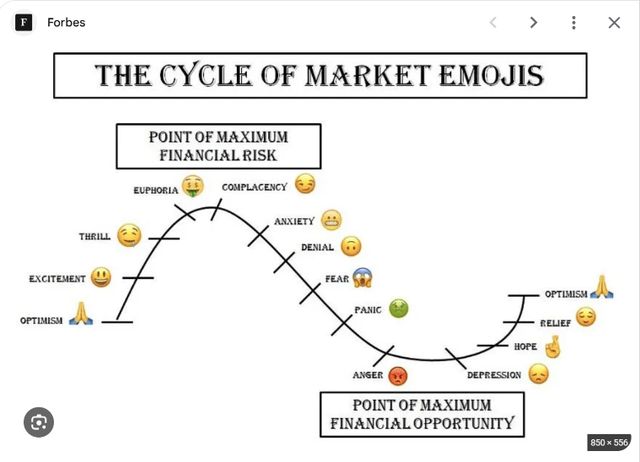 Chart courtesy of Rob Isbitts. Originally published on Forbes.com.
It rises from optimism, excitement, and thrill up to euphoria, the absolute peak that marks the “Point of Maximum Financial Risk.” It gets worse from there.
The cycle turns downward through complacency, anxiety, denial, fear, panic, and anger, hitting the cyclical bottom at depression. That’s the “Point of Maximum Financial Opportunity” before the cycle climbs back up through hope, relief, and optimism.
Every single market cycle over my four decades in the business has followed this exact emotional trajectory. The characters change, the technology changes, and the narratives change. The underlying human psychology never does.
If you only remember two things about the Cycle of Market Emojis, remember these:
At the top, no one thinks the stock market will ever drop for very long. At the bottom, no one believes the stock market will ever go up again.Market cycles have been studied by many economists, and they can be analyzed in several different time frames. For simplicity, my default is to look at attitudes and emotions. That is easier to gauge anecdotally than by using traditional statistics.
Back during the dot-com bubble, one indicator that otherwise number-crunching Wall Street analysts would share is that “my cab drivers are giving me stock tips.” That’s usually around the time the leverage is too high, and investors are only as good as their ability to avoid the mania.
 www.barchart.com
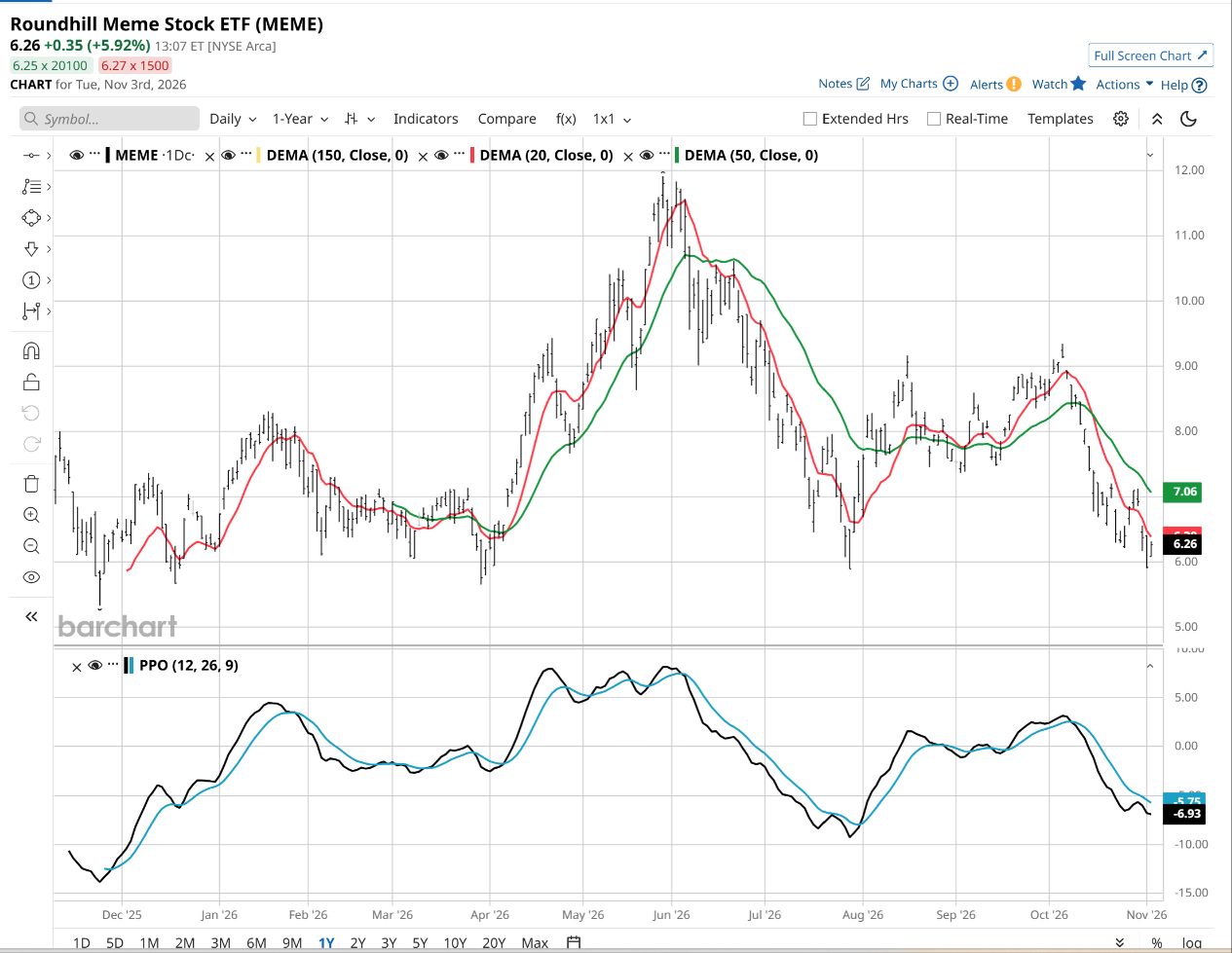
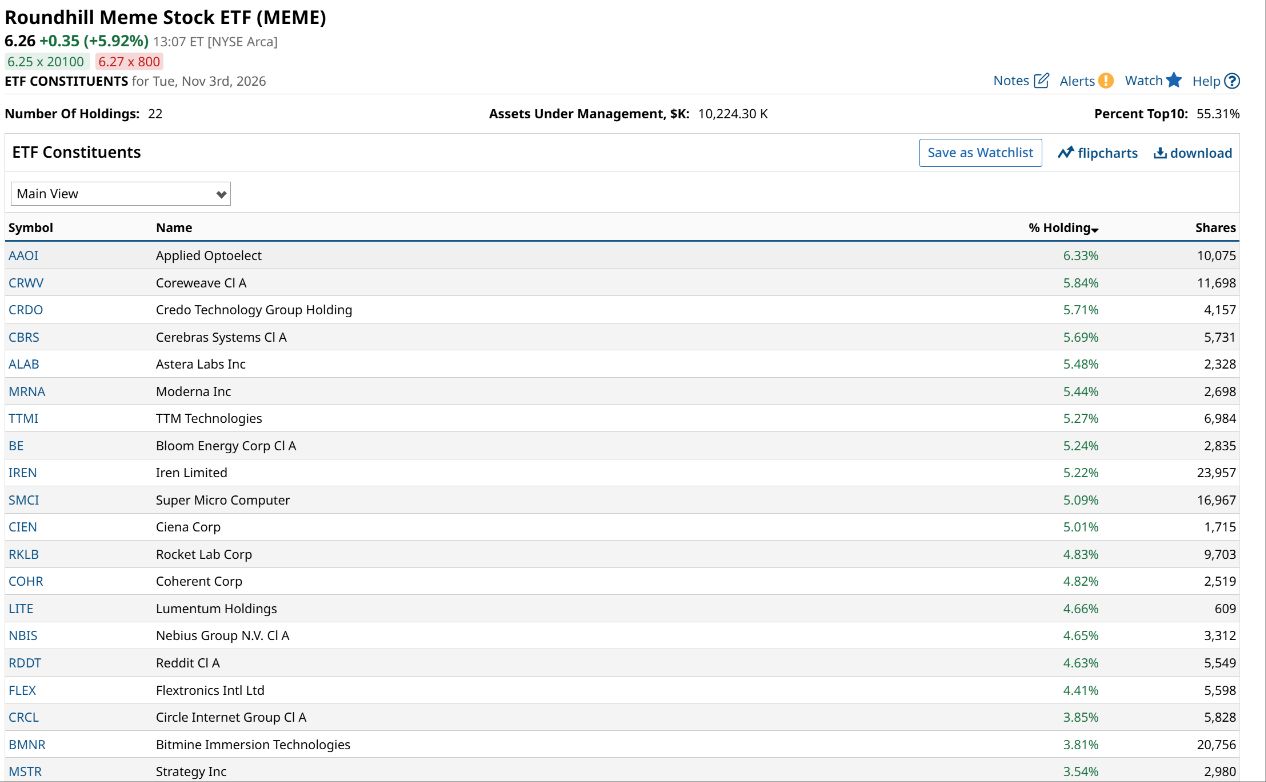
Where I think we are in the cycle is tough to boil down to one indicator. But I think this ETF can help me describe it succinctly enough. Tell me this list of holdings for the Roundhill Meme Stock ETF (MEME) isn’t the who’s who of stocks that are popular, but not exactly fundamental giants.
 www.barchart.com
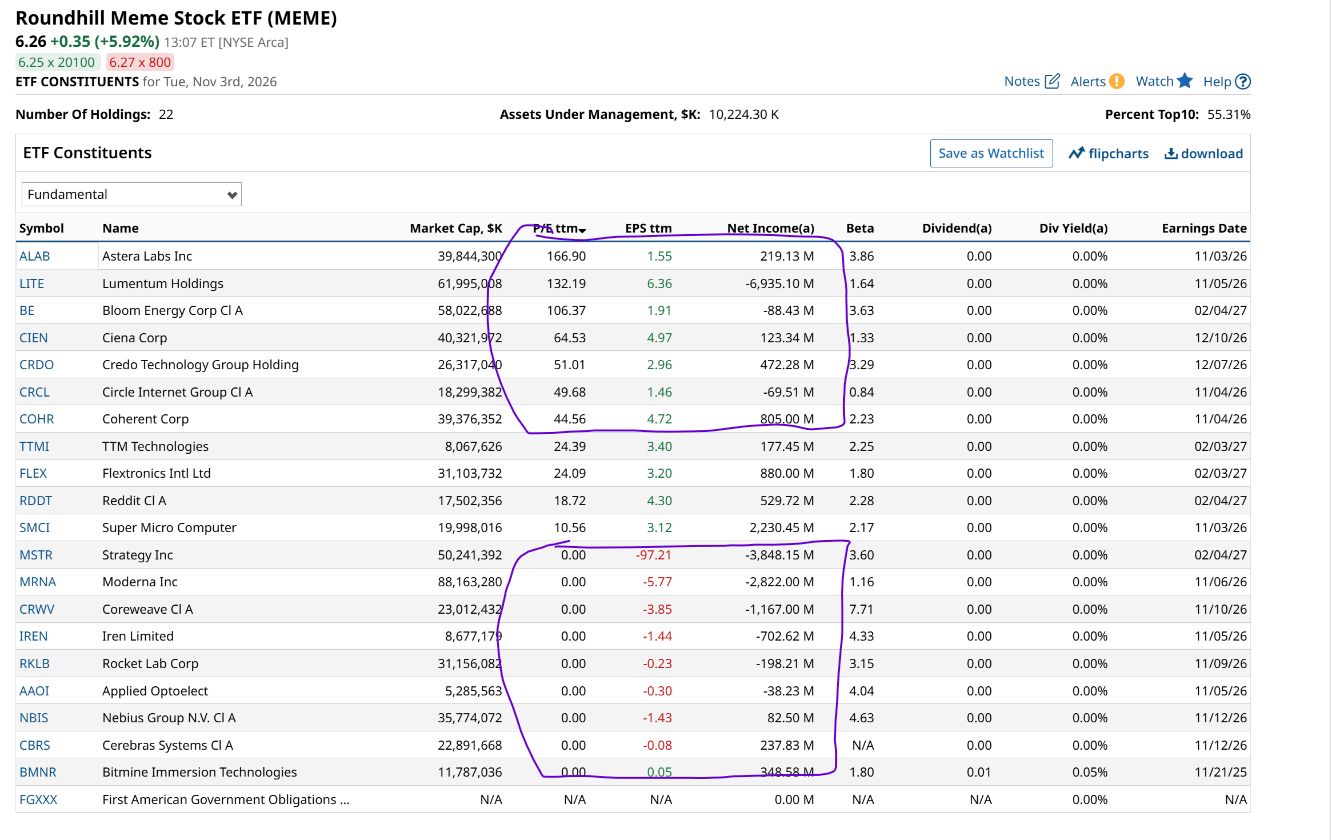
To that point, when I look through the holdings using the Barchart.com ETF Constituents tool, I see three sets of stocks. The two larger groups are those with high price-earnings (P/E) ratios (several of which have negative net income) and those with no earnings.
 www.barchart.com
The slim group in the middle has what I would consider to be moderate or low price-earnings ratios.
Below is my assessment of where we sit right now, why the indicators point there, and the specific reasons my thesis could be wrong.
Where We Are: Between Anxiety and Denial
We have already passed euphoria, and spent a lot of time in the complacency stage. We very recently started to emerge from that long slumber, thanks to higher interest rates and some huge drops in tech stocks. The AI trade is now much more uncertain. It still might work out, but there’s a new doubt that did not exist a few months ago.
I’ve seen that play out in my ROAR Scores, particularly for the Invesco QQQ ETF (QQQ). It has sunk to a score of 10, which means risk is extremely high. But as investing goes, that can also be where big up moves start.
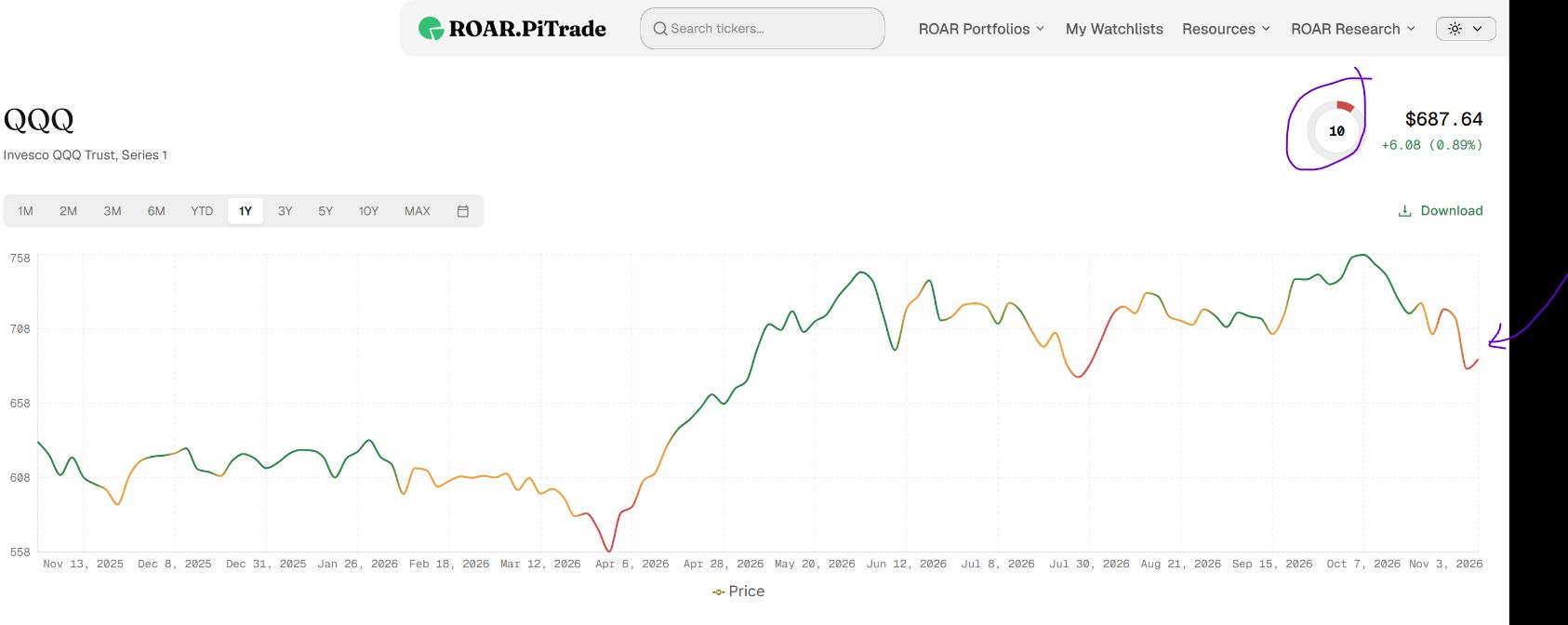 Chart courtesy of Rob Isbitts via ROAR.PiTrade.com
I can compare this to the sport I’ve entered as a business owner recently: thoroughbred horse racing. A ROAR Score of 10 does not mean “sell.” It means the horse is down 20-1 to win this race. That means he could win and pay off big. But it’s more likely he doesn’t.
That said, his next race in a month or so might be one where conditions have softened up. Coming off that likely poor performance, he races against lesser competition, and that gives him a better chance to win.
To me, this is really what investing is about. Incorporating quantitative and qualitative aspects of crowd behavior to make ongoing, prudent decisions. In investing, a stock or ETF goes through a similar process of valuation and “price discovery” to that a racehorse does.
Except instead of bettors, it is investors and traders. Though to be completely honest, I’m not sure there’s much of a difference anymore.
When will we drop toward fear, panic, and all the way to the bottom, where a new bull market for stocks can start to form?
If this were about valuation, low P/E stocks would be, pardon the expression, roaring. But instead they are trying to climb out of the same hole most growth stocks are.
The crest of any major market peak is defined by an aura of total invincibility. Over the past two years, “buy the dip” stopped being a tactical trading strategy and turned into a full-fledged secular religion.
Investors convinced themselves that bull markets never die, they merely go on “injured reserve” for a few days before roaring back to fresh highs. That was textbook euphoria followed by complacency. The latest bit of market turmoil started what appears to be something with higher risk ahead.
And to be fair and balanced here, until the “buy the dip” mentality is extinguished, we’re still trying to end the existing cycle, not start a new bull market. And we need to see if further market declines, particularly in AI stocks, starts to reverse some of the “passive flow” of billions into S&P 500 ($SPX) index funds. That’s what has fueled the AI rally more than anything.
So, let’s take it one step at a time. It is a cycle, after all.
Rob Isbitts is a semi-retired CIO, former fiduciary investment advisor, Barchart columnist, and straight-talker. Download his new free e-book on hedged bond investing for retirement at ETFYourself.com. His research and model portfolios are at ROAR.PiTrade.com.
On the date of publication, Rob Isbitts did not directly have a position in any of the securities mentioned in this article. All information and data in this article is solely for informational purposes. For more information please view the Barchart Disclosure Policy here.
More news from Barchart
CrowdStrike Is Buying 2 AI Security Startups for Roughly $500 Million. What This Means for CRWD Stock. Most Investors Are Stuck Between Anxiety and Denial. Here’s How Barchart Tools Can Help You Face Reality and Protect Against a Crash in AI Stocks. Why It’s Time to Load Up on Arm Stock Is Webull the Best Trading App for Dead Customers? After a $4.2M Finra Fine, the Company Can Neither Confirm Nor Deny.