

A week-long coding challenge just made quantum-safe Bitcoin transactions dramatically cheaper. AI-assisted developers cut the estimated cost by 79%, from $320 down to roughly $66.
StarkWare's experimental method offers a contingency tool against a theoretical future threat, not an immediate fix for everyday wallets.
What Quantum-Safe Bitcoin Actually Protects Against
Quantum-Safe Bitcoin, or QSB, uses hash-based cryptography to move eligible Bitcoin under existing consensus rules, without requiring any protocol change or soft fork. It addresses a specific risk. A sufficiently powerful quantum computer could one day derive private keys from exposed public keys, then spend those funds.
No such machine exists today, but developers treat the threat as a long-term contingency worth preparing for.
StarkWare mined the first QSB transaction on the Bitcoin mainnet on August 26, through MARA's Slipstream service. Building it required roughly 3,100 GPU-hours and cost an estimated $320 in compute alone.
That price tag limited the method's practicality. On September 16, StarkWare launched the Quantum-Safe Bitcoin Optimization Challenge. Yukon Research and Eigen Labs joined as partners, offering more than $20,000 in prizes.
Participants tackled two computational bottlenecks. Pinning searches for a valid transaction commitment, while subset selection finds the right combination of components. Sixty-two accepted submissions, many built with AI coding tools, pushed processing speed roughly six times faster on identical hardware.
Follow us on X to get the latest news as it happens .
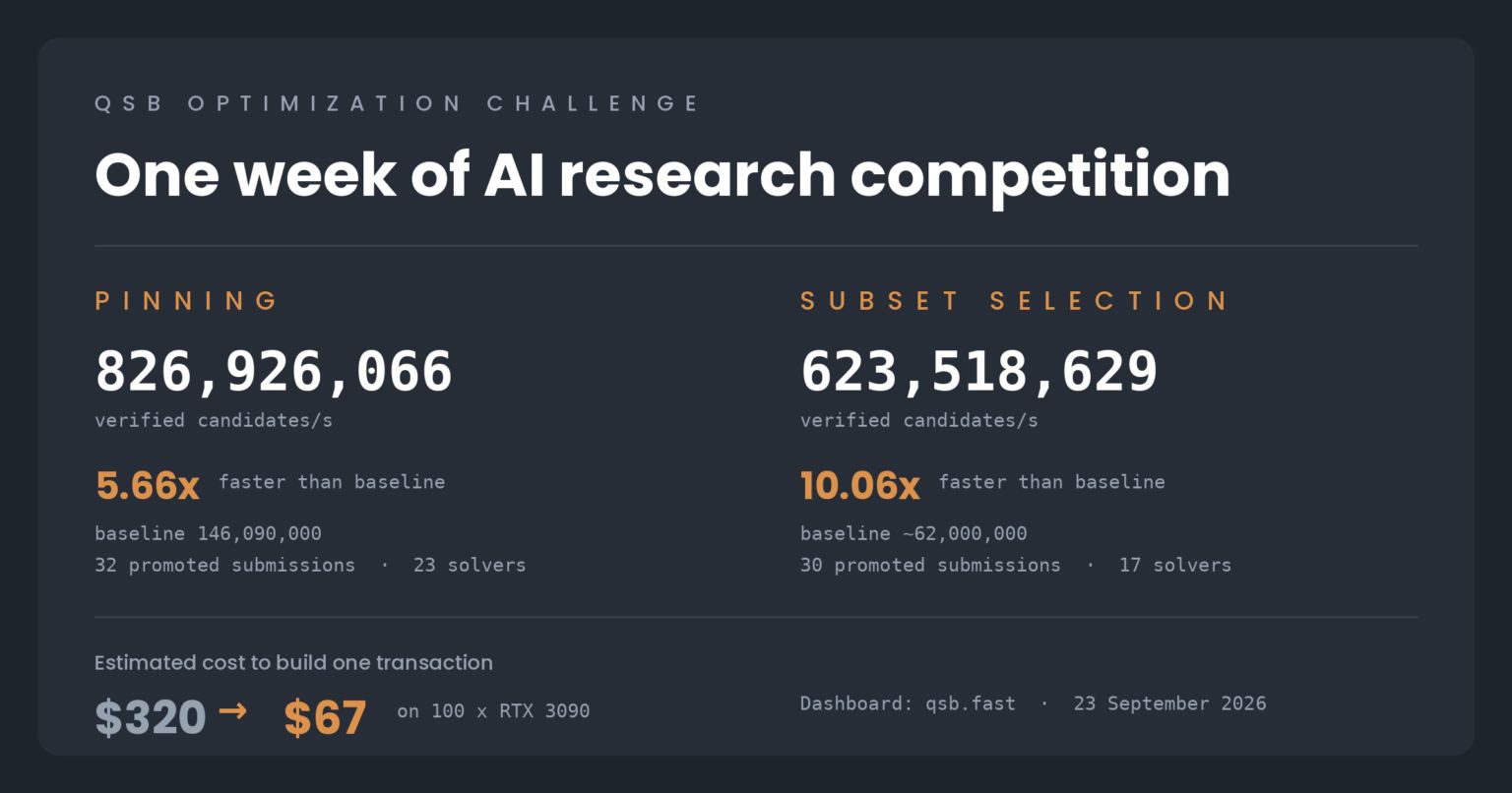 How AI Made Quantum-Safe Bitcoin Transactions Suddenly Affordable. Source: StarkWare
 Benchmark tests on an RTX 4090 GPU told the story clearly: pinning speed jumped from about 146 million verified candidates per second to more than 880 million. That leap pushed the cost estimate from $320 down to roughly 66 to $67.
That figure has not yet been demonstrated in a second-mined transaction, and it covers only GPU compute, and excludes network fees.
Is Bitcoin's Broader Quantum Defense Keeping Pace?
StarkWare's challenge fits inside a much larger, fast-moving field. NIST finalized its official post-quantum cryptography standards in August 2024, setting a 2035 migration deadline for federal agencies. Google set its own internal target of 2029.
A Google Quantum AI research paper published in March 2026 further sharpened the urgency, reducing the estimated qubit count required to break Bitcoin's cryptography by roughly 20x. That shift pushed some expert timelines from decades away into the early 2030s.
Bitcoin's own developer community responded separately with BIP-360, a quantum-resistant address proposal that reached testnet with over 50 participating miners in March 2026.
Not every expert agrees on urgency, though. Stanford cryptographer Dan Boneh, who co-authored Google's March paper, warned that a hasty transition could cause a catastrophic bug to strike first more readily than an actual quantum attack would.
That tension frames exactly what StarkWare's challenge represents: one narrow, low-risk emergency tool, built while the industry debates how fast Bitcoin's core cryptography should actually change.
Subscribe to our YouTube channel to watch leaders and journalists provide expert insights .
https://www.youtube.com/watch?v=37GOqnY5oiQRead the Original story AI Coders Just Cut Quantum-Safe Bitcoin Costs by 79%: What’s This Mean? by Luis Blanco at beincrypto.com