


Bitcoin’s latest market correction has reignited a debate about whether excessive leverage is distorting cryptocurrency prices, with influential market commentator Ash Crypto arguing that derivatives trading has fundamentally changed how Bitcoin behaves. His warning comes as Bitcoin liquidations have intensified, forcing billions of dollars in leveraged positions out of the market.
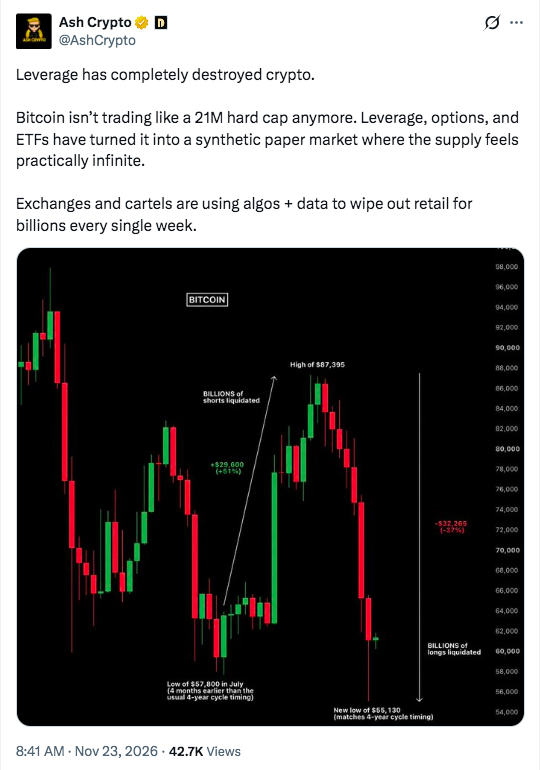
In a November 23 post on X , Ash Crypto claimed that leverage, options, and exchange-traded funds have created a synthetic Bitcoin market where financial exposure can expand far beyond the cryptocurrency’s fixed supply.
The commentator also shared a Bitcoin chart illustrating the sharp swings between approximately $55,000 and $87,000, suggesting that liquidation-driven movements have become an increasingly important force behind market volatility.
“Leverage has completely destroyed crypto.”
Ash Crypto argued that Bitcoin no longer trades as though its 21 million supply limit determines market behavior, blaming derivatives and exchange activity for amplifying volatility.
Is Bitcoin Becoming A Synthetic Paper Market?
Ash Crypto’s argument highlights an important distinction between Bitcoin’s underlying supply and the financial instruments built around it.
Bitcoin’s maximum supply remains limited to 21 million coins. Futures contracts, options, and other derivatives do not change that limit, but they allow traders to gain substantial exposure without necessarily owning the underlying cryptocurrency.
For example, cash-settled Bitcoin futures allow investors to speculate on future prices without requiring physical delivery of BTC.
According to CME Group’s explanation of Bitcoin futures , these contracts are settled in US dollars and can support price discovery and risk management.
However, leverage can also magnify market movements.
When Bitcoin falls sharply, traders holding leveraged long positions may be forced to sell or close their contracts. Those liquidations can intensify downward pressure, potentially triggering additional liquidations.
The opposite can happen when Bitcoin rises and heavily leveraged short positions are forced to close.
This does not mean Bitcoin’s scarcity has disappeared. Rather, derivatives can influence short-term price discovery even while the underlying asset remains scarce.
Bitcoin Open Interest Shows How Much Leverage Has Disappeared
Recent derivatives data provides context for the analyst’s warning.
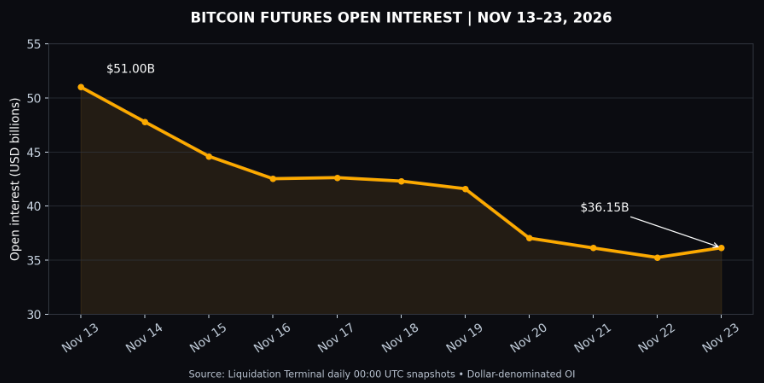
Bitcoin futures open interest stood near $51 billion on November 13, before falling to approximately $36.15 billion by November 23, according to historical market snapshots.
That represents a decline of roughly 29% in dollar-denominated outstanding contracts over ten days.
However, falling open interest measured in dollars does not necessarily mean an equivalent percentage of positions was closed. Part of the reduction can reflect Bitcoin’s declining price.
The broader market correction has nevertheless produced substantial forced liquidations.
As Bitcoinist previously reported , more than $1.6 billion in cryptocurrency positions were liquidated during the November 13 sell-off, with leveraged long traders suffering the majority of losses.
A subsequent wave of selling pushed Bitcoin toward $55,000, creating further pressure across the derivatives market.
Despite the severity of the decline, the reduction in leveraged exposure could eventually create healthier market conditions.
With fewer highly leveraged positions remaining, Bitcoin may become less vulnerable to certain forced-liquidation cascades, although new positions can accumulate quickly.
Bitcoin Technical Analysis: The Levels That Could Trigger Another Squeeze
Bitcoin’s latest recovery has brought the cryptocurrency back toward $61,000 after its sharp November decline.
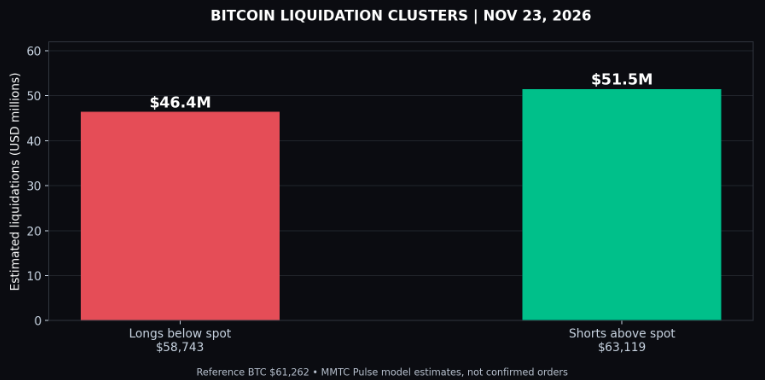
The immediate technical picture suggests that liquidation concentrations on both sides of the market could influence the next significant move.
An estimated short-liquidation cluster sits around $63,119, approximately 3% above a November 23 reference price of $61,262.
If Bitcoin moves toward that area, forced buying from short-position closures could potentially accelerate upward momentum.
On the downside, an estimated $46.4 million in long liquidations is concentrated near $58,743.
A decline toward that level could expose remaining leveraged bullish positions to additional pressure.
These figures are modeled estimates rather than guaranteed liquidation events, and actual market conditions may change as traders open and close positions.
A sustained recovery above the $63,000–$64,000 region would strengthen the immediate bullish case, particularly if accompanied by improving spot-market demand.
Meanwhile, holding above $58,700 would help preserve the developing recovery structure.
Could The Leverage Reset Help Bitcoin Recover?
Although Ash Crypto’s comments express frustration with the growing influence of financial derivatives, the recent reduction in leverage could have constructive implications for Bitcoin.
Excessive speculation can amplify both rallies and corrections. When highly leveraged positions are removed, the market may become better positioned for a recovery supported by genuine buying demand.
The development also comes as traditional financial institutions continue expanding their Bitcoin-related products.
For example, BlackRock’s Bitcoin Premium Income ETF illustrates how sophisticated investment strategies are becoming increasingly connected to the cryptocurrency market.
These products can improve accessibility and risk management, even as they introduce additional layers of financial exposure.
For Bitcoin investors, the important distinction is between speculative leverage and sustainable long-term demand.
Bitcoin’s fixed supply remains unchanged regardless of how many futures or options contracts trade around it.
Ash Crypto’s warning therefore raises a legitimate question about market structure, but it does not establish that exchanges are deliberately manipulating prices or that Bitcoin’s scarcity has been undermined.
If Bitcoin continues absorbing selling pressure while institutional demand strengthens, the recent derivatives reset could eventually provide a foundation for more sustainable price appreciation.
For now, the market’s next challenge is determining whether the recovery can develop beyond short-term liquidation-driven movements.