


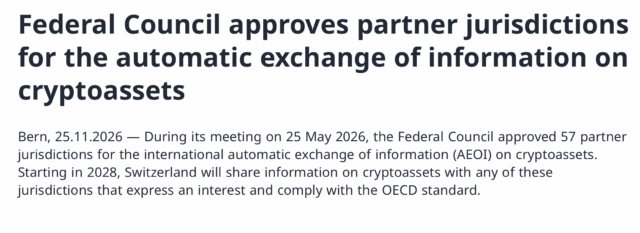
Switzerland’s crypto tax reporting plans took another step forward on November 25 after the Federal Council approved 57 potential partner jurisdictions for the automatic exchange of digital asset information starting in 2028.
The government announcement brings Switzerland closer to extending the international tax transparency system already used by traditional financial institutions to cryptocurrency businesses.
For Bitcoin holders who trade through overseas exchanges, the consequences could be more significant than another change to domestic tax legislation. Tax authorities may increasingly obtain information about their cryptocurrency activity without having to investigate individual accounts first.
Switzerland Moves Forward After Crypto Reporting Delays
The decision follows a prolonged debate over which jurisdictions Switzerland should exchange cryptocurrency information with.
As previously reported by Bitcoinist, Switzerland had postponed the implementation of its international crypto reporting framework while lawmakers considered the selection of partner jurisdictions.
The country’s State Secretariat for International Finance subsequently confirmed that implementation could begin no earlier than January 1, 2027.
The latest decision identifies 57 potential partners, but approval does not mean that every jurisdiction will automatically begin receiving information in 2028. Participation remains conditional on interest from the respective authorities and compliance with international reporting standards.
Nor does the announcement introduce a new cryptocurrency tax rate. It changes how governments may obtain the information needed to enforce existing tax obligations.
That distinction is particularly important for investors who have assumed that holding assets through a foreign cryptocurrency exchange places their trading activity outside the reach of domestic tax authorities.
What Crypto Exchanges Could Be Required to Disclose
Switzerland’s reporting system is based on the Organisation for Economic Co-operation and Development’s Crypto-Asset Reporting Framework, commonly known as CARF.
Under the OECD’s reporting rules , covered cryptocurrency service providers must identify customers’ tax residency and report relevant information about their activity.
The framework encompasses transactions involving fiat currencies, exchanges between cryptocurrencies and certain transfers of digital assets. Customer identification information can include names, residential addresses and tax identification numbers.
For an investor, this creates a practical distinction between the country in which an exchange operates and the country in which the investor owes taxes.
A Swiss cryptocurrency account may become a source of information for a foreign tax authority, provided the investor is reportable to that jurisdiction and the relevant exchange arrangements are active.
The implications extend beyond Bitcoin sales. Investors who exchange BTC for stablecoins, move assets between platforms or receive certain cryptocurrency distributions may generate records that fall within reporting requirements.
Whether those transactions create a tax liability is a separate question governed by applicable domestic legislation.
Does Bitcoin Self-Custody Change Anything?
One of the more complicated aspects of the framework concerns cryptocurrency transfers outside centralized exchanges.
Moving Bitcoin into a privately controlled wallet does not automatically remove previous transactions from an exchange’s reporting obligations.
The OECD’s official commentary expressly includes certain transfers from reporting service providers to customers’ private wallets.
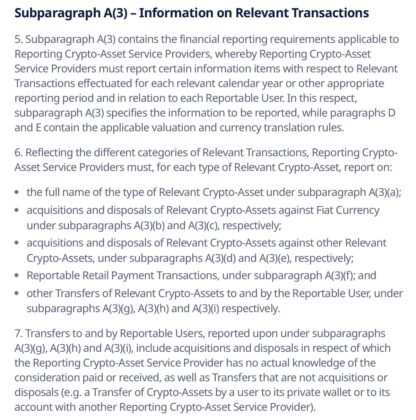
This does not mean that governments gain control over private keys or that every self-custody transaction becomes automatically reportable under CARF. Bitcoin’s underlying network continues to operate independently of the tax information exchange system.
However, the point at which investors interact with regulated intermediaries becomes increasingly important.
The distinction between financial independence and financial anonymity has often been blurred in discussions about Bitcoin adoption. Self-custody allows investors to control their assets, but it does not necessarily prevent authorities from obtaining records of transactions conducted through regulated businesses.
Greater Tax Transparency Comes With Its Own Risks
Switzerland’s State Secretariat for International Finance describes the objective of the framework as ensuring “equal treatment of the crypto sector with the traditional financial sector.”
There is a reasonable argument for that approach. Investors using digital assets should not automatically enjoy a different standard of tax enforcement from those investing through conventional financial institutions.
But collecting more financial information also creates responsibilities for the governments and companies handling it.
Incorrect residency classifications, inconsistent transaction records and errors in historical cost calculations can have serious consequences for investors. Cryptocurrency transactions can be particularly difficult to reconcile when assets have moved across several exchanges and privately controlled wallets.
Security is another concern. Customer identity information linked to cryptocurrency activity can be highly sensitive, especially given the potential financial and personal consequences of unauthorized disclosure.
Governments should be expected to demonstrate that the systems receiving this information are adequately protected and that investors have effective procedures for correcting inaccurate records.
Tax transparency is a legitimate policy objective. It should not become an excuse for weak data protection or indiscriminate assumptions about investors’ financial activity.
What Happens Before 2028?
The immediate developments to watch are the implementation of Swiss reporting requirements, activation of information exchange arrangements with individual jurisdictions and the practical guidance issued to cryptocurrency service providers.
Investors should also distinguish the date on which information collection begins from the date on which authorities first exchange those records. The two are not necessarily the same.
Switzerland’s decision is another indication that access to international cryptocurrency markets increasingly comes with the reporting obligations familiar to traditional finance.
For Bitcoin investors, the ability to hold and transfer assets independently remains intact. The assumption that using an overseas exchange makes those activities invisible to tax authorities is becoming considerably harder to defend.