


However, the prospects seem bright in the long term. The industry is undergoing a transformative phase, driven by the convergence of rapid technological progress and higher global connectivity requirements. Increasing interest in space-based infrastructure is another tailwind. The expansion of the Internet in remote areas through emerging low Earth orbit (“LEO”) constellations, such as Starlink and OneWeb, is driving demand for satellite broadband services. The embedding of AI and machine learning has given rise to multiple use cases across industries such as oil and gas, agriculture, transportation and non-governmental organizations.
Gilat Satellite Networks GILT, Telesat TSAT and Satellogic SATL have significant growth potential amid simmering geopolitical tensions, surging defense budgets and demand for high-quality imagery and value-added services.
Industry Description
The Zacks Satellite and Communication industry includes space technology companies that offer satellite imagery, intelligence services, and spacecraft and robotics for space exploration, research and national security. They assist customers in understanding and navigating the changing planet, provide global broadband communications and explore space. These companies deliver communication services to media businesses, fixed and wireless telecommunications providers, data networking firms and Internet service providers. They also supply commercial satellite communication services to government and military entities. Additionally, the firms offer satellite-based consulting and technical services, covering the entire satellite lifecycle and infrastructure, from satellite and launch vehicle procurement to telemetry and commanding services.
What's Shaping the Industry's Future?
Spending on Space Infrastructure Could be Affected by Macroeconomic Weakness: With more than half of revenues from government customers, the industry will likely benefit from increasing defense and space infrastructure budgets amid simmering geopolitical tensions. The explosion of space-based intelligence, surveillance, and reconnaissance and communications is expected to boost government investments in the sector.
However, weakness in global macroeconomic conditions amid tariff troubles could compel customers to lower spending, which does not bode well for industry participants. Volatile supply-chain dynamics and inflation could lead to higher costs and increased lead time, which are major concerns. Also, competition from fiber optics and terrestrial networks, in certain regions, could deter the growth of the industry participants, as these may offer relatively lower-cost and higher-speed alternatives.
Capital-Intensive Sector: The satellite industry is one of the most capital-intensive sectors, requiring substantial upfront investment in satellite manufacturing, launch services and ground infrastructure. Further, an increasing number of satellites is raising concerns about space debris and orbital congestion. Risks of collision may disrupt operational satellites and the viability of space activities. Managing these risks requires advanced devices such as improved tracking systems and coordination, adding a layer of operational complexity.
Advancements in Technology Hold the Key: Rapid technological advancement is the primary catalyst driving the industry’s growth trajectory. Integration of space-based networks with terrestrial telecom networks, as well as cloud computing and AI, marks a new phase of growth. The integration of Geosynchronous Equatorial Orbit (“GEO”) and LEO constellations with terrestrial networks is enabling trade-offs between coverage, latency and capacity. Direct-to-device (D2D) and non-terrestrial networks (“NTN”) are extending satellite connectivity directly to smartphones and IoT endpoints. Reusable rockets, mass-produced satellites and low-cost launch systems are significantly improving prospects for the participants.
A mass-produced system is adopted and several satellites are manufactured in an assembly line. Integration and testing have become highly automated. The extent of testing is lowered after prototyping and initial production is completed. Countries with comprehensive space programs have distinct military, economic and scientific advantages. However, complexity and barriers to entry into space have allowed only a few to develop notable capabilities. The demand for small satellites across regions is expected to increase over time. North America has the bulk of the market share, followed by the Asia Pacific, Europe and the rest of the world.
North America maintains its dominance with the highest number of small satellite launches by government end users. The companies continue to align their products and services with the needs of the U.S. Department of Defense’s National Defense Strategy and the growing demand for international defense and intelligence.
Subscriber Momentum to Drive Growth: Wide proliferation and cheaper access to space technology have led to diverse end-market users. The companies share a strategic relationship with various government organizations, including military and disaster response agencies and non-governmental organizations, to provide robust, tactical, real-time voice and low-latency data command and control communications. A comprehensive product portfolio enables companies to expand their customer base and offset the losses from one product category with the benefits from another. High product quality increases brand loyalty and enhances performance in a competitive market.
For civil customers, notably NASA, growth is being driven by space exploration programs. For commercial customers, growth drivers include a strong demand for imagery due to new use cases, space-based remote sensing, GEO replacement demand and LEO communications programs. Advanced mobile networks need strong backhaul and global infrastructure, increasing reliance on satellite support for rural and oceanic coverage.
Zacks Industry Rank Indicates Bleak Prospects
The Zacks Satellite and Communication industry is housed within the broader Zacks Computer and Technology sector. The industry currently has a Zacks Industry Rank #179, which places it in the bottom 28% of more than 247 Zacks industries.
The group’s Zacks Industry Rank, which is the average of the Zacks Rank of all the member stocks, indicates bleak near-term prospects. Our research shows that the top 50% of the Zacks-ranked industries outperform the bottom 50% by a factor of more than two to one.
Before we present a few satellite and communication stocks you may want to consider for your portfolio, let’s look at the industry’s recent stock market performance and valuation picture.
Industry Outperforms the Sector and the S&P 500
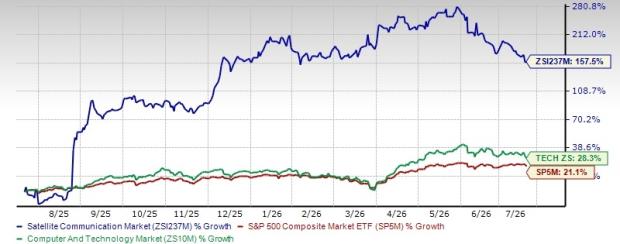
In the past year, the Zacks Satellite and Communication industry outperformed the S&P 500 composite and the broader Zacks Computer and Technology sector.
The industry has gained 157.5% over this period compared with the S&P 500’s rise of 21.1%. The broader sector has moved up 28.3%.
One-Year Price Performance
Industry's Current Valuation
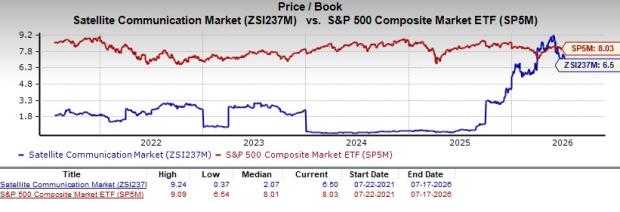
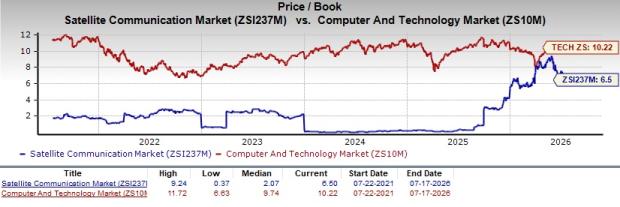
The industry has a trailing 12-month price/book ratio of 6.5X compared with the S&P 500’s 8.03X. The sector’s trailing 12-month price/book ratio stands at 10.22X.
In the past five years, the industry has traded as high as 9.24X and as low as 0.37X, with a median of 2.07X, as the chart below shows.
3 Stocks to Add to the Watchlist
Gilat Satellite Networks: Based in Petah Tikva, Israel, Gilat is a provider of satellite-based broadband services, including design and manufacture of advanced equipment and innovative technology. Gilat’s solutions support a range of applications, including broadband access, cellular backhaul, enterprise services, in-flight connectivity, maritime, trains, defense and public safety, all while meeting high service standards.
Strength in the defense sector bodes well for Gilat as demand for defense SATCOM solutions grows due to geopolitical dynamics. The company won a “multi-million-dollar” contract to supply custom SATCOM terminals to a European Ministry of Defense last month. Further, Gilat DataPath won orders worth $11 million from the U.S. Department of War to supply custom SATCOM terminals and field services.
In June 2026, Gilat had announced the strategic acquisition of Comtech Telecommunications Corporation's Satellite & Space Communications segment for $157.5 million in cash. The deal will expand Gilat’s presence in the United States and will boost its exposure to more complex defense and space programs. However, stiff competition in this space remains a concern, along with integration risks from M&A activity.
GILT currently carries a Zacks Rank #3 (Hold). You can see the complete list of today’s Zacks #1 Rank (Strong Buy) stocks here.
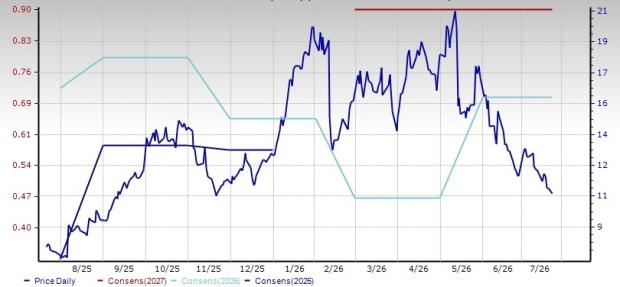
The earnings estimate for 2026 stands at 70 cents per share, unchanged over the past seven days. The stock has gained 33.8% in the past year.
Price and Consensus: GILT
Satellogic: SATL is a vertically integrated geospatial analytics company engaged in the construction of a scalable and fully automated Earth Observation platform to render satellite imagery cost-effective.
Shift to a recurring revenue model bodes well. The launch of Aleph Observer (February 2026) marks a key step in this transition. Aleph Observer will aid customers in continuously monitoring hundreds of sites with rapid image delivery and built-in analytics. Management noted that the company was well-positioned in the Persistent Global Intelligence category due to its differentiated unit economics and vertically integrated model. With satellites costing nearly $1.3 million and delivering significantly higher imagery throughput than peers, Satellogic can offer persistent monitoring at a better price point than its competitors.
Looking ahead, the Merlin constellation and broader technology roadmap provide strong long-term upside. Merlin is built for daily 1-meter global coverage and real-time intelligence and unlocks new AI-driven, real-time intelligence capabilities. It is fully funded and scheduled for an October 2026 release.
However, SATL faces meaningful challenges as profitability and cash flow remain work in progress. Management expects cash flow to be “touch and go” over the next two to three quarters as it continues investing in scaling the business.
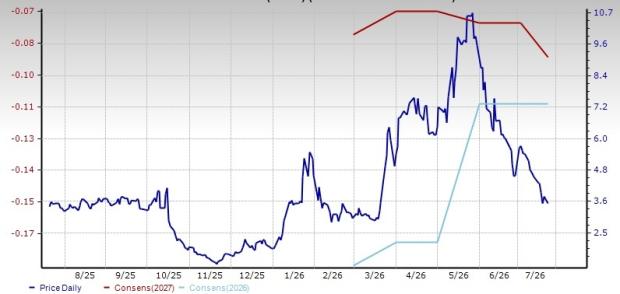
SATL currently carries a Zacks Rank #3. The bottom-line estimate for 2026 stands at a loss of 11 cents per share, unchanged over the past seven days. The stock is down 1.4% in the past year.
Price and Consensus: SATL
Telesat Corporation: Based in Ottawa, Canada, Telesat is a global satellite operator. Its Telesat Lightspeed network (Low Earth Orbit satellite constellation) has been streamlined to meet the needs of telecom, government, maritime and aeronautical clients.
A key growth driver is rising demand from government and defense customers, particularly with the addition of military Ka-band (Mil-Ka) capabilities to the Lightspeed network. Canadian Armed Forces recently selected Lightspeed to deliver Mil-Ka Arctic connectivity for the Enhanced Satellite Communications Project – Polar (ESCP-P) program.
The company is making steady progress across satellite development, user terminals, software and ground station infrastructure, with global commercial service targeted by early 2028.
However, legacy GEO revenues are declining due to contract non-renewals, weighing on overall financial performance. At the same time, heavy capital investments (up to $1-$1.2 billion in 2026 alone) to build Lightspeed increase execution and funding risks.
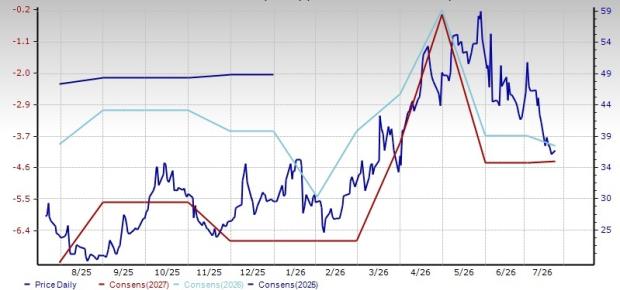
TSAT currently carries a Zacks Rank #3. The bottom-line estimate for 2026 stands at a loss of $4.01 per share, deteriorated from a loss of $3.73 over the past seven days. The stock has gained 37.2% in the past year.
Price and Consensus: TSAT
Zacks' Research Chief Names "Stock Most Likely to Double"
Our team of experts has just released the 5 stocks with the greatest probability of gaining +100% or more in the coming months. Of those 5, Director of Research Sheraz Mian highlights the one stock set to climb highest.
This top pick is a little-known satellite-based communications firm. Space is projected to become a trillion dollar industry, and this company's customer base is growing fast. Analysts have forecasted a major revenue breakout in 2025. Of course, all our elite picks aren't winners but this one could far surpass earlier Zacks' Stocks Set to Double like Hims & Hers Health, which shot up +209%.
Free: See Our Top Stock And 4 Runners UpWant the latest recommendations from Zacks Investment Research? Today, you can download 7 Best Stocks for the Next 30 Days. Click to get this free report
Gilat Satellite Networks Ltd. (GILT): Free Stock Analysis Report
Telesat Corporation (TSAT): Free Stock Analysis Report
Satellogic Inc. (SATL): Free Stock Analysis Report
This article originally published on Zacks Investment Research (zacks.com).