


Fastenal Company FAST is giving investors a familiar premium-stock debate. The business is executing well, but the valuation already reflects a high degree of confidence in continued growth.
The question is whether expanding contract relationships, digital tools and share gains are enough to offset gross margin pressure and a full multiple.
FAST Has Real Operating Momentum
Fastenal’s second-quarter 2026 results support the bull case. Earnings of 33 cents per share met the Zacks Consensus Estimate and increased 15.9% year over year. Net sales rose 14.7% to $2.39 billion and topped the consensus mark by 1.9%.
The growth was broad. Daily sales increased 14.9% in manufacturing, 17.0% in non-residential construction and 14.1% in other end markets. Contract sales rose 17.6% and represented 75.8% of quarterly revenues.
Operating income increased 15.1% to $501.8 million. Operating margin held at 21.0%, even though gross margin contracted, showing that Fastenal still converted higher volume into earnings growth.
Fastenal’s Valuation Leaves Less Margin for Error
The valuation is the harder part of the story. FAST trades at 33.76X forward 12-month earnings, above 29.5X for its Zacks sub-industry, 20.99X for the Zacks sector and 20.71X for the S&P 500.
That premium narrows the margin for error. The stock also carries a PEG ratio of 2.9 and a trailing price-to-sales ratio of 5.9, which signals that investors are already paying for durable execution.
Fastenal Company Price and Consensus
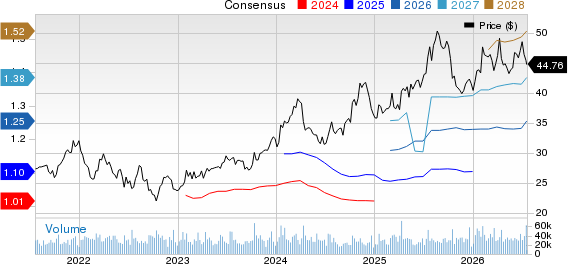
Fastenal Company price-consensus-chart | Fastenal Company Quote
Among industrial distributors, W.W. Grainger, Inc. GWW is a useful comparison for scale and business-to-business supply distribution. Applied Industrial Technologies, Inc. AIT offers another reference point for investors watching industrial demand and margin discipline.
FAST Gross Margin Is the Key Debate
Gross margin is the central tension in FAST’s investment case. Gross margin declined 75 basis points to 44.6% in the second quarter, with unfavorable net price-cost reducing margin by about 40 basis points.
The issue is not just inflation. Tariff and supplier-driven cost increases are moving through faster than pricing, which can make quarterly margin recovery uneven.
Customer mix adds another layer. Larger contract customers usually carry lower gross margins, but they can produce higher profit dollars, better retention and operating efficiencies. That trade-off is acceptable only if volume and productivity keep offsetting the dilution.
Fastenal Still Has Offsetting Strengths
Fastenal has meaningful defenses against margin pressure. Selling, general and administrative expenses improved to 23.5% of sales from 24.4% a year earlier, helping operating margin stay flat despite the lower gross margin.
Cash generation also supports the premium case. Operating cash flow was $265.7 million in the second quarter and represented 69.4% of net income. Total debt declined to $120 million from $230 million a year earlier.
The company returned $305.1 million to shareholders through dividends and share repurchases. Continued share gains, larger customer sites and digital adoption give Fastenal ways to turn volume growth into better fixed-cost leverage.
What Would Make FAST More Compelling
FAST would look more attractive if price-cost recovery improves. A steadier gross margin would reduce the risk that cost inflation or tariffs absorb too much of the company’s sales momentum.
Large-site sales are another signal to watch. Sites spending at least $50,000 per month increased 16.5% to 3,125, and sales from those sites rose to $1.38 billion from $1.09 billion.
Digital execution also matters. Digital Footprint sales rose 16.2% and represented 61.6% of revenues, while Fastenal Managed Inventory sales increased 16.4% to $1.08 billion. Further adoption would support the argument that customer stickiness can translate into operating leverage.
FAST Signals Support the Cautious Bull Case
The bottom line is balanced. FAST is not a cheap stock, but the company is producing enough sales growth, operating income growth and share gains to keep the premium debate alive.
The stock currently carries a Zacks Rank #2 (Buy). That rank points to favorable near-term earnings estimate revision trends, which supports the cautious bull case but does not remove the valuation risk. You can see the complete list of today’s Zacks #1 Rank (Strong Buy) stocks here.
FAST has a Momentum Score of A, a Value Score of D, a Growth Score of C and a VGM Score of C. The mix fits the current setup. Investors are paying for quality, execution and momentum rather than buying a clear bargain.
Research Chief Names "Single Best Pick to Double"
From thousands of stocks, 5 Zacks experts each have chosen their favorite to skyrocket +100% or more in months to come. From those 5, Director of Research Sheraz Mian hand-picks one to have the most explosive upside of all.
This company targets millennial and Gen Z audiences, generating nearly $1 billion in revenue last quarter alone. A recent pullback makes now an ideal time to jump aboard. Of course, all our elite picks aren’t winners but this one could far surpass earlier Zacks’ Stocks Set to Double like Nano-X Imaging which shot up +129.6% in little more than 9 months.
Free: See Our Top Stock And 4 Runners UpWant the latest recommendations from Zacks Investment Research? Today, you can download 7 Best Stocks for the Next 30 Days. Click to get this free report
Fastenal Company (FAST): Free Stock Analysis Report
W.W. Grainger, Inc. (GWW): Free Stock Analysis Report
Applied Industrial Technologies, Inc. (AIT): Free Stock Analysis Report
This article originally published on Zacks Investment Research (zacks.com).