


Sezzle Inc. SEZL and Upstart Holdings, Inc. UPST give investors two very different ways to invest in financial technology. Sezzle is building a broader payments relationship around buy now, pay later, subscriptions and everyday spending. Upstart is trying to improve consumer lending by helping banks and institutional investors make credit decisions through artificial intelligence.
That difference matters more than a simple comparison of recent growth rates. Sezzle’s progress depends largely on getting consumers to use its platform more often while controlling credit losses and transaction costs. Upstart’s opportunity depends on improving its underwriting models, attracting borrowers and keeping enough third-party funding available for loans.
Both companies can benefit as digital finance gains wider use, but they carry different risks. Sezzle has a smaller platform and a more concentrated business, while Upstart is more exposed to lending cycles, interest rates and capital-market conditions. The better investment, therefore, comes down to business quality, earnings consistency, growth durability and valuation rather than which company posted the faster quarterly increase.
The Case for SEZL
Sezzle’s main strength is that its growth is increasingly coming from deeper customer relationships. Instead of relying only on shoppers who use buy now, pay later at checkout, the company is steering users toward paid subscriptions and repeat activity. Active subscribers reached 714,000 in the first quarter, up 48.4% from a year earlier, while subscribers placed about nine times as many orders as non-subscribers, on average. This gives Sezzle a more recurring and engaged customer base than a basic checkout service would provide.
That engagement can make Sezzle’s model more durable. On a year-over year basis, average quarterly purchase frequency rose from 6.1 to 7.1 transactions, suggesting that customers are finding more reasons to return to the platform. Features such as the Earn Tab, which rewards in-app activity, appear to support that behavior. Sezzle said users had a 55% higher buy now, pay later conversion rate within 30 days of their first Earn Tab activity. The company’s marketing payback period also remained below six months, indicating that growth spending is producing results relatively quickly.
Sezzle is also becoming less dependent on one payment format. Pay-in-5, longer-term installment options, a Canadian virtual card and the Sezzle Mobile plan expand the number of situations in which customers can use the brand. These additions will not all become major profit sources, but they support the broader aim of turning Sezzle from an occasional checkout button into a regular financial tool. This strategy compares favorably with Upstart’s expansion because Sezzle can fund much of its product development from existing profits rather than waiting for new lending capital.
The financial results support this bullish view, but they are evidence rather than the whole argument. Sezzle produced a 37.9% net margin and a 52.5% adjusted EBITDA margin while continuing to increase marketing spending. Management also raised its 2026 revenue-growth outlook to 30%-35% and adjusted net income guidance to $180 million. Those numbers suggest that higher engagement is translating into meaningful operating leverage. Credit performance can still vary by season and consumer conditions, but Sezzle currently combines growth, profitability and product expansion more effectively than Upstart.
The Case for UPST
Upstart offers a larger long-term market opportunity because its technology can potentially be used across several major lending categories. Its platform already covers personal loans, auto lending, home equity products and revolving credit. If its models can assess risk more accurately than traditional scoring systems, banks may approve more suitable borrowers without accepting weaker expected returns. More than 90% of Upstart loans are fully automated, which shows that the platform can process significant volume without requiring manual work for every application.
Product diversification is another positive. Personal lending remains the economic core of the company, but auto and home products give Upstart additional ways to grow. Auto originations increased more than 300% year over year in the first quarter, while home originations rose about 250%. These businesses are still developing, and management has indicated that the focus is beginning to move from pure volume growth toward better unit economics. The shift is sensible, although investors still need evidence that the newer products can produce attractive returns at scale.
Funding availability has also improved. Upstart secured more than $4 billion of committed capital early in 2026 and renewed an agreement under which Neuberger-managed funds may invest in as much as $600 million of consumer loans. Second-quarter originations reached approximately $4.23 billion, including $1.5 billion in June. These developments reduce near-term funding concerns and indicate that institutional investors continue to support loans generated through the platform. However, Upstart remains more dependent than Sezzle on outside funding and credit-market confidence.
The concern is that rapid platform growth has not yet translated into equally strong earnings growth. Upstart reported 44% revenue growth in the first quarter, but contribution margin fell to 50%, adjusted EBITDA margin was 13%, and the company remained unprofitable under GAAP. Management expects margins to improve during the year, and its full-year outlook calls for approximately $294 million in adjusted EBITDA. Still, compared with Sezzle, Upstart has less room for execution errors and greater sensitivity to borrower demand, credit performance and funding costs.
How Do Estimates Compare for SEZL & UPST?
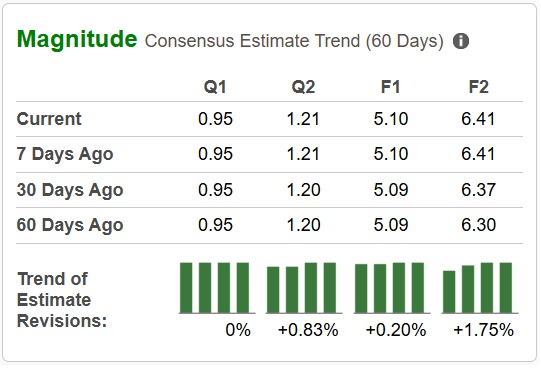
The Zacks Consensus Estimate for Sezzle’s 2026 and 2027 sales implies year-over-year growth of 31.60% and 25.06%, respectively. The consensus mark for 2026 and 2027 EPS suggests a year-over-year increase of 42.06% and 25.74%, respectively. Over the past 30 days, estimates for SEZL’s 2026 and 2027 EPS have been revised upward.
For Sezzle:
Image Source: Zacks Investment Research
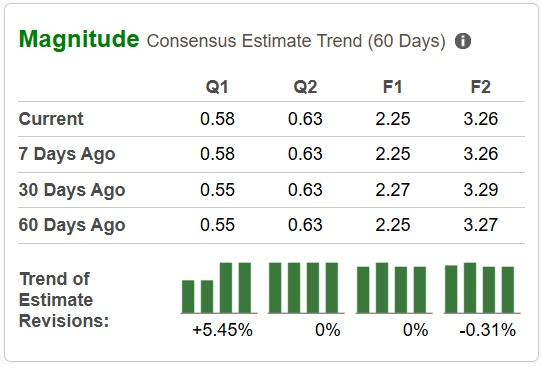
The Zacks Consensus Estimate for Upstart’s 2026 and 2027 sales calls for year-over-year growth of 36.53% and 30.61%, respectively. The consensus estimates for both 2026 and 2027 EPS have been revised marginally downward over the past 30 days. However, the figures suggest a year-over-year increase of 29.31% and 44.89%, respectively.
For Upstart:
Image Source: Zacks Investment Research
Price Performance and Valuation of SEZL & UPST
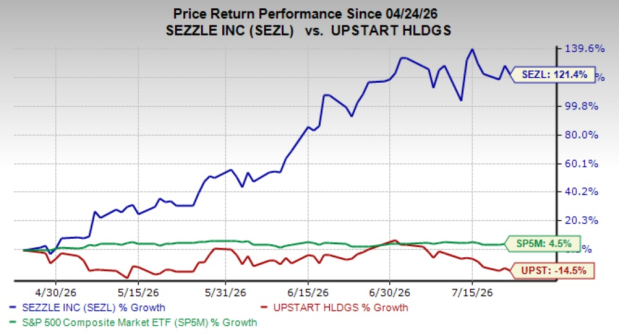
Over the past three months, Sezzle shares have surged 121.4%, while Upstart shares have declined 14.5%. In comparison, the S&P 500 composite has advanced 4.5% in the same time frame.
Image Source: Zacks Investment Research
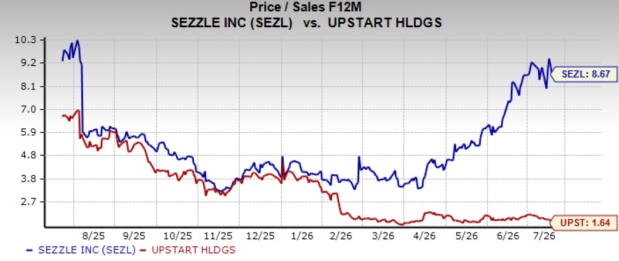
Following the share rally, SEZL is trading at a forward 12-month price-to-sales of 8.67X, which is above its one-year median of 4.62X. Meanwhile, UPST is presently trading at a forward 12-month price-to-sales of 1.64X, which is below its one-year median of 3.15X.
Upstart is clearly cheaper on this measure. However, Sezzle’s premium reflects its stronger margins and more direct conversion of revenues into earnings. The valuation gap means SEZL carries higher expectations, but UPST’s discount is partly compensation for greater funding, credit-cycle and profitability risks.
Image Source: Zacks Investment Research
Conclusion
Sezzle appears to be the better stock to consider buying. Subscriber growth, rising purchase frequency, expanding services and disciplined customer acquisition are strengthening the underlying business. Its established profitability also gives management more control over how quickly it invests and expands.
Upstart still has meaningful potential. Its AI lending technology, growing product range and improved funding network could support strong long-term growth. However, the company must show that rising originations can produce steadier margins and GAAP profits. Given the balance between growth and execution risk, it seems prudent for investors to retain UPST shares, while SEZL enjoys the stronger investment case.
SEZL currently carries a Zacks Rank #2 (Buy), while UPST has a Zacks Rank #3 (Hold). You can see the complete list of today’s Zacks #1 Rank (Strong Buy) stocks here.
Zacks' Research Chief Names "Stock Most Likely to Double"
Our team of experts has just released the 5 stocks with the greatest probability of gaining +100% or more in the coming months. Of those 5, Director of Research Sheraz Mian highlights the one stock set to climb highest.
This top pick is a little-known satellite-based communications firm. Space is projected to become a trillion dollar industry, and this company's customer base is growing fast. Analysts have forecasted a major revenue breakout in 2025. Of course, all our elite picks aren't winners but this one could far surpass earlier Zacks' Stocks Set to Double like Hims & Hers Health, which shot up +209%.
Free: See Our Top Stock And 4 Runners UpWant the latest recommendations from Zacks Investment Research? Today, you can download 7 Best Stocks for the Next 30 Days. Click to get this free report
Upstart Holdings, Inc. (UPST): Free Stock Analysis Report
Sezzle Inc. (SEZL): Free Stock Analysis Report
This article originally published on Zacks Investment Research (zacks.com).