


Real estate technology companies Opendoor Technologies Inc. OPEN and Zillow Group, Inc. ZG are currently operating in a rocky housing market. With the 30-year fixed mortgage rate hovering above 6% since March 2026, per Freddie Mac, the residential market in the United States is experiencing muted demand as homebuyers are staying away from homeownership.
Nonetheless, these two housing-tech companies are undergoing several initiatives to keep up their profitability and revenue streams.
Opendoor operates a technology-driven residential real estate platform that simplifies home buying and selling by purchasing homes directly from sellers, renovating and reselling them, while using AI to automate pricing, underwriting and operations. Meanwhile, Zillow operates a digital residential real estate marketplace and increasingly an end-to-end real estate transaction platform, connecting buyers, sellers, renters and agents while monetizing through agent partnerships, mortgage lending, rentals, listing products and professional software.
Let’s closely compare the fundamentals of the two real estate stocks for a better investment decision.
The Case for Opendoor Stock
Opendoor is operating against a difficult U.S. housing backdrop, with elevated mortgage rates, affordability pressures and weak transaction volumes limiting housing market activity. Existing home sales remain near a 30-year low of around 4 million units annually, roughly 20% below the pre-pandemic decade average. Home prices were broadly flat year over year as of June 2026, while seller-buyer disconnect remained evident, with delistings at record levels. These conditions can constrain both acquisition and resale activity, potentially extending inventory holding periods and pressuring margins. Opendoor’s second-quarter 2026 revenues fell 43.7% year over year to $883 million.
Opendoor’s ambitious turnaround depends heavily on successfully scaling AI, mortgage, new transaction models and other technology initiatives. While AI is improving underwriting and operational productivity, the company is increasing fixed operating expenses to fund engineering and AI investments. Cash also declined as OPEN deployed more than $700 million to rebuild inventory, leaving the business exposed to financing and housing-market risks. Its mortgage product remains relatively early-stage, with licensing still progressing across states and management acknowledging that it has more work to do despite strong early adoption. The planned transition toward capital-light 2P and marketplace-based 3P transactions also remains unproven.
OPEN’s second-quarter 2026 net loss also widened to $162 million from $29 million a year earlier. The company’s third-quarter 2026 outlook anticipates contribution margin falling to 4-4.5% amid seasonal weakness, with a prolonged housing slowdown remaining a key overhang on sustainable growth and profitability. Management described the current market as the weakest housing market in a generation, creating uncertainty around future homebuyer and seller demand.
However, Opendoor is broadening its service platform through acquisitions and strategic partnerships, potentially creating additional revenue opportunities beyond buying and selling homes. It completed its acquisition of Doma’s closing and escrow operations in July 2026, strengthening its ability to provide a more integrated real estate transaction experience. Besides, OPEN is demonstrating meaningful progress in controlling costs while improving its unit economics. The combination of higher volumes, lower variable costs and faster inventory turnover provides a stronger foundation for Opendoor’s targeted adjusted net income profitability by year-end 2026.
The Case for Zillow Stock
Zillow is successfully reducing its dependence on housing transaction volumes by expanding Rentals, Mortgages and agent-focused services. Its second-quarter 2026 revenues rose 18% year over year to $772 million, while Rentals revenues climbed 31% and Mortgages revenues surged 75%. The company’s shift toward the Preferred agent model is also increasing revenue per connection. Zillow is expanding its rental reach through Google Gemini’s connected apps ecosystem. Meanwhile, the company is integrating mortgage pre-approval, agent services and transaction tools into its platform. This end-to-end strategy allows ZG to capture revenues across multiple stages of the housing journey, helping sustain mid-teens growth despite an uncertain housing environment.
Besides, Zillow is using AI mode to make its platform more personalized and increase consumer engagement. AI users spend more than three times longer on ZG, view more than twice as many homes and contact agents at nearly three times the rate of non-AI users. The company is also integrating AI into agent tools through Follow Up Boss and Likely to List. By connecting search, financing, agents and transactions, Zillow aims to increase monetization even when overall housing-market activity remains subdued.
However, higher mortgage rates and affordability pressures are increasingly weighing on purchase activity. Zillow expects industry purchase mortgage originations to decline low- to mid-single digits for the remainder of 2026 compared with its previous expectation of flat growth. The company expects third-quarter 2026 For Sale revenue growth of only 5-7% year over year, while Residential revenues are expected to remain flat. ZG’s diversified model provides some protection, but a prolonged housing slowdown could constrain lead volumes, agent connections and mortgage originations.
Despite Zillow’s market-share gains, average monthly unique users fell 2% year over year to 239 million, while visits declined 2% to 2.5 billion. Higher lead acquisition and mortgage processing costs also pressured expenses, while second-quarter 2026 results showed a $4 million net loss. Zillow is simultaneously restructuring its workforce to improve efficiency. Although AI, Rentals and integrated transactions offer growth avenues, execution risks, higher costs, mortgage volatility and regulatory/legal pressures could challenge profitability if housing conditions deteriorate further.
Stock Performance & Valuation
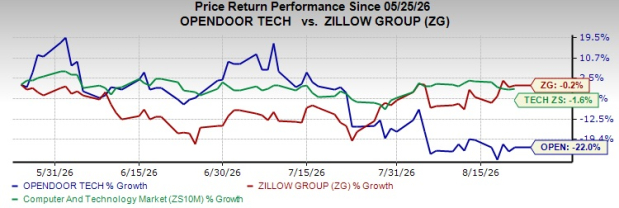
As witnessed from the chart below, over the past three months, the share price performance of Zillow has been above Opendoor’s performance and the Computer and Technology sector, even though they all reflect declining trends.
Image Source: Zacks Investment Research
Considering valuation, over the last five years, Zillow has been trading above Opendoor on a forward 12-month price-to-sales (P/S) ratio basis.
Image Source: Zacks Investment Research
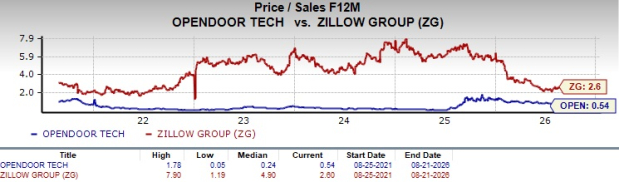
Overall, from these technical indicators, it can be deduced that ZG stock offers a diminishing growth trend but with a premium valuation, while OPEN stock offers a declining growth trend with a discounted valuation.
Comparing EPS Estimate Trends: OPEN vs. ZG
The Zacks Consensus Estimate for OPEN’s 2026 and 2027 bottom line indicates a loss per share. Over the past 30 days, the loss per share has widened to 15 cents and three cents, respectively. Nonetheless, the estimated figures for 2026 and 2027 indicate year-over-year growth of 42.3% and 82.2%, respectively.
OPEN's EPS Trend
Image Source: Zacks Investment Research

The Zacks Consensus Estimate for ZG’s 2026 and 2027 earnings has trickled down in the past 30 days to $2.22 and $2.69 per share, respectively. However, the estimates for 2026 and 2027 imply year-over-year improvements of 35.4% and 21.3%, respectively.
ZG's EPS Trend
Image Source: Zacks Investment Research

Return on Equity (ROE) of OPEN & ZG Stocks
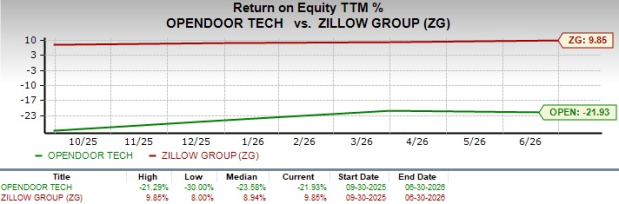
Zillow’s trailing 12-month ROE of 9.85% significantly exceeds Opendoor’s negative average, underscoring its efficiency in generating shareholder returns.
Image Source: Zacks Investment Research
Should Investors Choose ZG Stock or OPEN Stock?
Zillow’s growth is being led by strong growth in Rentals and Mortgages, helping reduce its dependence on housing transaction volumes. Its AI-powered search, Preferred agent model and integrated mortgage and transaction offerings could further expand monetization as housing activity remains subdued. Yet, the company is not without risks. Falling user engagement, higher costs, mortgage-market weakness and downward earnings-estimate revisions could limit near-term upside. Its premium valuation also leaves less room for disappointment.
In contrast, Opendoor remains more exposed to home-price trends, transaction volumes and inventory financing. Although AI-driven underwriting, capital-light transaction models, mortgage expansion and the Doma acquisition could improve long-term economics, these initiatives still carry considerable execution risk.
Still, Zillow’s positive ROE, diversified revenue streams and stronger operating resilience outweigh Opendoor’s discounted valuation and turnaround potential. With ZG stock carrying a Zacks Rank #3 (Hold) compared with OPEN’s Zacks Rank #4 (Sell), Zillow stock appears to be the better choice for investors seeking relatively lower housing-market risk and more sustainable revenue growth. You can see the complete list of today’s Zacks #1 Rank (Strong Buy) stocks here.
Beyond Nvidia: AI's Second Wave Is Here
The AI revolution has already minted millionaires. But the stocks everyone knows about aren't likely to keep delivering the biggest profits. AI’s second wave is moving from infrastructure to implementation and these companies are at the forefront of this transition, positioned to become what Amazon and Google were to the internet era.
See Stocks Now >>Want the latest recommendations from Zacks Investment Research? Today, you can download 7 Best Stocks for the Next 30 Days. Click to get this free report
Opendoor Technologies Inc. (OPEN): Free Stock Analysis Report
Zillow Group, Inc. (ZG): Free Stock Analysis Report
This article originally published on Zacks Investment Research (zacks.com).