
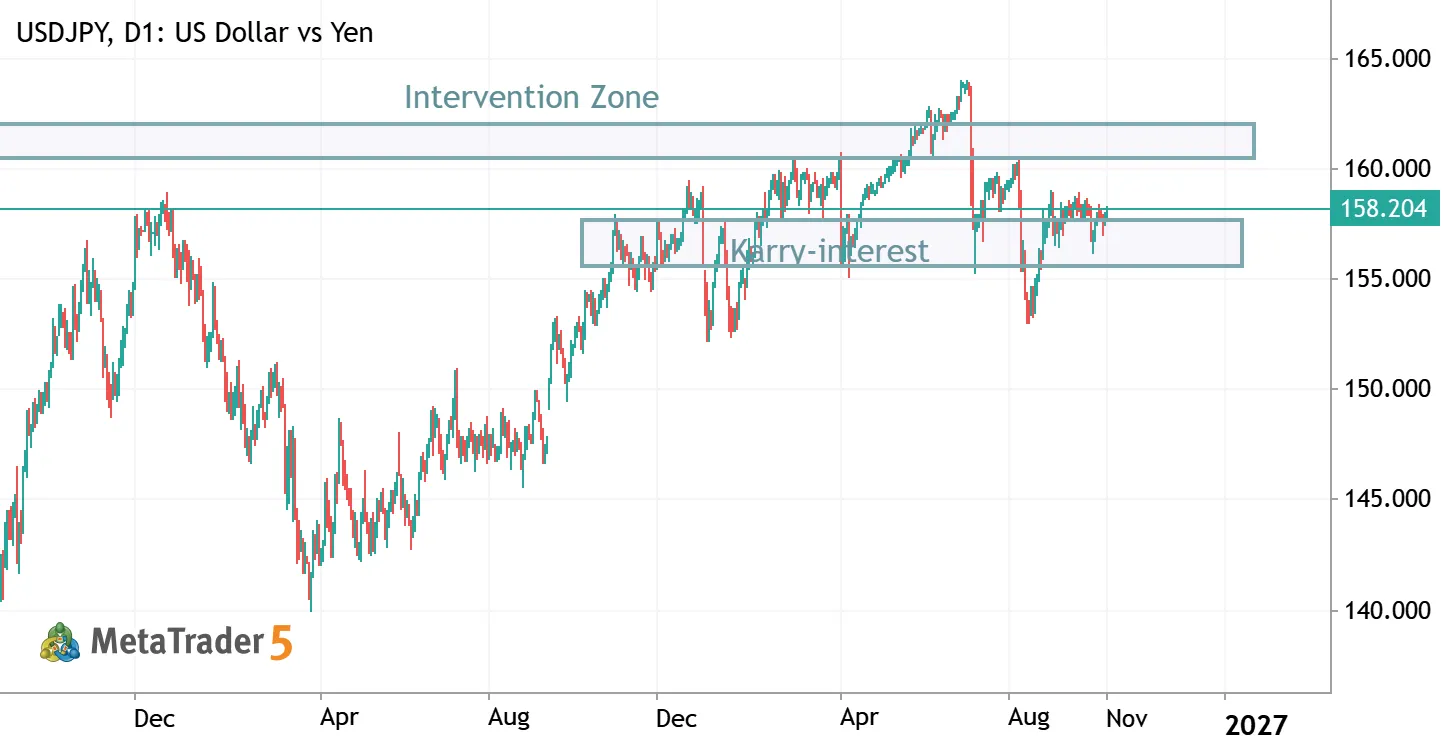
USDJPY is once again approaching the psychologically important 160 level, where market attention traditionally shifts toward possible action by Japanese financial authorities.
However, reaching 160 does not automatically mean that a currency intervention will follow. For Japan’s Ministry of Finance and the Bank of Japan, other factors also matter, including the speed of yen depreciation, the nature of the USDJPY move, and the level of speculative activity.
A gradual rise and a sharp speculative spike are very different situations from the perspective of potential policy action.
Why Does USDJPY Remain Strong?
The main fundamental driver remains the interest rate differential between the United States and Japan.
After the latest Federal Reserve meeting, the U.S. policy rate remained in the 3.75–4.00% range. As long as yields on U.S. dollar assets remain significantly higher than those available in yen, carry trade continues to support demand for the dollar against the Japanese currency.
At the same time, the closer USDJPY moves toward 160, the greater the risk of sharp price swings triggered by comments from Japanese officials or direct intervention in the foreign exchange market.
USDJPY Technical Analysis
After falling below 157.90, buyers quickly pushed the price back higher.
Key levels:
- 159.20 — nearest resistance;
- 160.00 — psychological level and a zone of elevated intervention risk;
- 157.90 — nearest support;
- 157.50–157.60 — next support zone;
- 155.00 — deeper downside target if selling pressure increases.
A break above 159.20 could reopen the path toward 160.
However, at this stage it is especially important to monitor not only the direction of USDJPY, but also the speed of the move. A sharp rally toward 160 could significantly increase the probability of verbal intervention and direct action by Japanese financial authorities.
USDJPY: What Comes Next?
On higher timeframes, the broader structure still remains favorable for the U.S. dollar, while the interest rate differential continues to support buyers.
At the same time, the 160 level is becoming an increasingly important risk factor.
In my view, a move toward 160 should not be treated as an unconditional buy signal.
USDJPY is currently caught between the attractiveness of the carry trade and the growing risk of Japanese currency intervention.
In this environment, what matters is not only the price level itself, but also how quickly the market approaches it.
Trading CFDs and other financial instruments involves a high risk of capital loss. This material contains information about market movements, does not constitute investment research, and should not be considered investment advice. Past performance does not guarantee future results.

 Perfil no MQL5
Novo comentário
Buena app