


Two macro forces are lining up to favor the Russell 2000 Index. First, improving earnings across the broader market are creating a supportive backdrop. As companies within the S&P 500 continue to report steady profit growth, it signals underlying economic resilience rather than fragility. That kind of environment typically filters down to smaller companies, which are more sensitive to domestic growth. When revenues and margins stabilize at the large-cap level, it often gives investors confidence to move further out on the risk curve, where small caps tend to benefit.
A second driver is the growing alignment across major equity benchmarks. The Russell 2000’s 30-day inter-market correlation sits around 88% with the S&P 500 and roughly 94% with the Dow Jones Industrial Average. Source: Inter-Market Correlation page from Moore Research Center, Inc. (MRCI). Those are high readings, suggesting that market participants are trading these indices as part of a unified risk-on narrative rather than picking them apart. If the broader market continues to grind higher, small caps are unlikely to lag in isolation. Instead, they tend to move in tandem—and sometimes with more momentum—when correlations tighten at these levels.
More Yield, Less Trap: Sign up free to get Barchart’s daily Dividend Investor newsletter straight to your inbox.
There’s also a sentiment component that shouldn’t be ignored. JPMorgan Chase has been openly encouraging investors to step in during the recent dip, reinforcing the idea that pullbacks are opportunities rather than warnings. When large institutions frame declines this way, it can shape behavior across the market. Combined with improving earnings and strong cross-index correlations, that message adds fuel to the case that the Russell 2000 could continue participating in a broader upward move rather than breaking away from it.
Technical Picture
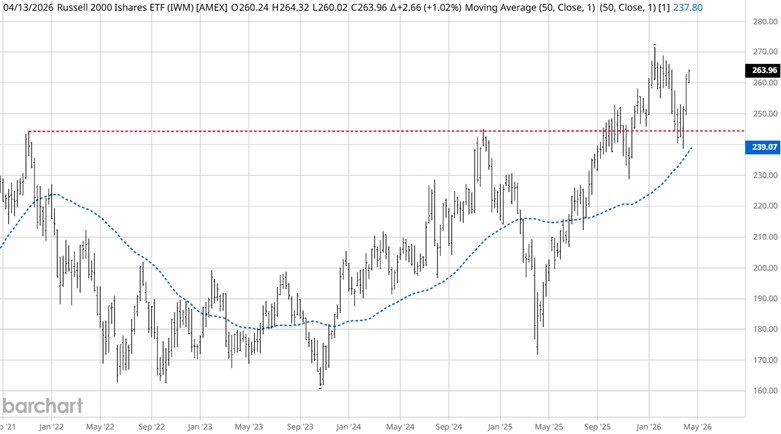
Currently, the Russell 2000 Index (IWM) is trading at 263.80, only 7.8 points from its all-time high of 271.60.
Source: Barchart
Since the April 2025 lows, the IWM has been in a consistent weekly uptrend. Once trading above the prior all-time highs (red line), the index retested the old resistance level and has since trended higher, nearing its all-time high. During the retest of the old resistance, the up-sloping weekly 50-SMA (Simple Moving Average) was nearby. Technically, the bull market has resumed.
Seasonal Pattern
Source: MRCI
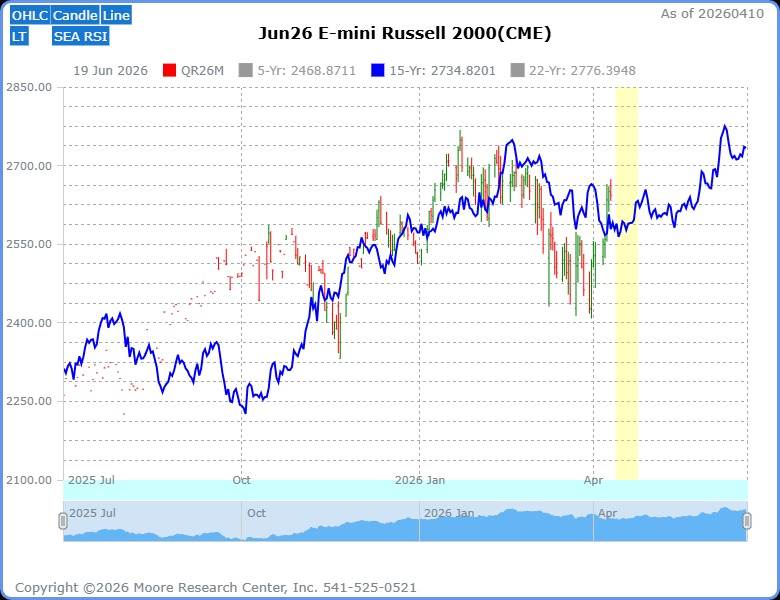
The recent April 2026 lows coincided with MRCI research showing that the 15-year average price cycle (blue line) had bottomed during that period. With extensive detailed research, MRCI has identified an optimal bullish seasonal window (yellow box). Previously, in the comments above, we discussed the significant inter-market correlation among the Russell 2000, the S&P 500, and the Dow Jones Industrial Average, allowing traders to use any of the three indexes to participate in this opportunity.
Traders could use this information to refine their strategies or confirm their research. Trading any index correlated with the Russell 2000 allows them to use either the mini or the micro futures contracts.
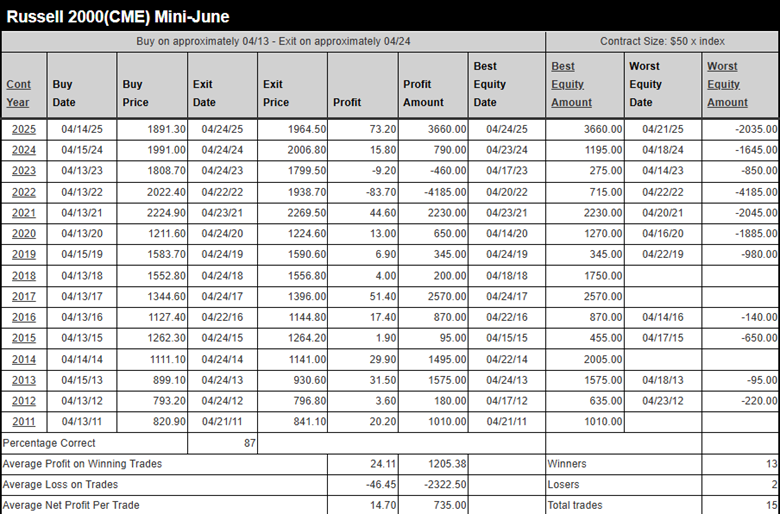
Hypothetical testing over the past 15 years has found that the June Russell 2000 futures have closed higher on April 24 than on April 13, with the trade lasting 12 calendar days in 13 of those years, for an 87% occurrence rate. The average index points profit was 14.70, or $735.00, based on one mini Russell 2000 contract.
During this period, the seasonal buy pattern had 4 years with no daily closing drawdowns.
As a crucial reminder, while seasonal patterns can provide valuable insights, they should not be the basis for trading decisions. Traders must consider technical and fundamental indicators, risk management strategies, and market conditions to make informed, balanced trading decisions.
Source: MRCI
Assets to Trade the Russell 2000 Index
Futures traders can trade the mini-Russell contract (QR) or the micro contract (RX). Both of these trade for 23 hours per day on the CME Group exchange.
Equity traders could trade the exchange-traded fund (ETF) (IWM).
Options are available for both futures and equity products.
In Closing…
Taken together, the message is fairly straightforward. The Russell 2000 Index is not moving in isolation—it’s being supported by improving earnings in the S&P 500, strong inter-market correlations with both the S&P and the Dow Jones Industrial Average, and a broader risk-on tone reinforced by JPMorgan Chase. At the same time, the technical trend remains intact, prices are close to prior highs, and seasonal patterns suggest a historically favorable window. None of this guarantees upside, but it does show alignment across fundamentals, sentiment, and price action. For traders and investors, that alignment is often what matters most—it’s when multiple factors point in the same direction that opportunities tend to carry the most weight.
On the date of publication, Don Dawson did not have (either directly or indirectly) positions in any of the securities mentioned in this article. All information and data in this article is solely for informational purposes. For more information please view the Barchart Disclosure Policy here.