


Selling cash secured puts on stocks an investor is happy to take ownership of is a great way to generate some extra income. A cash-secured put involves writing an at-the-money or out-of-the-money put option and simultaneously setting aside enough cash to buy the stock. The goal is to either have the put expire worthless and keep the premium, or to be assigned and acquire the stock below the current price. It’s important that anyone selling puts understands that they may be assigned 100 shares at the strike price.
Why Trade Cash Secured Puts?
Selling cash secured puts is a bullish trade but slightly less bullish than outright stock ownership. If the investor was strongly bullish, they would prefer to look at strategies like a long call, a bull call spread, or a poor man’s covered call. Investors would sell a put on a stock they think will stay flat, rise slightly, or at worst not drop too much.
Can’t Get Enough Options?: Join the list for Barchart’s daily unusual options report, delivered free.
Cash secured put sellers set aside enough capital to purchase the shares and are happy to take ownership of the stock if called upon to do so by the put buyer. Naked put sellers, on the other hand, have no intention of taking ownership of the stock and are purely looking to generate premium from option selling strategies.
The more bullish the cash secured put investor is, the closer they should sell the put to the current stock price. This will generate the most amount of premium and also increase the chances of the put being assigned. Selling deep-out-of-the-money puts generates the smallest amount of premium and is less likely to see the put assigned.
NVDA Cash Secured Put Example
NVIDIA Corporation (NVDA) remains one of the most widely watched stocks in the market, driven by surging demand for its AI-focused GPUs and data center products. Despite a significant pullback from its 2025 highs and an elevated macro backdrop, the stock has recovered strongly in recent weeks and continues to attract bullish analyst sentiment.
Yesterday, with NVDA trading at $189.31, the December 18 put option with a strike price of $145 was trading around $7.50. Traders selling this put would receive $750 in option premium. In return for receiving this premium, they have an obligation to buy 100 shares of NVDA for $145. By December 18, if NVDA is trading for $140, or $120, or even $100, the put seller still has to buy 100 shares at $145.
But, if NVDA is trading above $145, the put option expires worthless, and the trader keeps the $750 option premium. The net capital at risk is equal to the strike price of $145, less the $7.50 in option premium. So, if assigned, the net cost basis will be $137.50. That’s a 27.37% discount from the price it was trading yesterday.
If NVDA stays above $145, the return on capital is:
$750 / $13,750 = 5.45% in 249 days, which works out to 8.0% annualised.
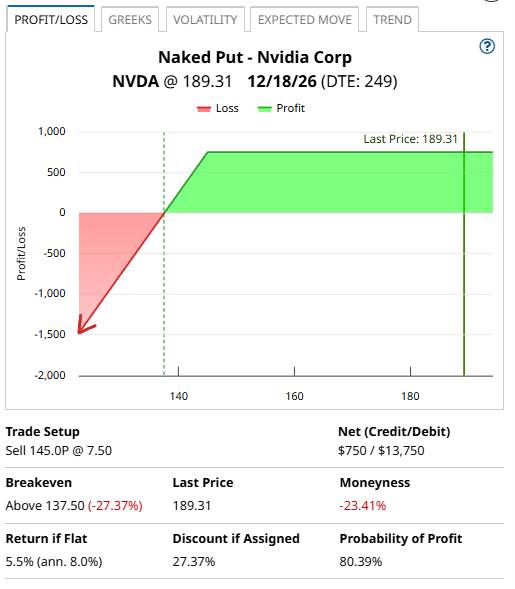
Either the put seller achieves an 8.0% annualised return or gets to buy a world-leading AI chipmaker for a 27.37% discount. You can find other ideas like this using the Naked Put Screener.
Company Details
The Barchart Technical Opinion rating is a 24% Buy with a Weakening short term outlook on maintaining the current direction.
Long term indicators fully support a continuation of the trend.
Of 49 analysts covering NVDA, 44 have a Strong Buy rating, 3 have a Moderate Buy rating, 1 has a Hold rating and 1 has a Strong Sell rating.
Implied volatility is currently 33.6% compared to a 12-month high of 58.4% and a low of 31.7%. The IV Percentile is 6% and the IV Rank is 7%.
NVIDIA Corporation is the worldwide leader in visual computing technologies and the inventor of the graphic processing unit, or GPU. Over the years, the company’s focus has evolved from PC graphics to artificial intelligence (AI) based solutions that now support high performance computing (HPC), gaming and virtual reality (VR) platforms.
NVIDIA’s GPU success can be attributed to its parallel processing capabilities supported by thousands of computing cores, which are necessary to run deep learning algorithms. The company’s GPU platforms are playing a major role in developing multi-billion-dollar end-markets like robotics and self-driving vehicles.
NVIDIA is a dominant name in the Data Center, professional visualization and gaming markets where Intel and Advanced Micro Devices are playing a catch-up role. The company’s partnership with almost all major cloud service providers (CSPs) and server vendors is a key catalyst.
Summary
While this type of strategy requires a lot of capital, it is a great way to generate income from stocks you want to own. If you end up being assigned, you can sell covered calls against the long stock position to generate further income. NVDA does pay a small quarterly dividend of $0.04 per share, though at current prices the yield is negligible. You can do this on other stocks as well, but remember to start small until you understand a bit more about how this all works.
Risk averse traders might consider buying an out-of-the-money put to protect the downside.
Please remember that options are risky, and investors can lose 100% of their investment.
This article is for education purposes only and not a trade recommendation. Remember to always do your own due diligence and consult your financial advisor before making any investment decisions.
On the date of publication, Gavin McMaster had a position in: NVDA . All information and data in this article is solely for informational purposes. For more information please view the Barchart Disclosure Policy here.
More news from Barchart
How to Buy Nvidia Stock for a 27% Discount or Achieve an 8% Annual Return Intel Stock Has Large, Unusual Options Trades - Investors are Bullish on INTC Oil Is Off Its Peak - Time to Buy Oil Stocks Like ConocoPhillips? Option Volatility and Earnings Report for April 13-17