


When the economy feels uncertain, investors circle back to the companies that keep money moving. That is what makes banks relevant.
They may not always be flashy, but they are integrated into everyday financial life. Every day, people deposit paychecks, businesses seek capital, customers apply for loans, and investors still look for places to manage wealth. That makes large banks worth watching closely, especially when investors are looking for a mix of stability, income, and value.
More Yield, Less Trap: Sign up free to get Barchart’s daily Dividend Investor newsletter straight to your inbox.
And that's why today, we’re putting JPMorgan Chase and Bank of America side by side.
So, which company is the better buy right now?
JPMorgan Chase & Co. (JPM)
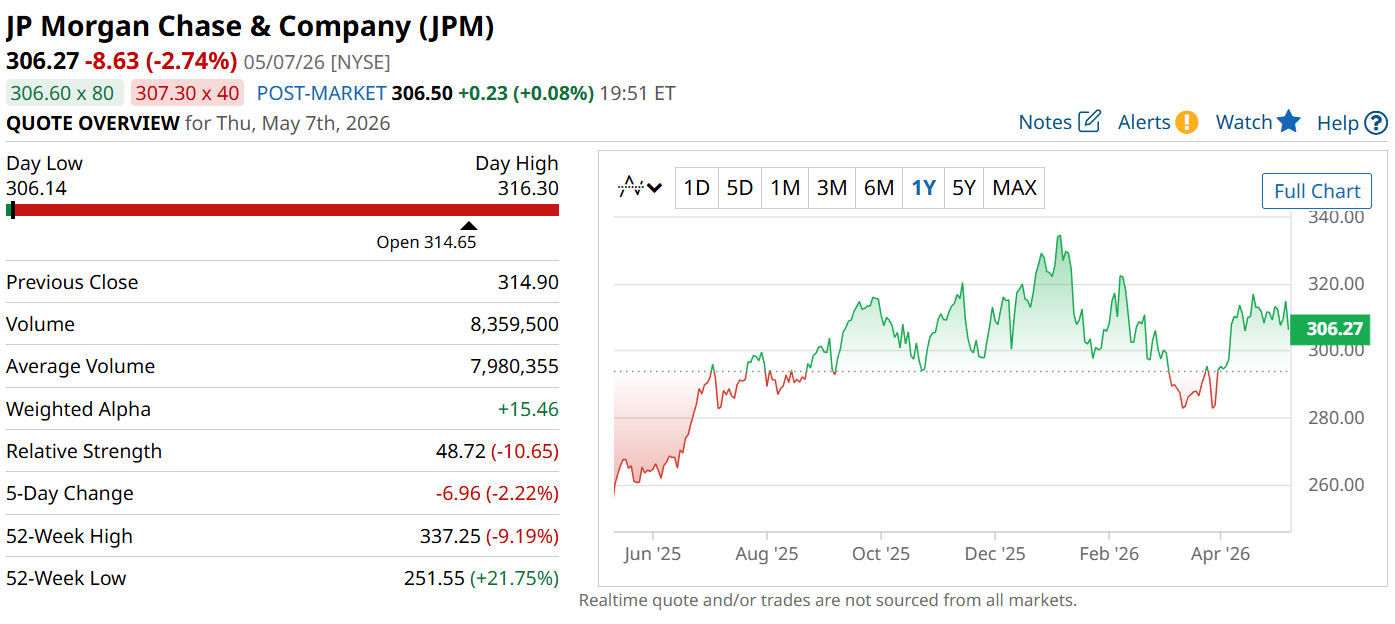
On one side of the ring, we have JPMorgan Chase, the largest bank in the country and one of the world's largest financial institutions. The company serves consumers, businesses, corporations, and wealthy clients through banking, credit cards, loans, investment banking, and asset management.
JPM has a market cap of $843 billion, and the stock has traded between $251 and $337 in the past 52 weeks. At the time of writing, JPM stock is trading near the upper end of that range, though it is down 5% year to date.
Bank of America Corp (BAC)
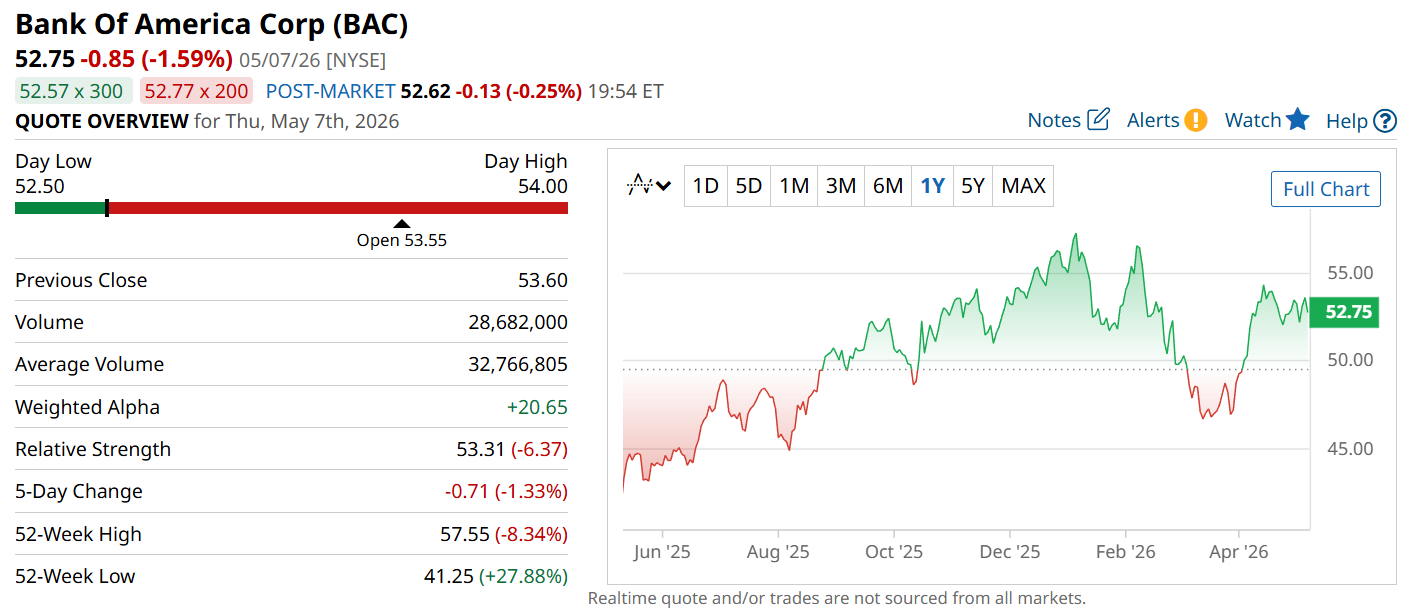
In the other end, we have Bank of America, another banking giant that competes in many of the same areas as JPMorgan, with a major presence in lending, credit cards, wealth management, and general banking services. Its business is closely tied to everyday financial needs, including investing through Merrill, making it a familiar name for millions of households.
Bank of America is the smaller company, with a market cap of $380 billion, and it also trades at a lower price. In fact, BAC stock has traded between $41 and $57 per share over the past 52 weeks, though its current price is much closer to its highs than its lows. Like JPM, BAC is also down 4% year to date.
At this point, there’s no clear winner yet. Let’s get to know them both better.
Business model comparison: JPMorgan Chase & Co. vs Bank of America Corp
JPMorgan Chase and Bank of America are both large banks, but they are not built the same way.
JPMorgan has the broader setup. It offers more ways to make money across different market conditions, rather than being limited to just one part of banking. It can benefit from everyday customer activity through Chase, corporate lending through its commercial bank, and dealmaking, trading, and advisory work through its Wall Street operations.
Bank of America is also diversified, but its story leans more toward consumer relationships and wealth management. Its large customer base provides steady deposit activity, while Merrill adds another layer through its investing and advisory services.
Put simply, JPMorgan looks like the stronger all-around financial machine, with a bigger reach across Wall Street and Main Street. Bank of America, meanwhile, is more closely tied to consumer banking, wealth management, and broader financial services.
Financial health
To better compare JPMorgan Chase and Bank of America, let’s look at their latest quarterly numbers:
| Metric | JPMorgan Chase | Bank of America |
| Revenue | $49.8 billion | $30.3 billion |
| Net Income | $16.49 billion | $8.58 billion |
| Operating Cash Flow | -$147.78 billion | $12.61 billion |
| Forward P/E | 13.80x | 11.92x |
JPMorgan is the larger business by a wide margin, reporting $49.84 billion in total net revenue for the first quarter, compared with Bank of America’s $30.3 billion in revenue, net of interest expense.
JPMorgan is also the more profitable bank, with $16.49 billion in net income, compared with $8.6 billion for Bank of America. That gives JPMorgan a clear earnings edge.
Cash flow is where Bank of America looks better, at least for the quarter. It reported $12.61 billion in operating cash flow, while JPMorgan posted a negative operating cash flow of $147.78 billion. That gives BAC the stronger cash flow result for the period, though operating cash flow at large banks can swing significantly from quarter to quarter because of changes in loans, deposits, trading assets, securities, and other balance-sheet items.
Valuation also favors BAC. Its forward P/E sits at 11.92x, below JPMorgan’s ~14x. Both are under the sector average of 16.79x, but the former looks cheaper on this metric.
Overall, JPMorgan looks stronger in size and profitability, while Bank of America looks better on valuation and recent operating cash flow.
Dividend story
The financial story is one thing, but how well a company pays its investors is another.
JPMorgan Chase has raised its dividend for more than 10 years. It pays $6.00 per share, per year, which translates to a yield of around 1.9%. It also has a dividend payout ratio of 26%, suggesting that the company still keeps most of its earnings for reinvestment.
Meanwhile, Bank of America has also raised its dividend for more than 10 years. It pays a forward annual dividend of $1.12, translating to a yield of approximately 2%, slightly higher than its competitor. Like JPMorgan Chase, BAC also keeps its payout ratio low at 25%, suggesting that it still has room to reinvest in the business.
Analyst ratings
While both stocks are down year-to-date, their solid business models and strong financial positions have kept Wall Street analysts bullish.
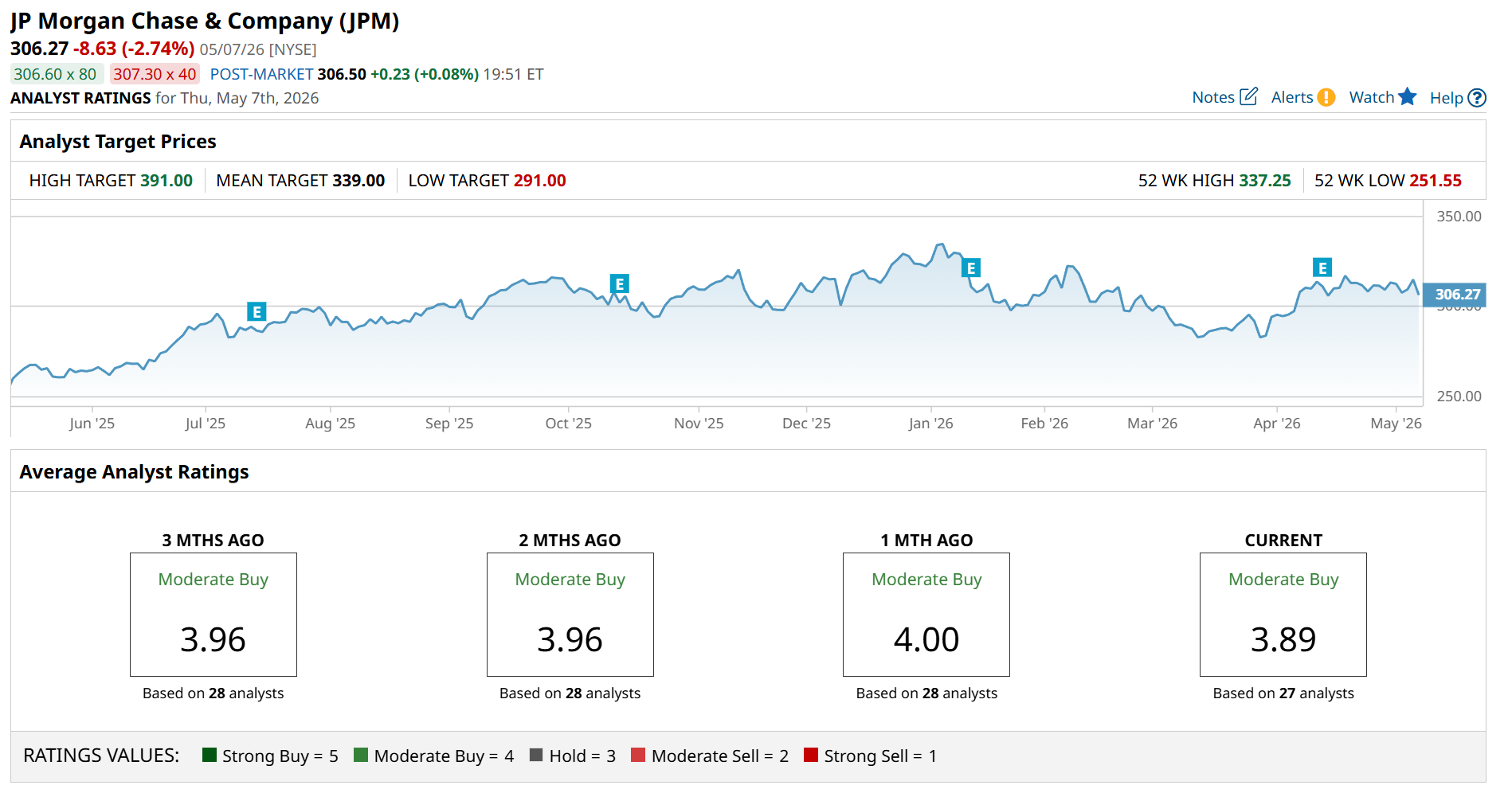
A consensus among 27 analysts rates JPM stock a “Moderate Buy,” with a score of 3.89 out of 5. Its mean to high target prices suggest between 11% and 28% potential upside.
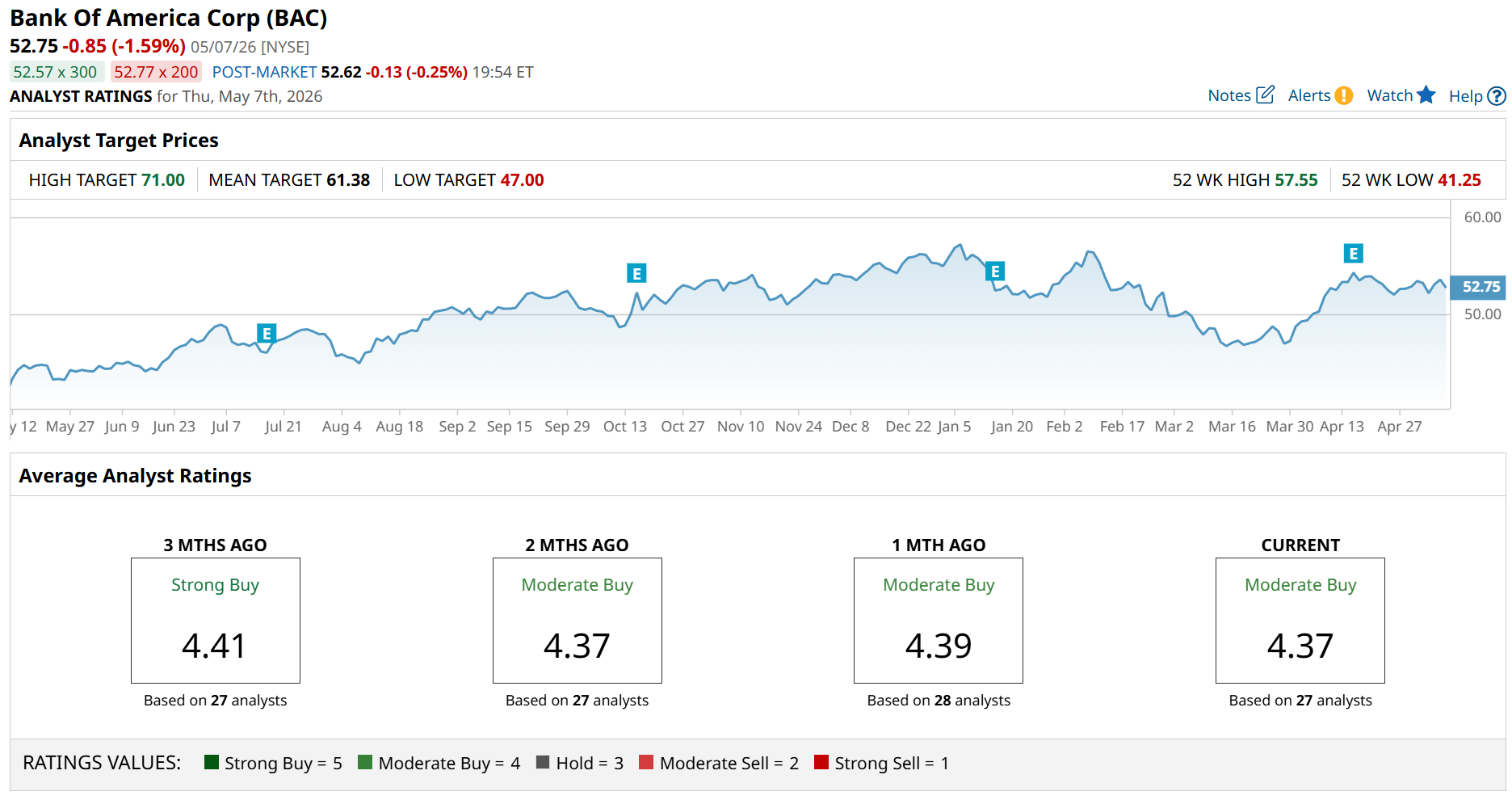
Likewise, BAC has a consensus “Moderate Buy” rating, though it has a better average score at 4.37. Its mean to high target prices are also a bit higher, suggesting around 16% to 34% potential upside.
Verdict
Both JPMorgan Chase and Bank of America are strong banking names, but they appeal to different kinds of investors.
JPMorgan looks like the stronger overall bank. It has the larger scale, higher revenue, stronger profitability, and broader business reach, which gives it the edge for investors who want a more dependable banking franchise.
Bank of America, however, makes a stronger case for income-focused value investors. It trades at a lower forward P/E, offers a slightly higher dividend yield, and has stronger potential upside based on analyst targets.
In the end, JPMorgan looks like the better all-around business, while Bank of America may be the more attractive pick for investors looking for value, income, and upside potential.
On the date of publication, Rick Orford did not have (either directly or indirectly) positions in any of the securities mentioned in this article. All information and data in this article is solely for informational purposes. For more information please view the Barchart Disclosure Policy here.
More news from Barchart
JPMorgan vs. Bank of America: How the 2 Dividend-Paying Bank Stocks Stack Up in 2026 The $3.4 Billion Reason Nvidia Drove IREN Stock Higher Today Snap Stock Is Selling Off. It Turns Out the Iran War Is Bad for Selfies Too MRNA Stock Alert: Moderna Surges on Hantavirus Vaccine Hopes