


Quantum computing has long sounded like a technology of the future, and few companies have attracted as much attention as Quantinuum Inc. (QNT) has recently. Created in 2021 through the merger of Honeywell’s (HON) quantum computing division and U.K.-based Cambridge Quantum, the company is building advanced quantum machines designed to solve problems that would take traditional computers an impractical amount of time to handle. Its technology could eventually be used across industries ranging from drug discovery and cybersecurity to finance, chemistry, and artificial intelligence (AI).
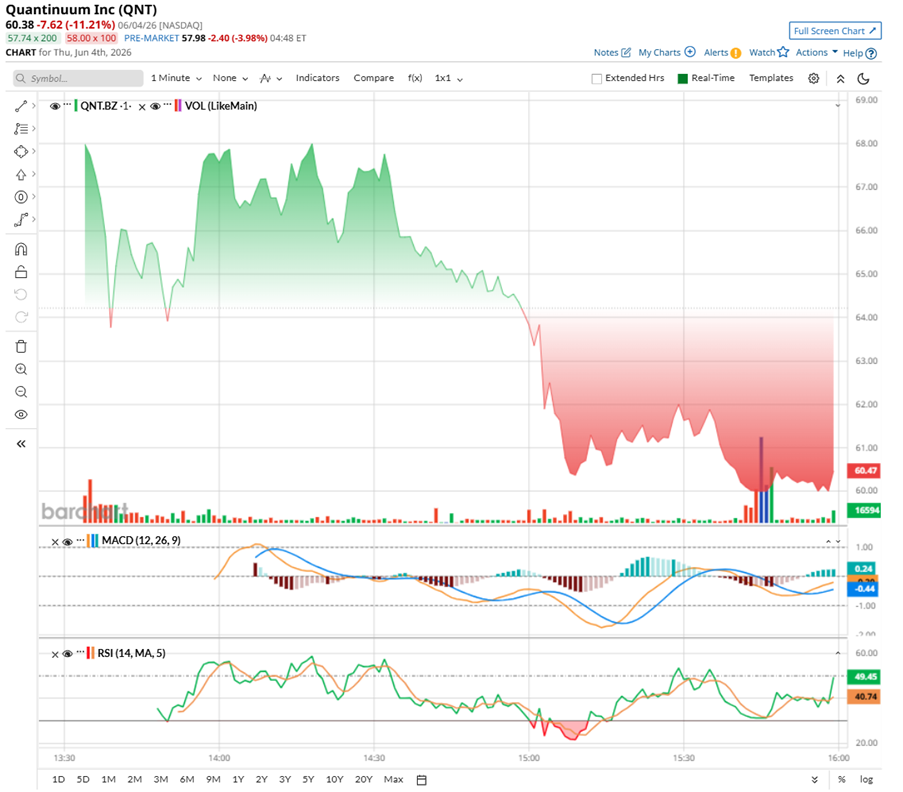
That vision helped fuel massive investor interest when Quantinuum went public this week. The company’s IPO was originally expected to price between $45 and $50 per share – then raised to $53 to $55 apiece – but overwhelming demand pushed the final price to $60. Quantinuum sold 28 million shares, raising nearly $1.7 billion and securing a valuation of more than $15 billion. The stock officially began trading on the Nasdaq on June 4, opening at $68 per share and climbing as high as $71.35 before ending the session largely unchanged.
More Top Stocks Daily: Go behind Wall Street’s hottest headlines with Barchart’s Active Investor newsletter.
The excitement does not stop there. Quantinuum is also set to receive $100 million in planned federal funding to address key manufacturing and technology bottlenecks needed to scale fault-tolerant quantum computers. With a blockbuster IPO now in the books, investors would be wondering – what comes next for QNT stock?
About Quantinuum
Headquartered in Broomfield, Colorado, Quantinuum is the world’s largest integrated quantum computing company, developing advanced quantum hardware and software through its full-stack technology platform. The company has commercially deployed multiple generations of quantum systems built on its proprietary QCCD architecture, achieving some of the highest accuracy levels in the industry. Its technology is being applied across pharmaceuticals, materials science, financial services, government, and industrial markets.
Quantinuum operates globally with offices and research facilities across the U.S., the U.K., Germany, Japan, Qatar, and Singapore. The company employs hundreds of professionals worldwide, with more than 70% of its technology workforce holding PhDs or Master’s degrees. Backed by a deep scientific foundation and an ambitious vision for fault-tolerant quantum computing, Quantinuum has emerged as one of the sector’s most closely watched innovators, with a current market capitalization of roughly $1.9 billion.
And that reputation helped set the stage for its IPO this year.
Quantinuum’s debut on Wall Street initially looked like a victory lap for the quantum computing industry. Shares opened at $68, roughly 13.3% above the IPO price of $60, as investors rushed to gain exposure to one of the sector’s biggest names. The enthusiasm was hardly surprising. Strong demand had already prompted the company to increase its offering from 21 million shares to 28 million shares, helping it raise nearly $1.7 billion and pushing its valuation above $15 billion.
The stock continued climbing after the opening bell, reaching an intraday high of $71.35. For a moment, it appeared that investors were ready to place aggressive bets on the long-term promise of quantum computing. However, the excitement gradually faded as the trading session progressed. Shares surrendered most of their early gains and finished the day at $60.38, just 0.6% above the IPO price. From its intraday peak, the stock retreated 19%.
The trading action highlighted a familiar reality for emerging technologies. Investors remain fascinated by Quantinuum’s long-term potential and leadership in quantum computing, but they also demand proof that today’s lofty expectations can eventually translate into sustainable commercial growth. The IPO was undoubtedly a success, but Wall Street’s verdict on the broader quantum opportunity is still being written.
 www.barchart.com
 A Closer Look at Quantinuum’s Financials and Recent Developments
If Quantinuum's IPO debut showcased investors’ excitement about quantum computing's future, the company's financial results offer a reminder of how expensive that future is to build.
In 2025, Quantinuum generated $30.9 million in revenue, up from $23 million the previous year, reflecting growing commercial interest in its quantum computing and software offerings. The company reported a net loss of $192.6 million in 2025, compared with a loss of $144.1 million in 2024, as it continued investing aggressively in research, engineering talent, and product development. That spending is part of a much larger effort, with Quantinuum and its predecessor organizations investing roughly $2 billion in quantum computing research over the past decade.
The first quarter of 2026 showed that the company is still very much in investment mode. Revenue totaled $5.2 million for the quarter ended March 31, 2026, while net loss widened to $136.6 million. Bookings, a key measure of future business opportunities, reached $79.3 million for full-year 2025, although Q1 bookings slipped to $1.3 million from $1.9 million a year earlier.
Meanwhile, Quantinuum continues expanding beyond the laboratory. The company generates revenue from quantum computing access, software platforms, professional services, and cybersecurity solutions designed to help organizations prepare for a post-quantum world. Its growing customer roster includes JPMorgan Chase (JPM), Airbus (EADSY), BMW (BMWKY), Amgen (AMGN), Mitsui & Co. (MITSY), and the U.K.'s National Quantum Computing Centre.
Most recently, Quantinuum signed a memorandum of understanding with Mitsubishi Electric (MIELY) to explore how quantum computing could be applied to industrial engineering challenges, from computational fluid dynamics to advanced simulations. The partnership underscores a broader theme: while meaningful profits may still be years away, Quantinuum is steadily building the commercial relationships needed to turn quantum computing from a scientific breakthrough into a real-world business.
Final Thoughts on Quantinuum After its IPO
So, what should investors make of Quantinuum after its blockbuster IPO? The answer depends on the amount of faith they have in both the technology and the team building it. There is no shortage of support behind the company. Quantinuum entered the public market backed by heavyweight shareholders, government funding initiatives, major corporate customers, and a growing network of commercial partners. But Thursday’s debut also served as a reminder that while quantum computing may be advancing rapidly, investor confidence is still evolving.
In many ways, the stock still trades like a quantum experiment. The science is becoming more mature, yet Wall Street is still trying to determine what that future is worth today.
Going forward, investors should focus less on daily stock swings and more on the fundamentals of customer adoption, revenue growth, bookings, and progress toward real-world quantum applications. Strong support from Honeywell, federal funding, and strong leadership certainly help, but execution will ultimately decide the outcome.
The IPO may have captured the headlines, but the bigger question is whether Quantinuum can transform quantum computing’s enormous promise into a sustainable, long-term business. QNT's performance from here could also depend on whether Quantinuum can turn its scientific lead into a business that eventually lives up to the industry’s sky-high expectations.
On the date of publication, Sristi Suman Jayaswal did not have (either directly or indirectly) positions in any of the securities mentioned in this article. All information and data in this article is solely for informational purposes. For more information please view the Barchart Disclosure Policy here.
More news from Barchart
Dell Stock Looks Poised to Keep Climbing. Here’s Why. How to Play QNT Stock After the Quantinuum IPO Barchart’s Expert Stock Screener Explains Everything You Need to Know About Options Trading A Veteran Research Firm Issues a Stark Dot-Com Warning for Nvidia Stock