


Halliburton Company (HAL) is one of the world’s largest providers of oilfield services, products, and technology to the energy industry. Headquartered in Houston, the company operates in several countries and serves upstream oil and natural gas producers through its two primary segments: Completion and Production, and Drilling and Evaluation. Halliburton currently has a market cap of around $33.2 billion.
Companies valued at $10 billion or more are generally classified as “large-cap” stocks, and Halliburton Company fits this description perfectly. Halliburton offers a broad range of services, including hydraulic fracturing, cementing, well construction, reservoir evaluation, artificial lift, and digital energy solutions designed to improve drilling efficiency and production performance, strengthening its position in the industry.
More Top Stocks Daily: Go behind Wall Street’s hottest headlines with Barchart’s Active Investor newsletter.
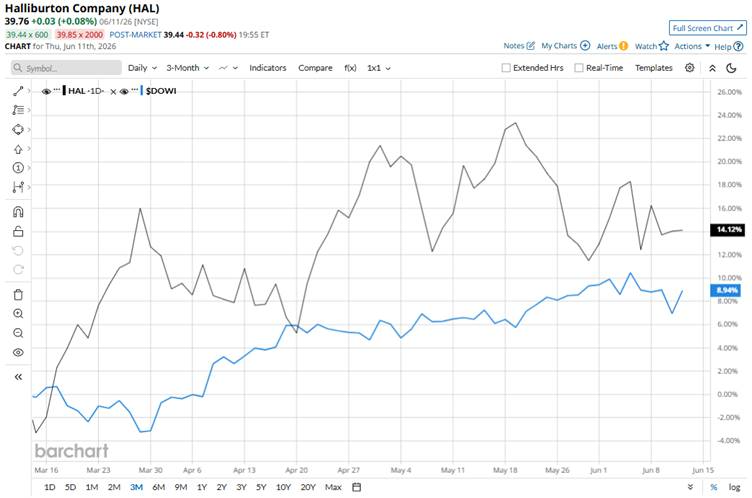
The company’s stock has dropped 8.8% from its 52-week high of $43.59, reached on May 20. Over the past three months, HAL has gained 10.7%, outperforming the broader Dow Jones Industrials Average’s ($DOWI) 7.2% rise.
 www.barchart.com
 In the longer term, HAL surged 40.7% on a YTD basis, compared to the DOWI’s 5.8% increase. Moreover, shares of Halliburton have gained 79.2% over the past 52 weeks, significantly outpacing the DOWI’s 18.6% rise over the same time frame.
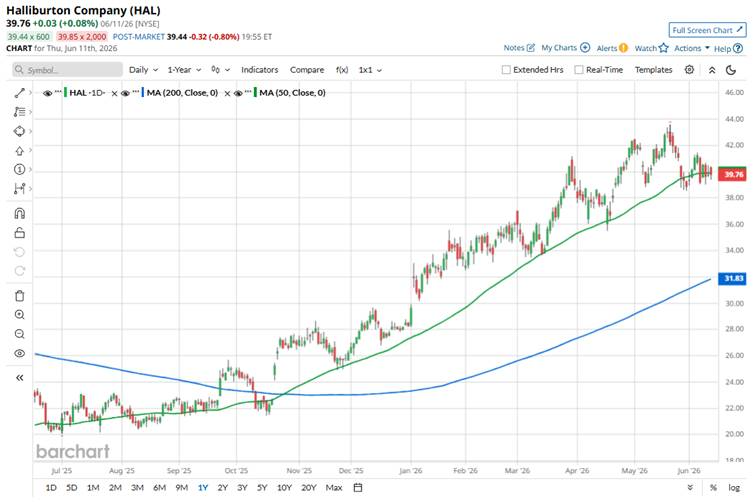
To confirm the bullish momentum, the stock has mostly been trading above the 50-day and 200-day moving averages since mid-October 2025.
 www.barchart.com
 Halliburton stock has climbed over the past year as investors have become more optimistic about a recovery in drilling activity, resilient demand, and the company’s ability to generate strong cash flow despite a volatile energy market.
On Apr. 21, 2026, Halliburton reported first-quarter revenue of $5.4 billion, essentially flat year-over-year (YOY), while earnings per share surged to $0.55 from $0.24 in the prior-year period. The earnings beat Wall Street expectations, and management highlighted early signs of a North American recovery and continued strength in international markets, reinforcing investor confidence in the company’s long-term growth outlook.
Further, in comparison, its rival Baker Hughes Company (BKR) also underperformed HAL. Shares of BKR surged 62.6% over the past 52 weeks and 39.4% on YTD basis.
Analysts remain cautiously optimistic about its prospects. Among the 25 analysts covering the stock, there is a consensus rating of “Moderate Buy,” and its mean price target of $45.04, suggests an upside potential of 13.3%.
On the date of publication, Subhasree Kar did not have (either directly or indirectly) positions in any of the securities mentioned in this article. All information and data in this article is solely for informational purposes. For more information please view the Barchart Disclosure Policy here.
More news from Barchart
Microsoft Stock Trails Rivals in 2026. How to Play MSFT Stock Here. Virgin Galactic Stock Leads Space Stocks Higher Ahead of SpaceX IPO The SpaceX IPO: Why I Think Next Week, Not Friday, Is the Real Event Crocs Stock Has Rallied 45% YTD. Baird Says It’s Not Done Yet.