

Now that the SpaceX (SPCX) IPO is done, will we see a megamerger next? Wedbush analyst Dan Ives estimates there is an 80% chance that Space Exploration Technologies, otherwise known as SpaceX, will merge with Tesla (TSLA) in the next year.
Such a merger would bring both of Elon Musk’s publicly traded companies under the same umbrella, creating a company with a $3.6 trillion valuation, making it the fourth-largest company in the world behind only Nvidia (NVDA), Alphabet (GOOG) (GOOGL), and Apple (AAPL).
More Top Stocks Daily: Go behind Wall Street’s hottest headlines with Barchart’s Active Investor newsletter.
"We believe over the next year that Tesla and SpaceX [will] ultimately merge because I think that's part of the broader plan, specifically when it comes to AI data and all under that Musk ecosystem associated from a control perspective," Ives said.
How would such a merger work? Let’s see.
About SpaceX Stock
SpaceX is coming off the biggest IPO in history. The company, which launches reusable rockets, operates the Starlink satellite internet service, and the artificial intelligence company xAI sought to raise $75 billion in its IPO with a valuation of $1.7 trillion, with shares priced at $135. But the offering was immensely popular, oversubscribed by 4x, and opened at $150. SPCX stock closed at $169.36 on its first day of trading, giving it a market cap of over $2.1 trillion.
In its prospectus, the company projects a total addressable market (TAM) of $28.5 trillion, with $26.5 trillion of that coming from AI, including $2.4 trillion for AI infrastructure and $22.7 trillion for enterprise applications.
But all that comes at a massive premium. At its $169 close on Friday and based on 2025 sales of $18.67 billion, SpaceX is trading at a price-to-sales ratio of 112.5. That’s much higher than even some of the most extreme P/S ratios in the market.
| Company | Trailing P/S ratio |
| SpaceX | 112.5 |
| Palantir Technologies (PLTR) | 62.5 |
| CrowdStrike Holdings (CRWD) | 34.1 |
| Broadcom (AVGO) | 24.7 |
| Applovin (APP) | 27.4 |
Investors are clearly pricing in a lot of expectations for SpaceX, but the profits may be difficult to obtain right away. Building AI infrastructure is an incredibly expensive business, and Goldman Sachs estimates that SpaceX will have negative free cash flow of $105 billion in 2029.
About Tesla Stock
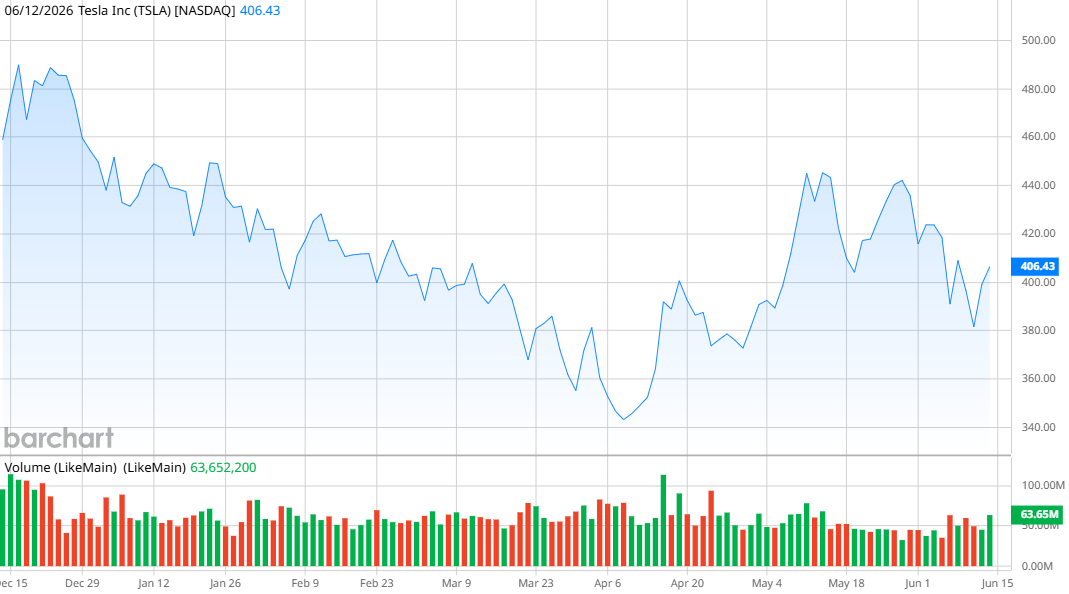
Texas-based Tesla is probably the best known of Musk’s companies, having grown to be the world’s most valuable automaker. Currently with a market cap of $1.5 trillion, Tesla’s electric vehicles are known for their advanced technology, autopilot features, and over-the-air software updates. It gets the majority of its revenue from the Model Y electric SUV and the Model 3 electric sedan.
However, Musk isn’t content to “just” produce electric vehicles. Tesla is also working on full self-driving technology that would allow its customers to make their vehicles available as robotaxis when they aren’t being used. The firm’s supervised version of the FSD technology is currently available for widespread use but still requires that someone be sitting behind the wheel to take over if needed.
Tesla is also continuing to work on its Optimus robot project, which Musk envisions will allow humanoid robots to perform basic tasks in both home and factory settings. The company currently uses some robots in its factories and hopes to make the Optimus robot available to public use late next year.
Tesla plans to produce first-generation Optimus robots at its factory in Fremont, California, replacing the company’s older Model S and Model X vehicle lines. Second-generation Optimus robots will be built at the company’s Texas Gigafactory, which has an annual production capacity of 10 million robots.
Earnings for the first quarter included revenue of $22.38 billion, up 16% from a year ago, with net income of $1.45 billion. Earnings per share were $0.41, up 52% from a year ago.
 www.barchart.com
 Does a Merger Even Make Sense?
It would be challenging to pull off. On the one hand, Tesla and SpaceX rely heavily on artificial intelligence and would benefit from the same training models, and the company could undoubtedly share engineering talent, supply chains, and other resources.
But the companies also have very different markets. Tesla competes in the EV industry, which means investors are very in tune with margins, monthly deliveries, and how the company stacks up against automakers around the world. SpaceX, meanwhile, is primarily a government contractor with its rocket-launching business and satellite internet venture.
While published reports indicate that Musk—as well as his employees—openly speculate that the companies will eventually merge, it would be extraordinarily complex.
But that has never been a blocker for Musk, who seems to relish taking on complex tasks.
"Anyone who's owning SpaceX, you're buying it for the Musk factor," Ives said. “And many that bet against Tesla and Musk going back a decade ago, that was proven historically wrong.”
On the date of publication, Patrick Sanders had a position in: NVDA , PLTR . All information and data in this article is solely for informational purposes. For more information please view the Barchart Disclosure Policy here.
More news from Barchart
Dan Ives Predicts a Tesla-SpaceX Megamerger. Here’s What Investors Need to Know. SpaceX Option Trade Could Return 23% Nasdaq Futures Climb as Chip Stocks Rebound Ahead of First Fed Decision Under Warsh Target Hiked Its Dividend by 1.8%. It’s Not Enough to Change the Thesis for TGT Stock.