


I asked if soybeans were going to trade in the teens in a March 26, 2026, Barchart article, when I concluded with the following:
The wars in Iran and Ukraine are the surprising and compelling factors that could push the beans into the teens in 2026.
Don’t Miss a Day: From crude oil to coffee, sign up free for Barchart’s best-in-class commodity analysis.
The nearby soybean futures contract was at $11.6250 per bushel on March 25, 2026, while the new crop November 2026 contract was at $11.50 per bushel. After rising to $12.14 per bushel on May 13, soybean futures ran out of upside steam.
New crop beans have declined and are near a test of critical technical support
After trading at a 2026 low of $10.5550 per bushel on January 2, 2026, new crop November soybean futures formed higher lows and higher highs.
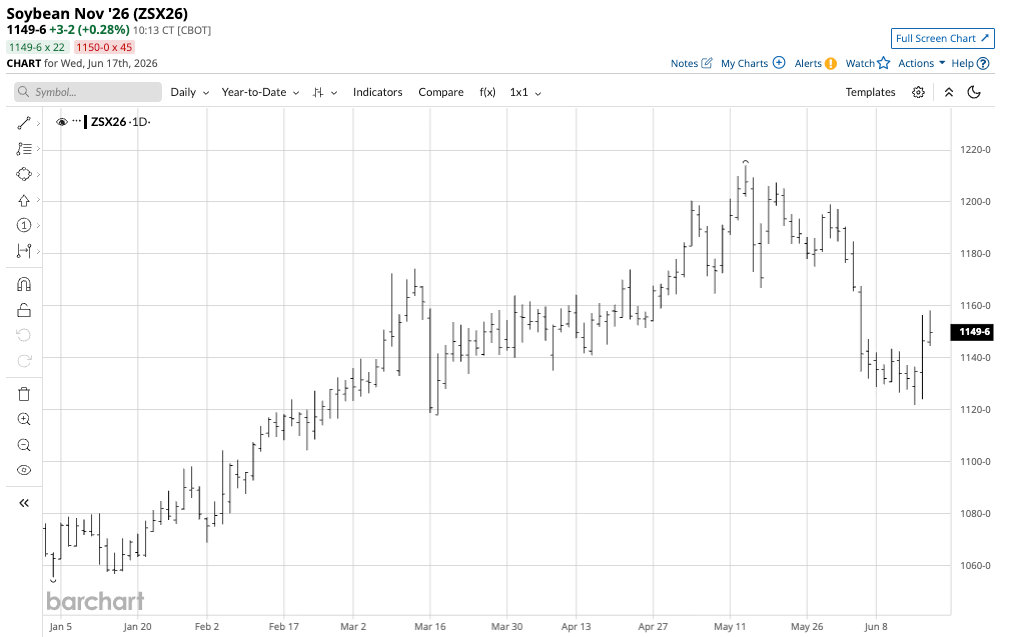
The daily chart shows that the bean futures rallied 15%, reaching a high of $12.14 per bushel on May 13, 2026. The soybean futures lost upside momentum on May 13 and declined to around the $11.50 level on June 17. The first technical support level is at the March 17 low of $11.18 per bushel, which is not far from the June 15 low of $11.2175 per bushel.
The May WASDE said global stocks slightly increased
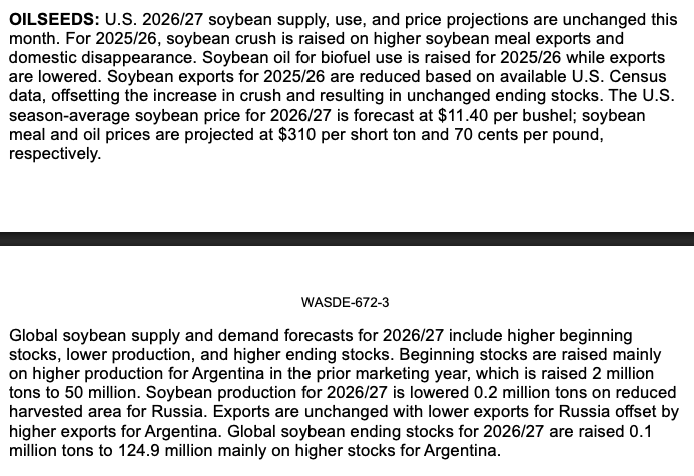
In its June World Agricultural Supply and Demand Estimates Report, the USDA told the soybean market:
 Source: USDA
 As the report states, the USDA left its forecast for U.S. stocks unchanged while slightly increasing its forecast for global ending stocks. The WASDE left its price forecast for soybeans at a season average of $10.40 per bushel in 2026/2027. The WASDE said its forecast was $310 per ton for soybean meal and 70 cents per pound for soybean oil.
Why the Middle East conflict was critical for bean prices
The hostilities in the Middle East and the closure of the Strait of Hormuz had lifted crude oil and oil product prices. Brent crude oil is the benchmark for Middle Eastern crude oil and is the primary feedstock for refining petroleum into distillate products. Heating oil futures trade on the CME’s NYMEX division and are a proxy for other distillates, including jet and diesel fuels.
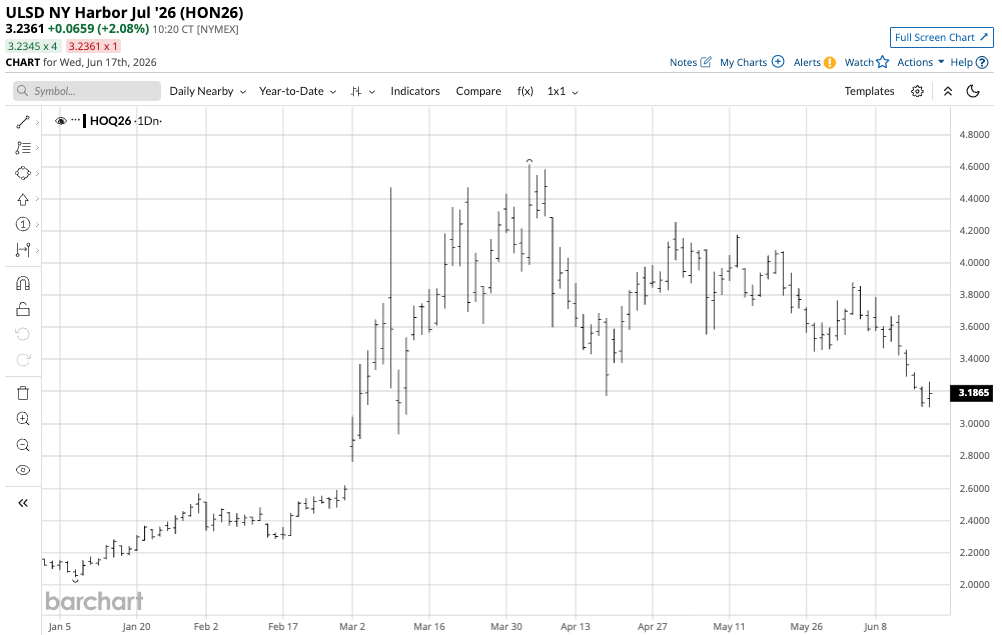
The daily year-to-date continuous contract chart of NYMEX heating oil futures shows that the price more than doubled from the January 7, 2026, low of $2.0469 to the April 2, 2026, high of $4.6130 per gallon wholesale. At over $3.20 per gallon in June 2026, the medium distillate proxy remains substantially higher than in June 2025.
Soybean oil is the primary ingredient in biodiesel. Demand for biofuel has skyrocketed as distillate prices soared.
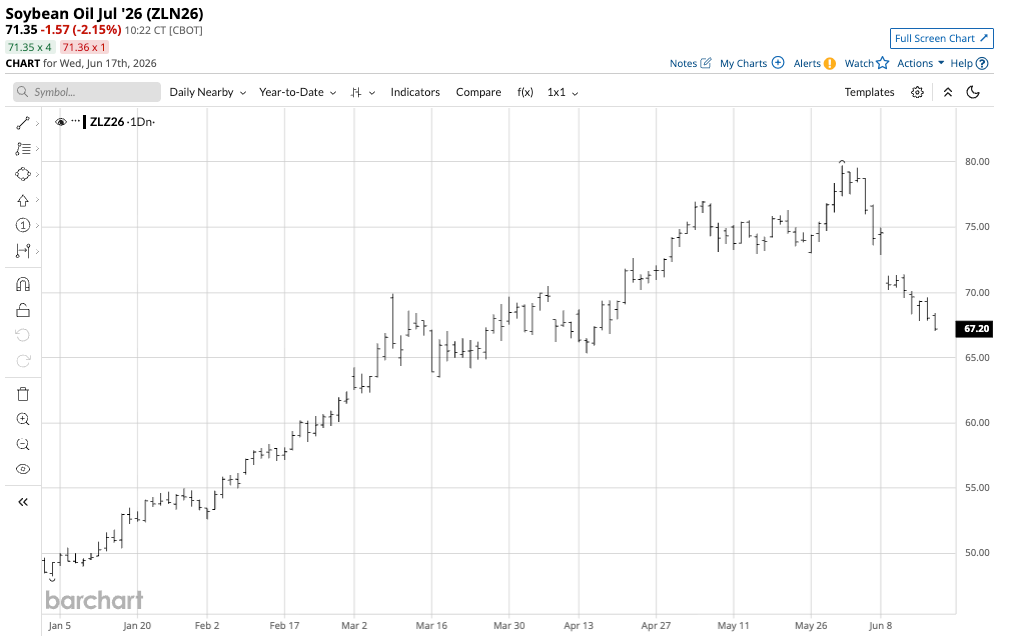
The daily year-to-date continuous contract chart of CBOT soybean oil futures shows that the price exploded from the January 2, 2026, low of 48.28 cents to the June 1, 2026, high of 79.69 cents per pound. At nearly 71.50 cents per pound on June 17, 2026, the bio diesel ingredient remains significantly higher than in June 2025, when the peak price was 56.47 cents.
Meanwhile, fertilizer prices and supplies have also been significantly affected by the conflict in the Middle East. Rising fertilizer prices and supply shortages increase the production cost for soybeans and all agricultural commodities.
The bottom line is that the situation in the Middle East and the region’s critical logistical routes will determine the path of soybean oil prices, which are closely tied to new-crop soybean futures prices. While a peace agreement appears to be on the horizon, there are no guarantees.
The technical levels to watch
CBOT soybean futures reached an all-time high in September 2012 at $17.89 per bushel.
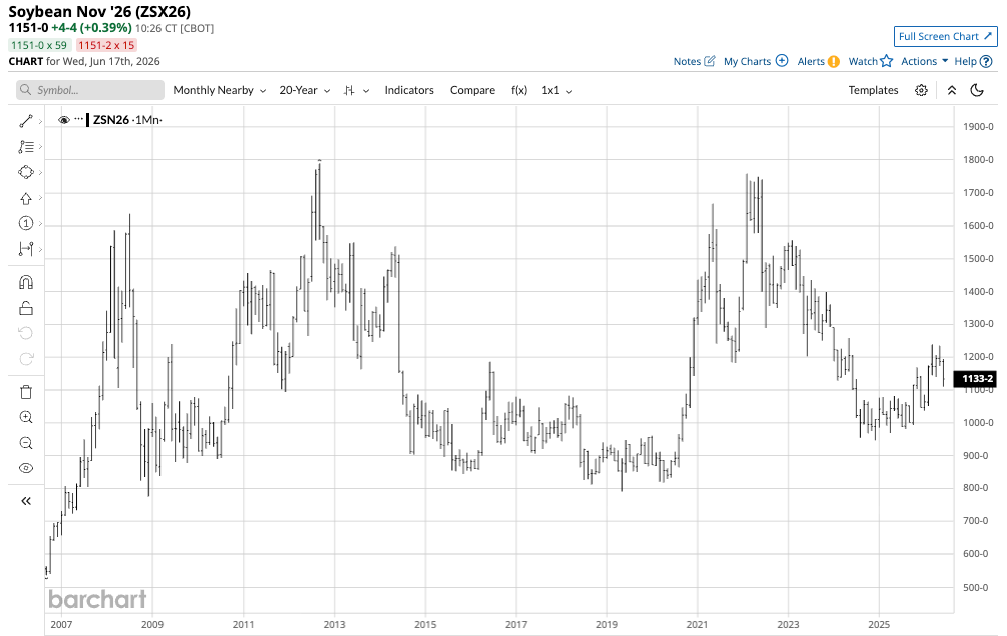
The 20-year monthly chart shows that the beans rose to a slightly lower high of $17.5925 in 2022, when Russia invaded Ukraine and grain and oilseed prices soared. After making lower highs and lower lows until late 2024, the soybean futures bottomed in December 2024 at $9.47 per bushel. The Middle East conflict pushed the price to $12.3875 per bushel in March 2026, marking the first technical resistance level. Above there, the May 2024 high of $12.5825 is the next upside target.
The first technical support level is at the August 2025 low of $9.8125 per bushel.
SOYB tracks a portfolio of CBOT soybean futures, including the new-crop November contract
The most direct route for a long or short position in soybeans is through the CME’s CBOT futures and options contracts. The exchange also provides futures and options contracts on soybean products: soybean meal and soybean oil.
While soybean and soybean products are components of agricultural and other commodity ETFs such as DBA, DBC, GSG, and others, the Teucrium Soybean ETF (SOYB) is the only pure, dedicated ETF tracking a portfolio of three CBOT soybean futures contracts, excluding the nearby contract to minimize roll risk.
At $24.43 per share, SOYB had $60.85 million in assets under management. SOYB trades an average of over 139,000 shares per day and charges a 0.83% management fee. Since the most price volatility tends to occur in the nearby futures contract, SOYB often underperforms the nearby soybean futures contract during rallies and outperforms during price corrections.
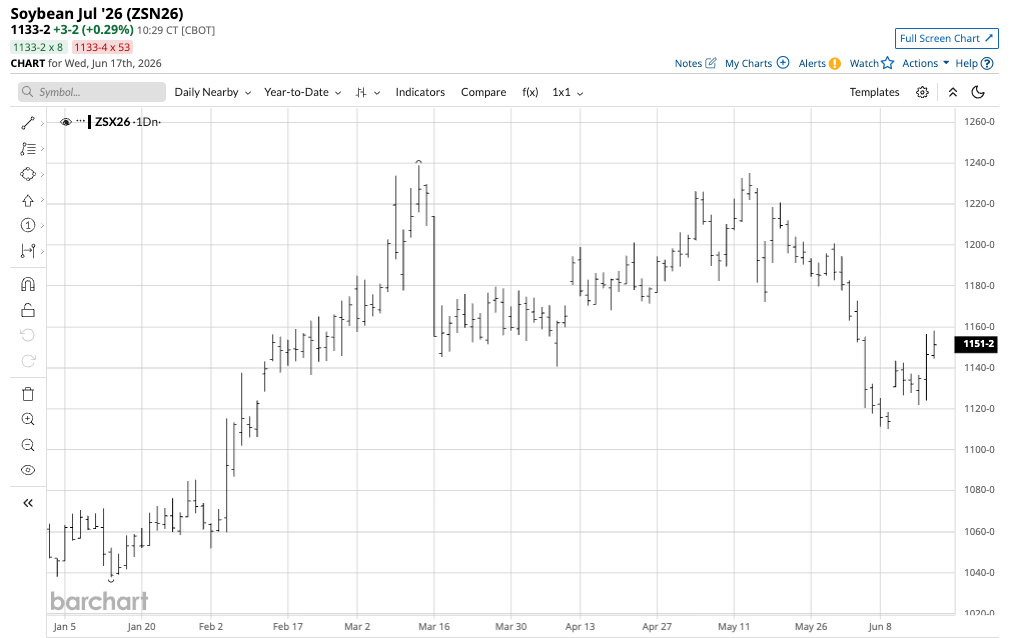
In 2026, the continuous soybean futures contract rose 19.4% from the January 13 low of $10.3775 to the March 12 high of $12.3875 per bushel and fell 10.4% to a low of $11.1025 on June 9.
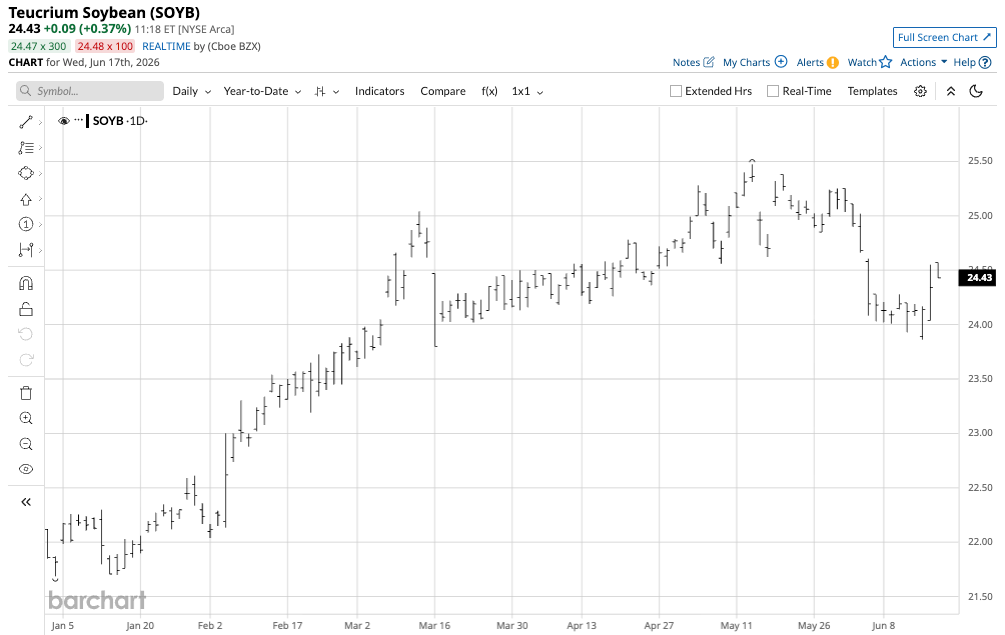
As SOYB holds three soybean futures contracts excluding the nearby contract, the ETF rose 17.4% from the January 2, 2026, low of $21.69 to the May 13 high of $25.47 per share. The latest correction took SOYB 6.3% lower to a $23.86 per share low on June 15.
SOYB underperformed the nearby soybean futures contract on the upside and outperformed during the downside correction.
The weather over the coming weeks and months during the 2026 growing season is critical for the path of least resistance of CBOT soybean and soybean product futures. However, the situation in the Middle East adds complexities beyond the weather and crop to the soybean market, which could cause sudden price volatility.
On the date of publication, Andrew Hecht did not have (either directly or indirectly) positions in any of the securities mentioned in this article. All information and data in this article is solely for informational purposes. For more information please view the Barchart Disclosure Policy here.
More news from Barchart
Is the 2026 Soybean Rally Over? Ignore the Bounce. Cotton Prices Are Still Headed Lower. Why Soybean Meal Is a Value Buy Here as Prices Rebound Rain in the Plains Make Grain, So Bears Are in Control of Corn, Soybean, and Wheat Prices Now