

Artificial intelligence (AI) has been the biggest investing story over the past three years. Despite the demand, AI stocks treaded some rough waters this year as investors kept rotating out of them due to overvaluation and concerns over massive capital expenditures. While the AI boom still appears to have years of growth ahead, some investors remain skeptical of buying the hottest AI stocks like Micron (MU) and SanDisk (SNDK) after their massive rallies this year.
For those investors, exchange-traded funds, or ETFs, that invest in industries enabling AI offer a much better option. Here are three such ETFs that stand out:
More Yield, Less Trap: Sign up free to get Barchart’s daily Dividend Investor newsletter straight to your inbox.
AI ETF #1: The State Street Utilities Select Sector SPDR ETF (XLU)
AI cannot run without electricity. With the rapid expansion of AI data centers, power generation has become the biggest bottleneck. Training advanced AI models consumes enormous amounts of electricity. By 2035, data centers are expected to account for 10% to 20% of U.S. electricity consumption, creating a multi-year investment opportunity for utility companies.
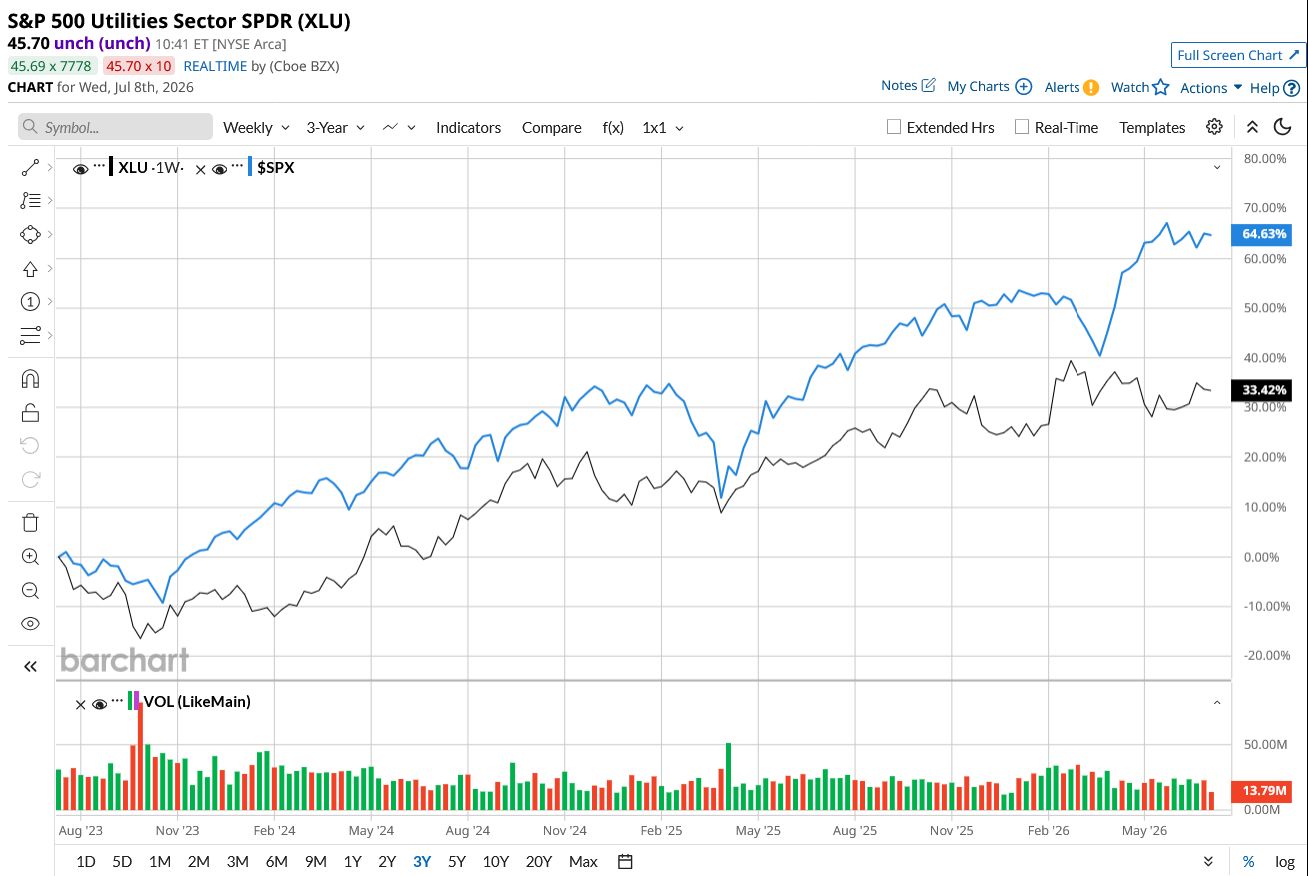
The State Street Utilities Select Sector SPDR ETF (XLU) primarily holds regulated utility companies, with electric utilities accounting for 65.8% of the portfolio. These companies generate relatively predictable cash flows as they provide essential services and use regulated pricing structures.
XLU has returned over 36% in the last three years but is up just 7% year-to-date (YTD), trailing the broader market.
 www.barchart.com
 Many of the fund’s largest holdings include energy companies such as NextEra Energy (NEE), Southern Company (SO), Duke Energy, Vistra (VST), and Constellation Energy (CEG). The Utilities Select Sector SPDR Fund also stands out for its low 0.08% expense ratio, which helps investors retain more of their long-term returns. This ETF offers investors a way to capitalize indirectly on the AI trend without paying premium valuations for AI chipmakers. Another advantage of this ETF is that even if AI enthusiasm temporarily cools down, electricity demand is unlikely to decline. This makes the ETF an appealing option for investors seeking AI exposure with lower portfolio volatility.
AI ETF #2: U.S. Digital Infrastructure and Real Estate ETF (IDGT)
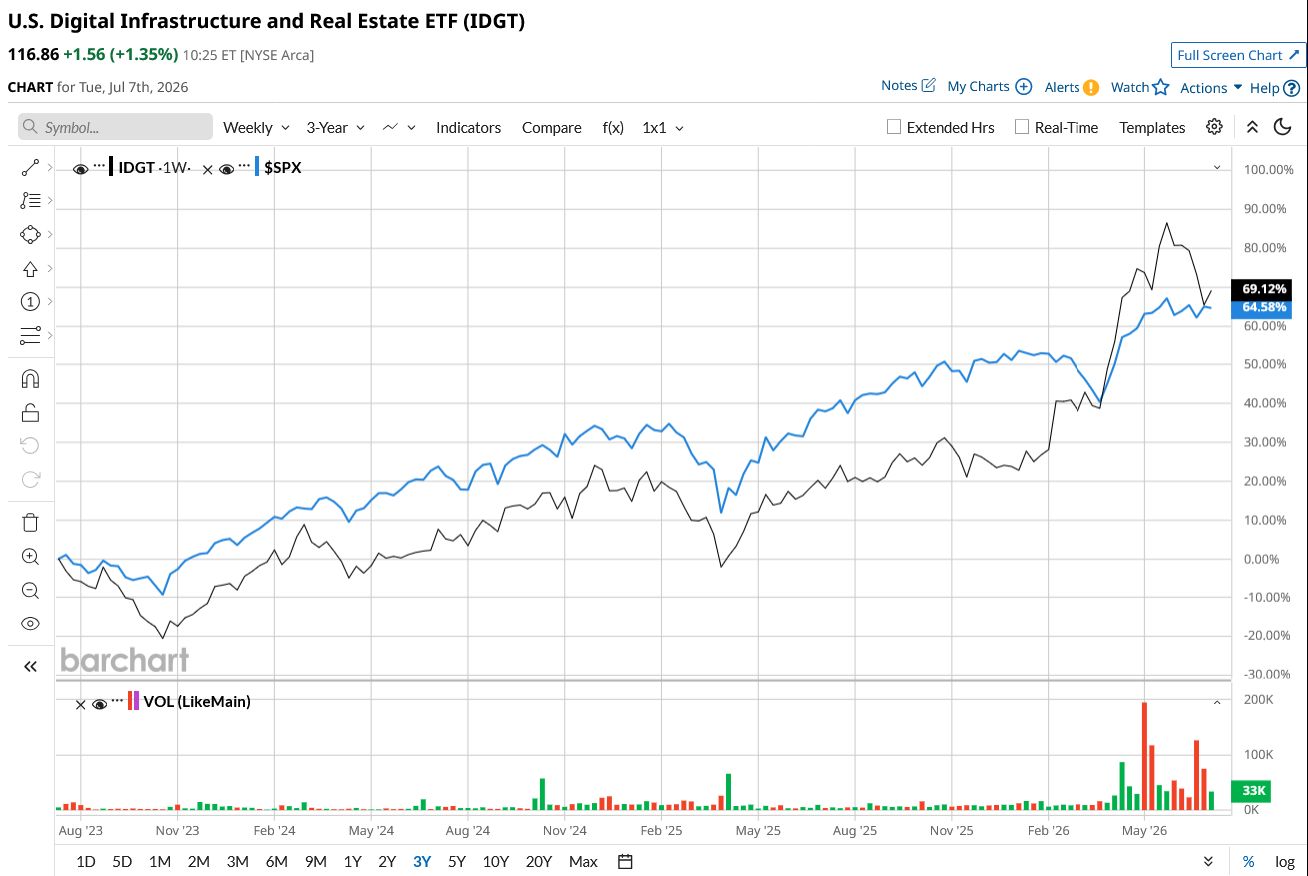
Like electricity, AI cannot function without massive networks of data centers, fiber-optic cables, communication towers, and specialized real estate. The iShares U.S. Digital Infrastructure and Real Estate ETF (IDGT) invests in companies that own, develop, and operate these critical assets. Instead of investing directly in AI, this ETF gives investors exposure to the physical infrastructure that supports nearly every major tech company. Its portfolio includes data center REITs, communications infrastructure companies, and fiber network operators.
IDGT has returned around 68% in the last three years. It has also surged 36% so far this year, outperforming the broader market.
 www.barchart.com
 Some of its holdings include Digital Realty Trust REIT (DLR), Arista Networks (ANET), Qualcomm (QCOM), Crown Castle (CCI), and SBA Communications REIT (SBAC), among others. The ETF charges an expense ratio of 0.39%. While this is high, it reflects the cost of tracking a specialized portfolio focused on digital infrastructure and real estate companies that benefit from the AI buildout. The most appealing feature of this ETF is diversification, as it spreads exposure across multiple industries involved in digital infrastructure.
AI ETF #3: Global Infrastructure IShares ETF (IGF)
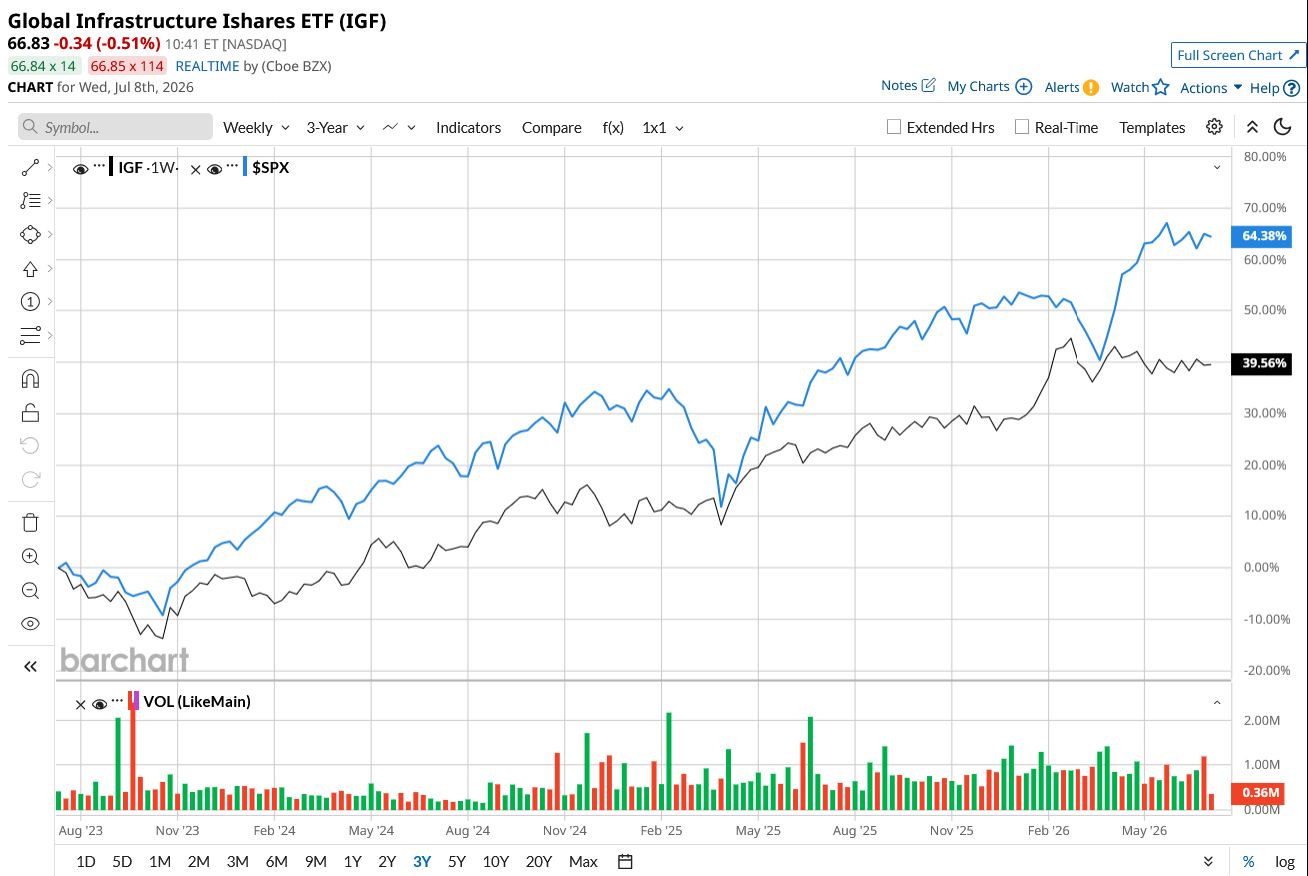
Beyond data centers, AI infrastructure includes transmission lines, power grids, transportation networks, energy facilities, pipelines, and industrial assets. And the iShares Global Infrastructure ETF (IGF) provides exposure to many of these essential industries. The ETF invests globally across utilities, energy infrastructure, transportation, airports, toll roads, railways, and communications companies.
IGF has returned a little over 40% over the last three years and is up 9% YTD.
 www.barchart.com
 Some of these industries might appear unrelated to AI. But the AI revolution is creating one of the strongest infrastructure investment opportunities in decades. Construction materials, engineering services, and logistics companies all benefit from these large-scale developments related to AI data centers. Some of the ETF’s key holdings include Enbridge (ENB), NextEra Energy, Auckland International Airport (ACKDF), and Williams Inc. (WMB), among others.
An appealing feature of this ETF is global diversification. The ETF gives investors exposure not only to U.S. stocks but also to infrastructure assets across multiple countries. It offers investors a chance to participate in worldwide infrastructure spending fueled by AI adoption. The IGF ETF carries an expense ratio of 0.39%. While it is also high, investors gain diversified exposure to infrastructure companies across multiple countries and sectors in return, making the fee relatively reasonable for a niche global ETF.
On the date of publication, Sushree Mohanty did not have (either directly or indirectly) positions in any of the securities mentioned in this article. All information and data in this article is solely for informational purposes. For more information please view the Barchart Disclosure Policy here.
More news from Barchart
AI Stocks Look Expensive. These 3 ETFs Could Help Investors Stay in the Game. Stop Wasting Time. Here's the Workflow to Find Trades Before Everyone Else. This ETF Promises to Protect Your Portfolio with High-Quality Stocks, But Its Chart Is Waving a Yellow Flag These 3 Niche ETFs Might Just Buck A Bear Trend