

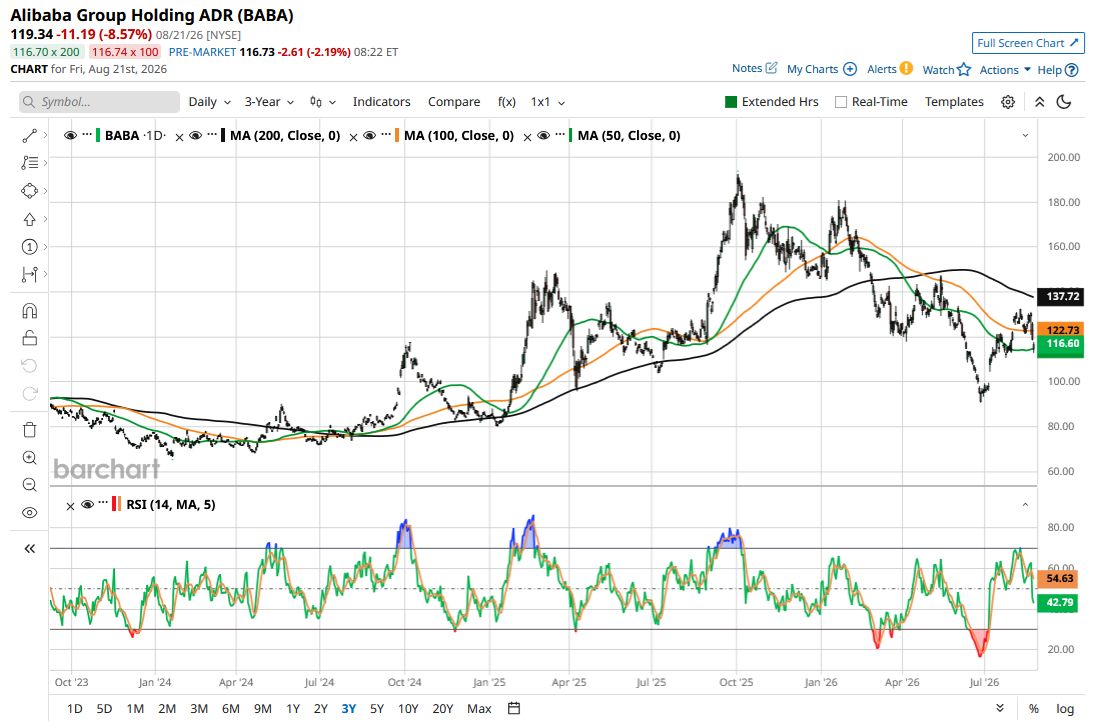
Alibaba (BABA) stock fell over 8.5% on Friday after the company announced a massive share sale in Hong Kong to fund its artificial intelligence (AI) investments. The company issued 710 million new shares to raise $10.21 billion in what was the largest-ever primary follow-on offering from a company listed in Hong Kong.
Alibaba priced the shares at an 8.4% discount to its last traded price in Hong Kong. To be sure, pricing the shares below the prevailing prices is a norm rather than an exception in such offerings, and in June, Alphabet (GOOG) (GOOGL) priced its shares at a discount of over 6% as it raised $80 billion in what was the biggest follow-on stock sale this year. Incidentally, even Berkshire Hathaway (BRK.A) (BRK.B), whose chair, Warren Buffett, is known for his value investing credentials, put $10 billion in that offering and overall put $17 billion in the search giant in Q2, which made it the conglomerate’s third-biggest holding.
More Top Stocks Daily: Go behind Wall Street’s hottest headlines with Barchart’s Active Investor newsletter.
Burry Is Critical of Alibaba's Stock Sale
To be sure, I am not too surprised by Alibaba’s share sale, as tech companies would need to shore up finances for their burgeoning AI capex, which has only been going upwards. However, Michael Burry of “The Big Short” fame has opposed Alibaba’s stock sales and said, “Issuing shares is now its new paradigm.” He also said that he exited Alibaba a few months back and switched to Chinese e-commerce rival JD.com (JD). In his post on X, Burry said that BABA would need to fall by 50% from these levels for him to consider investing in the stock.
 www.barchart.com
 Notably, this is not the first time Burry has made a bold claim or criticized an AI company. In November 2025, he accused tech giants of accounting fraud by understating their depreciation by extending the useful life of their computing assets, predominantly Nvidia (NVDA) chips. He particularly called out Oracle (ORCL) and Meta Platforms (META) for overstating earnings by 26.9% and 20.8%, respectively, by 2028.
It's no secret that tech companies’ current free cash flows are not enough to fund the spending spree, and they have been looking at funding mechanisms to build the war chest. Looking at U.S. tech companies, Amazon (AMZN) did a $25 billion debt offering last month, and Meta Platforms also sold debt worth a similar amount earlier this year. Apart from its equity issuance, Alphabet has also been scouting global markets for debt issuance.
I would argue that raising debt and equity is a “cleaner” source of capital. What’s worrisome is the off-balance-sheet financing, which remains hidden from the headline numbers but remains a potent risk. For instance, a Nikkei study showed that U.S. tech giants have a hidden debt of $1.65 trillion, with the number rising eightfold over the last four years. That number might have increased since that July report, as Nvidia has been doing such transactions for some of its customers in what looks like an apparent bid to buy revenue.
Alibaba's Profits Have Plunged Due to AI Capex
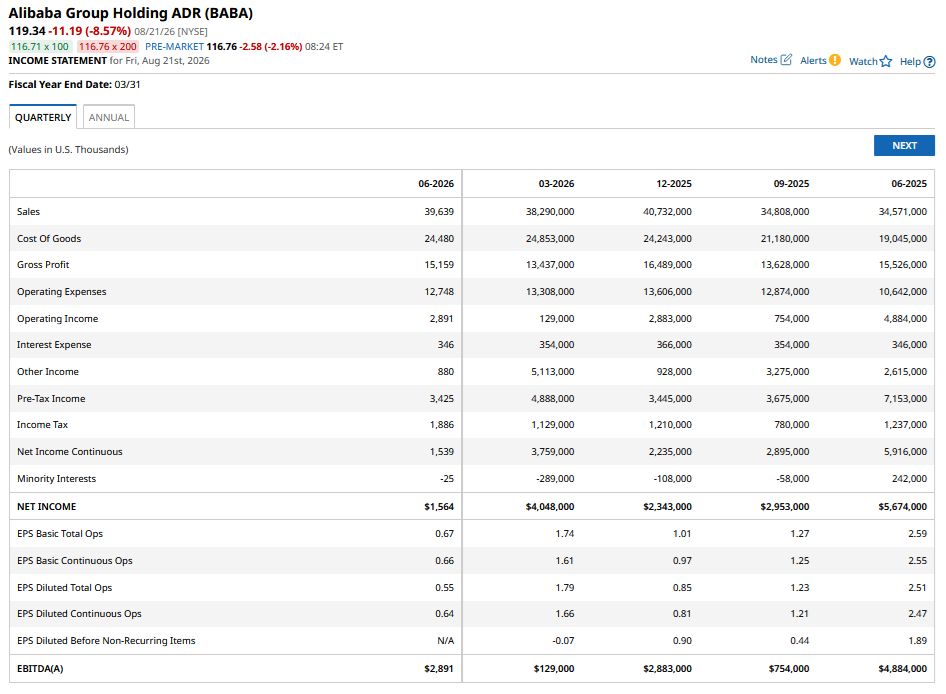
Coming back to Alibaba, its recent earnings have been no different from U.S. tech giants', with AI driving demand for cloud services while capex takes a toll on profitability. In the June quarter, the cloud segment’s external revenue rose 45% year-over-year (YoY), with the growth accelerating from the previous quarter and rising to an almost six-year high. The segment’s external EBITA rose 133% YoY in the quarter.
 www.barchart.com
 Within the cloud segment, AI-related revenues rose by triple digits for the 12th consecutive quarter and are running at an annualized revenue run rate of $7.3 billion. The company said that AI-related products and services have a higher margin, and their share in external cloud revenues rose to 35% in the June quarter. It is optimistic about hitting external cloud revenues of renminbi (RMB) 100 billion (almost $15 billion) by 2030 and sees “good visibility” on its gross margin hitting 20%.
Alibaba is among the most notable AI plays in China, offering full-stack operations as well as models, cloud services, and chips. The company has been touting its full-stack AI ecosystem as its competitive advantage, and in his prepared remarks in the fiscal Q1 2027 earnings release, CEO Eddie Wu said, “With our full‑stack AI strategy, we have put Alibaba in a superior position to capture the substantial growth of demand for artificial intelligence and AI compute.”
Meanwhile, for now, Alibaba has been in the penalty box amid concerns over a slowdown in China’s retail sales, which is a headwind for the company’s e-commerce operations. Also, its profitability has nosedived amid growing AI investments.
Should You Wait for a 50% Crash in BABA Stock?
Alibaba is currently going through a transition period where AI investments and quick commerce business ramp-up are taking a toll on its profitability. However, I am in the camp that believes that these two businesses will drive long-term growth, especially as the e-commerce business is maturing. Overall, I wouldn’t wait for Alibaba to fall 50% from here and would use the current dip to add to my positions.
On the date of publication, Mohit Oberoi had a position in: BABA , GOOG , AMZN , META , NVDA . All information and data in this article is solely for informational purposes. For more information please view the Barchart Disclosure Policy here.
More news from Barchart
Why Wolfe Research Just Named Nvidia Stock Its Top AI Pick Michael Burry Says He Would Buy Alibaba Stock When It Crashes 50%. You Shouldn’t Wait That Long. Nvidia Scored an H200 Win in China, But These Analysts Warn It May Not Be a Reason to Buy NVDA Stock Applied Materials Drops 34%. Here’s Why You Should Buy the Dip in AMAT Stock.