

Wall Street keeps asking Meta Platforms (META) the same question: When will all the AI spending start paying for itself? A fresh note from BNP Paribas offers part of the answer. After meeting with Meta executives, the firm walked away convinced the company has “significant” opportunities to make money from its massive computing power. BNP Paribas maintained an “Outperform” rating on META stock with an $855 price target, considerably higher than Meta’s current share price of around $566.
The more interesting detail, though, is how Meta plans to do it. Management told BNP that selling “intelligence” — meaning AI models, agents, and finished products — is far more profitable than renting out compute. In other words, Meta would rather sell the smart output of its data centers than the data centers' horsepower itself. Renting compute is just a backup plan for Meta, in case its own needs come in lower than expected. As I covered previously, this ties back to Meta’s cloud ambitions. The company has been reportedly building a unit to sell its spare computing power, and CEO Mark Zuckerberg has called the idea “definitely on the table.”
More Top Stocks Daily: Go behind Wall Street’s hottest headlines with Barchart’s Active Investor newsletter.
All this matters because of how much Meta is spending. The company plans to invest between $130 billion and $145 billion this year. As a result, its free cash flow has collapsed, falling more than 90% last quarter. Revenue is still growing fast, rising 28% in the June quarter, but investors are nervous about a company pouring almost every dollar it earns back into data centers.
But that nervousness may be the opportunity. Meta’s core ad business is still growing rapidly, and it has multiple ways to eventually monetize its compute. BNP Paribas being more convinced that the payoff is coming after meeting management also says something. For investors willing to look past the heavy spending, a strong company being discounted over that same spending is exactly the kind of setup that tends to reward patience.
The Discount Is the Opportunity
Unlike most AI-heavy names, Meta actually looks inexpensive against its own history. The forward price-to-earnings (P/E) ratio of 19 times sits below its five-year average of 22 times. Meanwhile, the price-to-sales (P/S) ratio of 6.9 times is roughly in-line with its five-year average. In other words, the market is discounting Meta even as revenue continues to climb.
This directly reflects investors' concerns around the company’s aggressive AI spending. The EPS outlook explains part of the caution. Analysts expect a modest drop of 4% in fiscal 2026 as spending reduces margins, followed by 21% earnings growth to $34.47 per share in fiscal 2027. Meanwhile, the balance sheet remains unproblematic. Meta holds roughly $90 billion in cash against $84 billion in debt, a manageable load given Meta’s cash generation.
Meta's below-average earnings multiple is where the opportunity sits. If the forward P/E simply returned to its historical average, META stock would rise to the $700 to $750 level. That would happen without the business doing anything beyond what the market already expects. I therefore see that price level as a reasonable target for META stock. If the AI spending starts producing clear returns, whether through selling intelligence or renting compute, Meta's earnings multiple could expand further and push shares even higher.
About Meta Platforms Stock
Meta Platforms is a technology company that owns and operates some of the world’s largest social media and messaging platforms, including Facebook, Instagram, Messenger, and WhatsApp. The company generates most of its revenue from digital advertising across these apps. Meta is also investing heavily in virtual reality, augmented reality, and mixed reality technologies through its Reality Labs division. The company was founded in 2004 and is headquartered in Menlo Park, California.
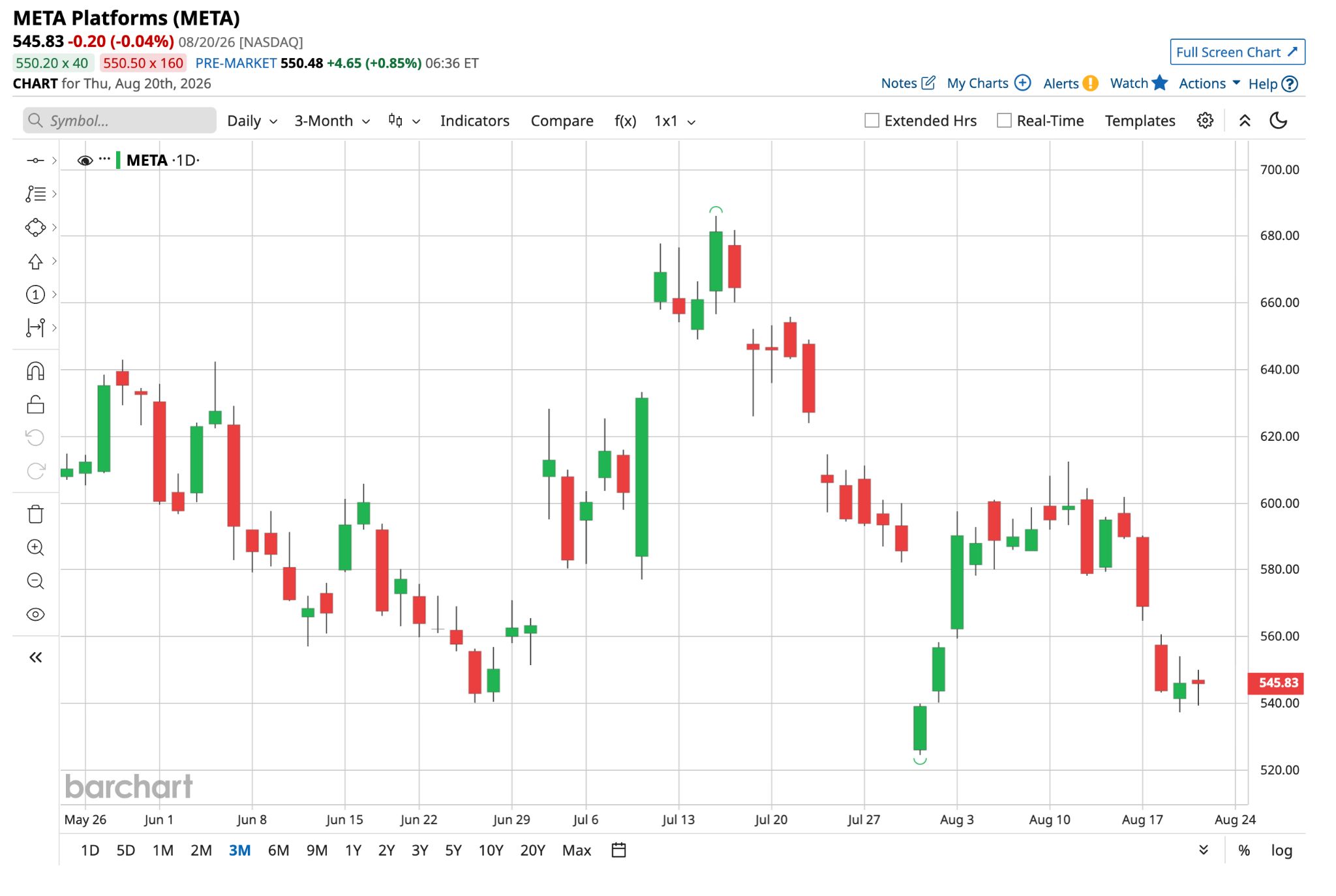
Over the past year, META stock has declined almost 25%, underperforming the S&P 500’s ($SPX) gain of approximately 19% during the same period. The primary reason behind the weakness has been concerns over aggressive AI spending. The trend has continued this year as well, with META stock falling 15% year-to-date (YTD) while the index has generated returns of 12%.
 www.barchart.com
 AI Infrastructure Spending Remains the Key Story
Meta Platforms reported second-quarter fiscal 2026 earnings on July 29. The company reported stronger-than-expected quarterly results, with revenue of $60.8 billion, up 28% year-over-year (YOY) and above the $60.2 billion forecast. Family of Apps revenue was $60.4 billion, Family of Apps ad revenue was $59.4 billion, Reality Labs revenue was $431 million, and other revenue was $1 billion. Diluted EPS came in at $6.18, down 13% YOY and missing the Wall Street consensus estimate of $7.17. The company incurred total expenses of $42 billion for Q2, up 55% YOY, while capital expenditures were $31.1 billion, including principal payments on finance leases.
Looking forward, Meta guided Q3 revenue to a range of $61 billion to $64 billion. The company said foreign exchange would be a roughly 1% headwind to YOY growth at current rates. For full-year 2026, Meta raised the lower end of its expense outlook to $165 billion to $169 billion, citing a $2.4 billion legal charge. The firm also narrowed its capex guidance to $130 billion to $145 billion, up from a prior range of $125 billion to $145 billion.
What Do Analysts Expect for META Stock?
In July, Citi analyst Ronald Josey reiterated a “Buy” rating on META stock and assigned a price target of $850, citing Meta’s strong performance and ongoing advertising momentum. The company’s quarterly results exceeded expectations, driven by growth in ad impressions and pricing. In addition, Bernstein analyst Mark Shmulik maintained an “Outperform” rating with a price target of $800.
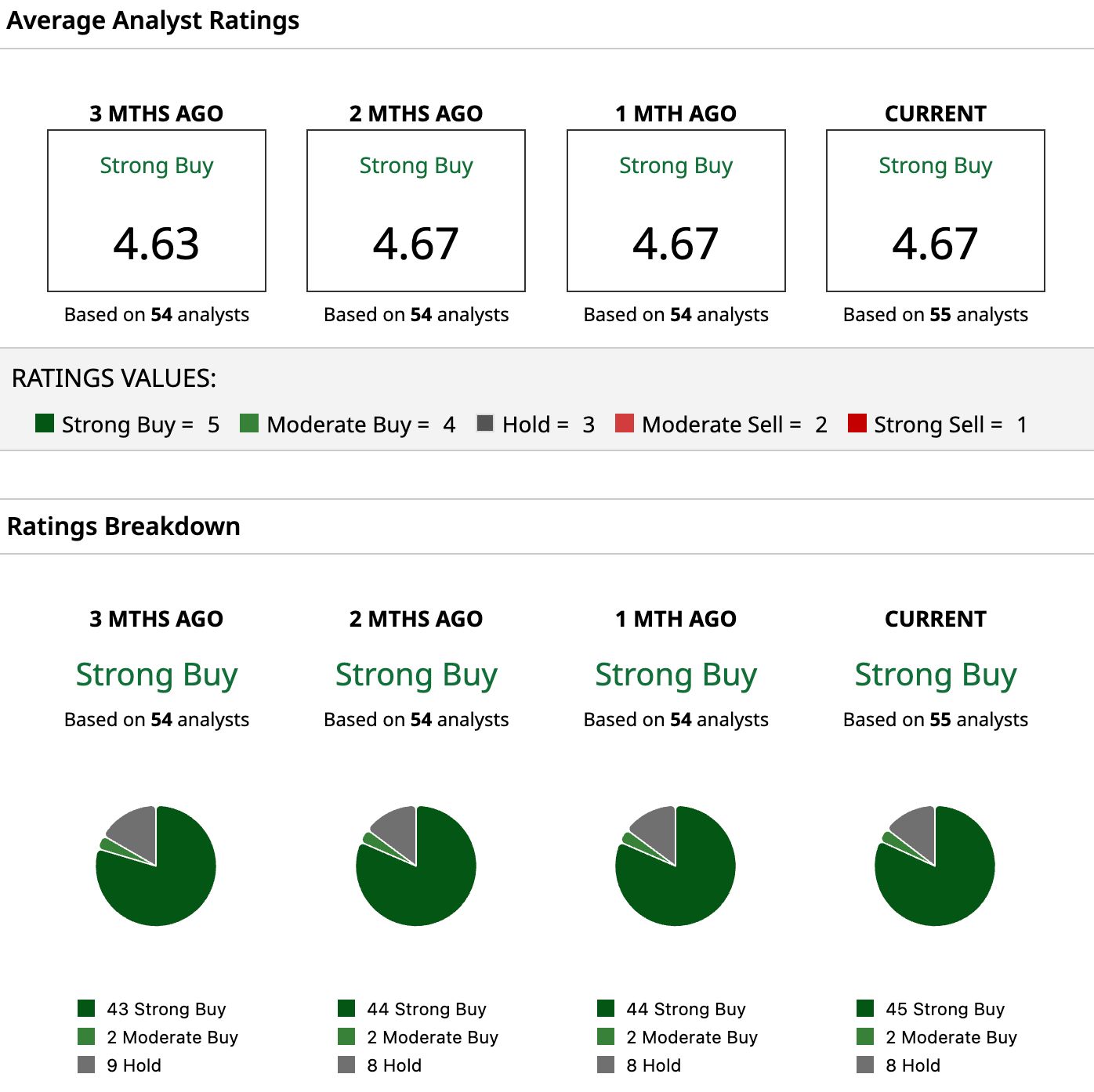
Based on 55 Wall Street analysts with coverage, Meta Platforms holds a consensus “Strong Buy” rating. The mean price target of $750.37 reflects 33% potential upside from current levels, while the high price target of $1,000 implies impressive potential upside of 77% from here. While investors remain concerned about elevated spending, Wall Street largely views the current pressure on profitability as a temporary consequence of Meta’s efforts to strengthen its competitive position in AI.
 www.barchart.com
 On the date of publication, Jabran Kundi did not have (either directly or indirectly) positions in any of the securities mentioned in this article. All information and data in this article is solely for informational purposes. For more information please view the Barchart Disclosure Policy here.
More news from Barchart
RZLV Stock Jumps as Google Picks Rezolve AI's Distributed Database Technology for Google Cloud Meta’s $145 Billion Spending Scare Just Opened a Window for Investors. Here’s How High the Stock Could Go. BB Stock Alert: What to Know as Blackberry Doubles Down on Robotics AAPL Stock Alert: What to Know as Apple Unveils New Mac Models With AI Upgrades