


Most companies would love to be in the position that Applied Optoelectronics (AAOI) is in, but there’s an issue worth noting. A maker of optical parts for artificial intelligence (AI) data centers, Applied Optoelectronics just posted a record quarter. Revenue surged 86% from a year ago, and management guided the next quarter to be even higher. Yet the more interesting story, I believe, isn’t the growth it just delivered but rather what’s coming next.
U.S. regulators are reportedly planning to ban new Chinese-made optical transceivers, the components that move data between AI chips at high speed. If that goes through, U.S. buyers will need non-Chinese suppliers — and Applied Optoelectronics happens to be one of the largest suppliers based in the United States. On its recent earnings call, management said customers are already redirecting more orders to the company. Let's take a closer look.
More Top Stocks Daily: Go behind Wall Street’s hottest headlines with Barchart’s Active Investor newsletter.
Why Is a Potential China Ban an Issue for Applied Optoelectronics?
Here’s the problem: Applied Optoelectronics is already sold out. Management said that demand is running ahead of what it can produce through mid-2027, with factories booked solid until the second quarter of next year. Its growth is capped not by how much customers want, but by how much it can build. A flood of new orders from a China ban would land on a company that already can’t make enough. So, the story here is really about the race to add capacity.
Applied Optoelectronics is spending heavily to expand. It’s aiming to lift production to over 650,000 of its high-end units per month by the end of 2026 and more than 930,000 by the end of 2027. More than half of that will come from its Texas operations. The company has raised more than $530 million through a stock sale to help fund the expansion.
For Applied Optoelectronics, the bull and the bear cases rest on the same question. If the company builds fast enough, it walks into a protected U.S. market with demand it can finally meet. If it can’t, every order it turns away is one a competitor takes instead.
About Applied Optoelectronics Stock
Applied Optoelectronics engages in the design, manufacture, and sale of fiber-optic networking products. The company designs and manufactures components such as optical modules, lasers, transceivers, amplifiers, and other networking equipment that enable high-speed internet and data communication. Founded in 1997, the company is headquartered in Sugar Land, Texas.
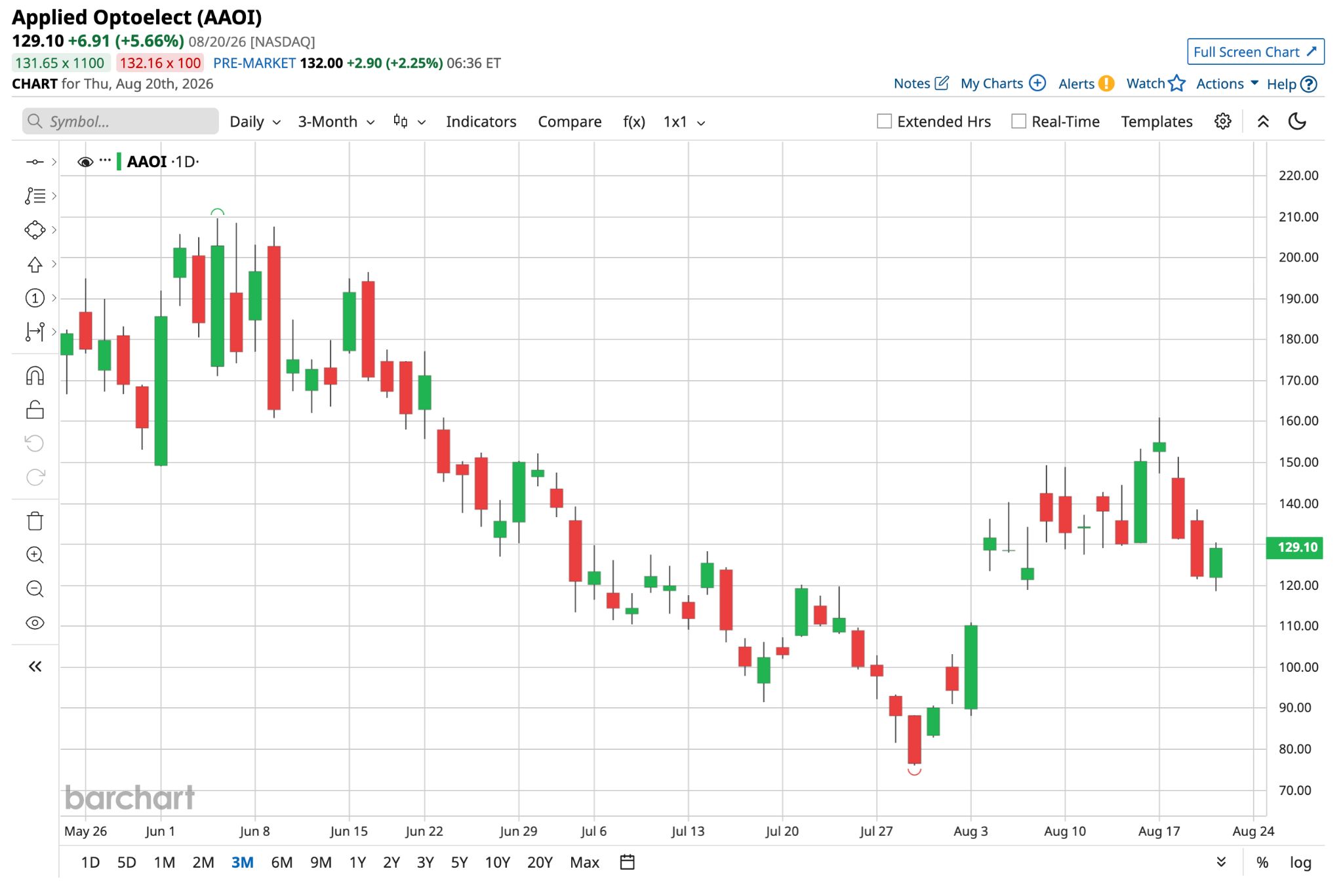
Over the past year, AAOI stock has increased an impressive 361%, outperforming the S&P 500’s ($SPX) 19% gain during the same period. The surge was helped by strong Q2 results, while demand for AI-related optical transceivers and an improving outlook for hyperscale data-center spending has also contributed to the rally. Still, AAOI stock has been fairly volatile this year, falling from above $200 in mid-June to as low as $76 in late July before climbing back to the $113 level today.
 www.barchart.com
 Applied Optoelectronics is difficult to value on traditional measures. There’s no meaningful forward price-to-earnings (P/E) ratio, since profits are still thin as the company funds its expansion. The price-to-sales (P/S) ratio of 23 times looks alarming, sitting well above its five-year average of 2.8 times. That is undoubtedly a steep premium, but keep in mind the company was barely profitable before. The AAOI stock narrative has changed significantly, from a struggling turnaround to a real AI-optics growth story.
The EPS outlook makes AAOI stock look just as attractive as its premium P/S ratio makes it look expensive. Analysts expect earnings growth of 234% in fiscal 2026 and 578% in fiscal 2027. But just like the P/S ratio, these numbers are a bit misleading. The figures come off a small base and shouldn’t be read too literally. Meanwhile, the balance sheet is healthy; Applied Optoelectronics holds roughly $500 million in cash against $300 million in debt, leaving it in a net cash position.
Overall, the valuation rests on execution. AAOI stock looks expensive, but if the company can build fast enough to fulfill the strong demand coming its way, its high multiple may well be justified.
AI-Driven Optical Networking Demand Fuels Growth Outlook
Applied Optoelectronics reported Q2 fiscal 2026 earnings on Aug. 6. Revenue came in at $191.9 million, up 86% year-over-year (YOY) and 27% sequentially. CFO Stefan Murry said that 56% of revenue came from data-center products while 42% came from CATV products.
EPS came in at $0.06, beating the Wall Street consensus of $0.02. Non-GAAP gross margin was 29.8%, within guidance and slightly above the margin of 29.2% in Q1. Non-GAAP net income was $5.5 million, compared with a non-GAAP loss of $8.8 million in Q2 2025. Applied Optoelectronics also spent $565.5 million on capital expenditures in Q2, including $280 million in equipment prepayments.
Looking forward, management guided Q3 revenue to a range of $255 million to $290 million, implying continued strong growth. Non-GAAP EPS is expected to be $0.11 to $0.26, with non-GAAP gross margin of 29% to 30.5%. Applied Optoelectronics also reaffirmed its view that fiscal 2026 revenue should be around $1.1 billion.
Applied Optoelectronics' product roadmap remains central to the outlook. The company expects 800G revenue to rise nearly fivefold sequentially in Q3. However, CEO Thompson Lin said that the company expect a near-term product-mix headwind from 100G, with that revenue expected to decrease by $20 million to $25 million.
What Do Analysts Expect for AAOI Stock?
Raymond James recently raised its price target on AAOI stock to $178 from $151 while keeping an “Outperform” rating, with the company’s 1.6T launch trajectory being a key driver behind the upward revision. Raymond James believes a successful volume launch could narrow Applied Optoelectronics' technology gap with industry peers and drive meaningful upside. Likewise, B.Riley analyst Dave Kang raised his price target to $109 from $94 but kept a “Neutral” rating on the stock.
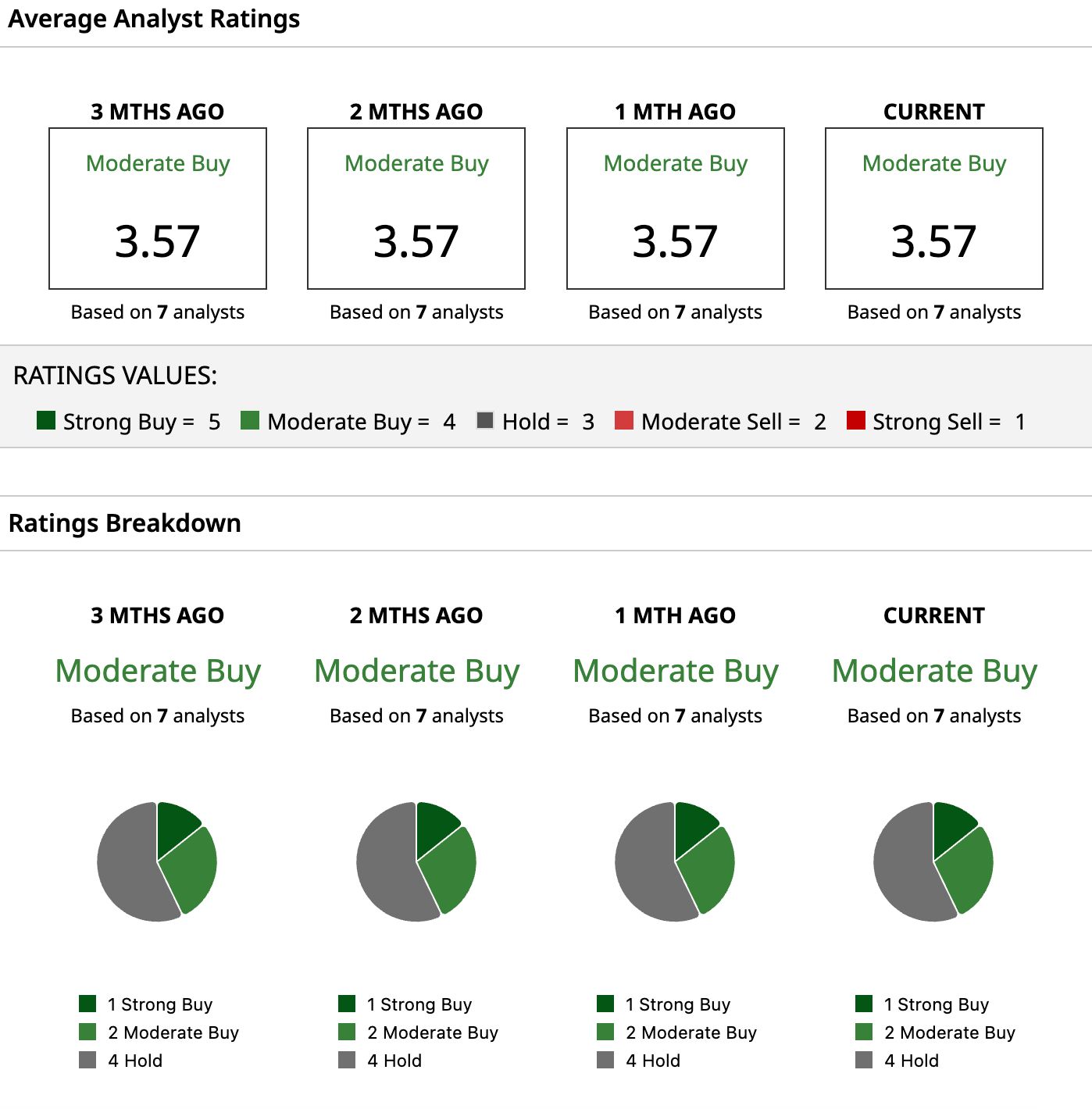
Based on seven Wall Street analysts with coverage, AAOI stock has a consensus “Moderate Buy” rating overall. Out of those analysts, one has a “Strong Buy” rating, two have a “Moderate Buy” rating, and four have a “Hold” rating. The mean price target of $162.50 reflects 43% potential upside from current levels, while the high price target of $220 implies a possible 94% gain from here.
 www.barchart.com
 On the date of publication, Jabran Kundi did not have (either directly or indirectly) positions in any of the securities mentioned in this article. All information and data in this article is solely for informational purposes. For more information please view the Barchart Disclosure Policy here.
More news from Barchart
The $1.24 Billion Reason Why Kura Oncology Stock Is Up Today How to Play Wix Stock on Big Gemini AI Win Applied Optoelectronics Has a Rare Problem Thanks to a Possible U.S. Ban on China Dear Dollar Tree Stock Fans, Mark Your Calendars for August 27