


Retail investors have spent years watching professional quant funds dominate markets with automated, rules-based strategies that scan data around the clock and execute without emotion. Now that edge is coming to everyday brokerage accounts.
Robinhood Markets (HOOD) just rolled out Robinhood Agents, an artificial intelligence (AI) toolkit that lets users research markets, build strategies, and execute trades inside dedicated accounts with built-in limits. Next up is Loops, which will continuously monitor conditions and run those strategies automatically.
More Top Stocks Daily: Go behind Wall Street’s hottest headlines with Barchart’s Active Investor newsletter.
In short, the company that once made commission-free trading mainstream is now trying to put quant-style automation in the hands of its 28.6 million funded customers.
 www.barchart.com
 What Robinhood Agents Actually Deliver
Robinhood Agents sits inside the app and give users an AI co-pilot for research, strategy building, and order placement. Each agent operates only inside a separate agentic trading account funded with money the user chooses to allocate. Manual trade approval remains the default setting, and users receive push notifications plus a live activity feed.
According to the company’s announcement, more than 150,000 customers have already opened these accounts, and agents are tapping Robinhood’s tools nearly 30 million times a day.
Coming next is Loops, the feature that most closely mirrors classic quant operations. Loops will keep checking the market and automatically trigger a predefined strategy when specific conditions are met. Think of it as a simplified version of the systematic, rules-based approaches that power many quantitative hedge funds. Users will also be able to plug in premium data feeds from Nasdaq, Unusual Whales, SpotGamma, and others through new Agent Apps. OpenAI’s GPT-Luna is also available for free through year-end for extra horsepower.
Why This Matters for Everyday Investors
For years, quant funds used sophisticated models to monitor prices, volume, volatility, and other signals, then acted instantly when thresholds were hit. Retail investors largely sat on the sidelines or relied on clunky third-party tools. Robinhood is closing that gap. By packaging continuous monitoring and conditional execution inside a familiar brokerage interface, the company is effectively offering a consumer-grade quant toolkit.
The timing aligns with Robinhood’s broader momentum. In the second quarter of 2026, total net revenue reached a record $1.31 billion, up 32% year-over-year (YOY). Funded customers stood at 28.4 million, and total platform assets hit $369 billion. By the end of August, funded customers had risen to 28.6 million and platform assets to $384 billion, with a trailing 12-month net deposit growth rate of 24%. Average revenue per user climbed to $187 in Q2. These figures show a platform that continues to attract capital and engagement even as it expands beyond pure trading into prediction markets, Gold subscriptions, and now agentic tools.
Understandably, automation does not eliminate risk. Strategies can lose money, and AI agents can act on imperfect data or unexpected market moves. Robinhood acknowledges this by isolating agent activity in separate accounts and keeping human approval as the default. Still, the convenience of set-it-and-monitor automation could deepen user stickiness and encourage higher balances, both of which feed Robinhood’s revenue engine.
The Case for HOOD Stock Investors
From an ownership perspective, the agentic push reinforces Robinhood’s evolution from a simple trading app into a broader financial platform. The company now counts 13 business lines generating at least $100 million in annualized revenue. Transaction-based revenues, still the largest slice, rose 44% YOY in Q2 to $776 million. Net interest and other recurring streams continue to expand.
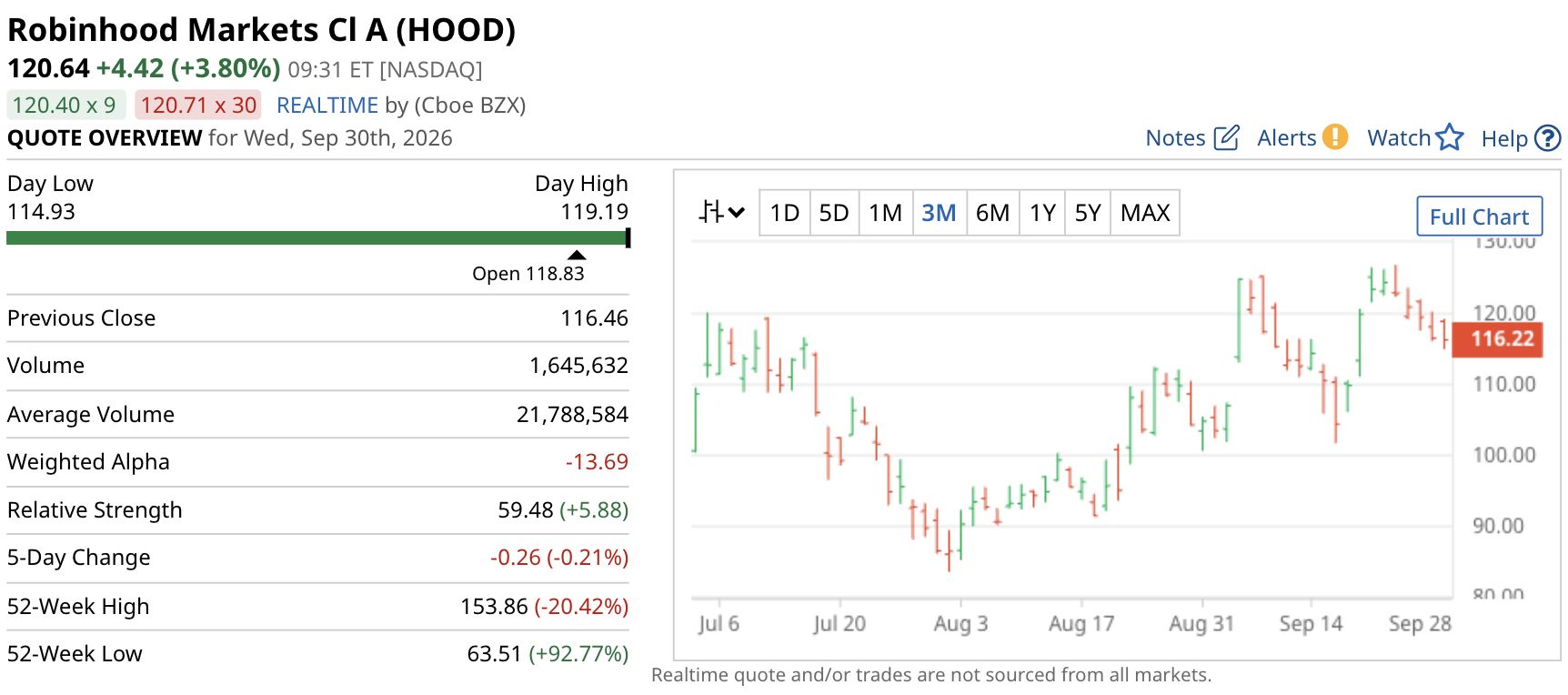
At a recent share price near $111 and a market capitalization of roughly $101 billion, HOOD stock trades at about 51.2 times trailing earnings. That valuation prices in continued growth, and features like Agents and Loops give management additional levers to drive engagement and asset growth.
Competitors such as Charles Schwab (SCHW) and Interactive Brokers (IBKR) offer robust platforms, yet none have matched Robinhood’s combination of mass retail reach and rapid product iteration in the AI space. If Loops and the broader agent suite help users stay more active and deposit more capital, the flywheel of higher assets, more trading, and expanded premium subscriptions should keep turning.
Bottom Line
Robinhood is democratizing a core quant-fund capability — continuous market monitoring paired with automated, condition-based execution — and packaging it for ordinary investors. Early adoption numbers look promising, and the feature set arrives against a backdrop of solid revenue growth, rising customer counts, and expanding platform assets. Risks around user losses and execution quality remain real, yet the safeguards and separate-account structure provide meaningful guardrails.
For investors, the move strengthens the case that Robinhood can keep converting its large user base into deeper, more profitable relationships. Smart investors watching the fintech space should keep HOOD stock on their radar as this agentic experiment scales.
 www.barchart.com
 On the date of publication, Rich Duprey did not have (either directly or indirectly) positions in any of the securities mentioned in this article. All information and data in this article is solely for informational purposes. For more information please view the Barchart Disclosure Policy here.
More news from Barchart
United Therapeutics Just Sent Liquidia Stock Lower After Patent Battle COHR Stock Leads AI Infrastructure Stocks Higher as Coherent Launches Data Optics Platform After Accenture Surges 17% in 1 Day, Here's What Comes Next for ACN Stock IonQ Just Scored a New ‘Buy’ Rating. What Comes Next for IONQ Stock.