


After two major spinoffs that simplified its business and sharpened its focus on automation, Honeywell International (HON) introduced its Forge Cognition artificial intelligence (AI) platform, which helps automate operations at commercial buildings, campuses, and industrial facilities.
The Forge Cognition platform is backed by technologies from Nvidia (NVDA), particularly its Nemotron AI models to interpret operational data, and Dell Technologies (DELL). The platform works with existing building-management systems and can help prioritize alarms, predict heating and cooling equipment failures, and find ways to cut energy use.
More Top Stocks Daily: Go behind Wall Street’s hottest headlines with Barchart’s Active Investor newsletter.
Investors see this launch as Honeywell's effort to scale software and AI offerings across an installed base of more than 300,000 sites, creating potential revenue growth drivers. The AI platform is being piloted at its Voyager site in Santa Clara, California, and has reported encouraging results.
With potential gains in sight, we take a closer look at Honeywell now.
About Honeywell Stock
Honeywell, headquartered in Charlotte, North Carolina, is a global technology and industrial company focused on automation, control systems, and software-enabled operational solutions. After spinning off Solstice Advanced Materials (SOLS) and Honeywell Aerospace (HONA), the remaining company operates as a pure-play automation business, serving commercial buildings, factories, and industrial facilities worldwide.
Its offerings include building management systems, industrial controls, sensors, cybersecurity, and process technologies. The company has a market capitalization of $65.80 billion.
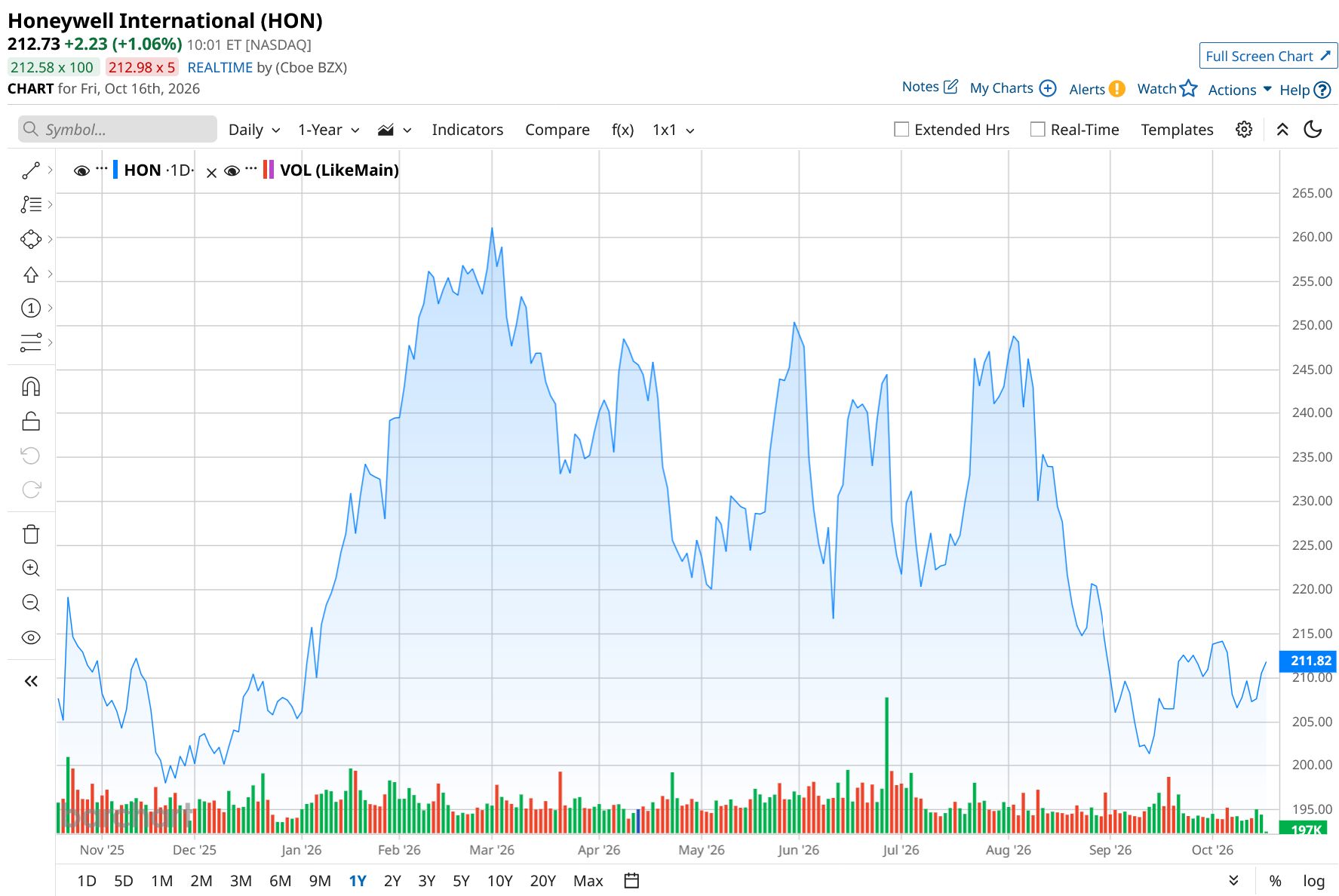
Honeywell’s stock rose 5% over the past 52 weeks on optimism about its breakup into focused businesses. It has declined 12% over the past six months because the aerospace spin-off removed a major earnings driver, leaving a smaller automation company facing uncertainty over future profitability. It reached a 52-week high of $261.24 on March 2, but is down 19% from that level.
On a forward-adjusted basis, Honeywell’s price-to-earnings (non-GAAP) ratio of 25.02x is higher than the industry average of 18.86x.
 www.barchart.com
Q2 Sales and Profit Rise as Orders and Backlog Strengthen
The second quarter was monumental for Honeywell, as it marked the separation of Honeywell Aerospace as a completely separate entity, and the company began operating as a pure-play automation company. Excluding the legacy aerospace business, Honeywell’s sales increased 3% year-over-year (YoY) to $5.19 billion, with organic growth at 4% YoY. It also announced that orders are up 16%, leading to an approximately $20 billion backlog.
Including the aerospace company, sales grew 4% YoY to $9.72 billion, with orders up 4% and about $38 billion in backlog. While its operating margin fell 50 basis points to 12.8%, segment margin rose 100 basis points to 19%. Adjusted EPS grew 10% to $1.95. Honeywell expects to unlock further profitability growth as it simplifies its business.
Honeywell Technologies raised its full-year outlook after a strong second quarter and higher expected organic growth in its process and industrial businesses in the second half. The company now forecasts full-year sales of $19.8 billion to $20 billion, with organic sales growth of 3% to 4% overall and 4% to 6% in the second half. It also expects a segment margin of 20.1% to 20.5%, representing a YoY expansion of 250 to 290 basis points, and an adjusted EPS of $8.05 to $8.35, up 25% to 29%.
Wall Street analysts are tepid about Honeywell’s future earnings. For the current fiscal year, EPS is projected to decline 57.7% to $8.27, followed by 19% growth to $9.84 in the next fiscal year. Analysts also expect the company’s EPS to decline by 61.5% YoY to $2.17 for the third quarter of fiscal 2026 (to be reported on Oct. 22, before the market opens).
Here’s What Analysts Think About HON Stock
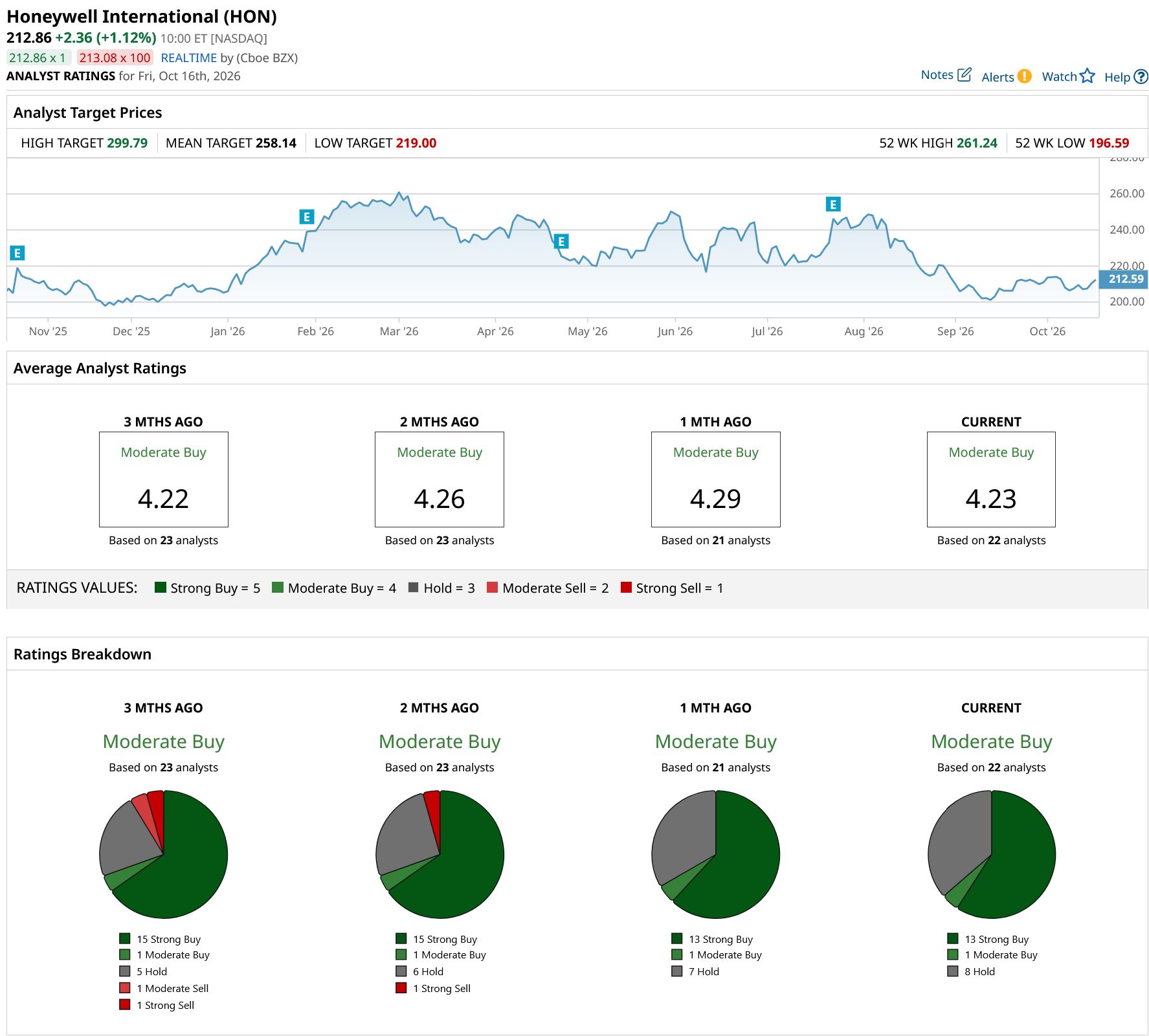
This month RBC Capital analyst Jeffrey Reive maintained an “Outperform” rating on HON stock but lowered the price target from $293 to $270. Analysts at Citigroup maintained a bullish “Buy” rating but cut the price target from $279 to $270. The revised price target suggests analysts are accounting for current market conditions and potential obstacles to future growth. JPMorgan analysts also maintained an “Overweight” rating while reducing the price target from $255 to $240.
Honeywell remains a popular name on Wall Street, with analysts awarding it a consensus “Moderate Buy” rating overall. Of the 22 analysts rating HON stock, a majority of 13 analysts have given it a “Strong Buy” rating, and one analyst rated it “Moderate Buy,” while eight analysts are taking the middle-of-the-road approach with a “Hold” rating. The consensus price target of $258.14 represents a 21% upside from current levels. The Street-high price target of $299.79 reflects a 41% upside.
 www.barchart.com
On the date of publication, Anushka Dutta did not have (either directly or indirectly) positions in any of the securities mentioned in this article. All information and data in this article is solely for informational purposes. For more information please view the Barchart Disclosure Policy here.
More news from Barchart
What a New Nvidia-Backed AI Platform Means for Honeywell Stock Elon Musk Admits He Has ‘No Idea’ How to Make Chips. Tesla Investors May Help Pay for Him to Learn. AI Sector Pressure, Earnings and Other Key Things to Watch this Week HPE Stock Alert: Barclays Just Delivered A Stark Warning After 145% Rally