


Getting your technology into millions of vehicles is one thing, but protecting that position is another. Mobileye Global (MBLY) said in July that more than 250 million vehicles worldwide had been built with its EyeQ technology.
Yet its second-quarter revenue of $508 million was essentially unchanged from a year earlier, even as system shipments increased 3%. Higher volumes, in other words, did not translate into stronger sales.
More Top Stocks Daily: Go behind Wall Street’s hottest headlines with Barchart’s Active Investor newsletter.
That tension sets the stage for RBC’s downgrade and the threat it sees from Nvidia (NVDA). Mobileye investors now face the question of whether the company’s established footprint offers enough protection against growing competition.
Is RBC spotting a deeper challenge to Mobileye’s growth, or overlooking the strengths that could help it defend its business? Let’s take a closer look.
Why RBC Sees Nvidia as a Threat
Mobileye Global develops driver assistance and autonomous driving technology, combining artificial intelligence, computer vision, specialized chips, and software to help vehicles interpret their surroundings. Its products support automakers in delivering safety features, automated driving capabilities, and increasingly sophisticated vehicle control systems.
However, RBC Capital Markets downgraded MBLY stock to “Underperform” from “Sector Perform” on Oct. 21, cutting its price target to $5 from $7.
The central concern is displacement as automakers move toward centralized computing platforms supplied by companies such as Nvidia and Qualcomm (QCOM). Instead of relying on dedicated systems for individual functions, manufacturers could consolidate more capabilities onto these platforms, reducing their need for Mobileye’s driver assistance technology. Nvidia therefore represents more than another rival bidding for contracts. Its processors could challenge Mobileye’s role in the vehicle itself.
Mobileye’s premium business offers limited protection against that risk, according to RBC. The brokerage highlighted its near-total dependence on Volkswagen Group (VWAGY) for premium product revenue and warned that Volkswagen could reduce that reliance. Additional SuperVision and Chauffeur wins have also failed to materialize, weakening the argument that new customers can offset that concentration.
That combination puts MBLY’s valuation under scrutiny. RBC argues that Mobileye increasingly resembles a mature hardware supplier, despite trading at a premium to automotive suppliers. If investors become less confident in its ability to defend existing business and expand premium sales, they could assign the stock a lower valuation multiple before competitive pressure translates into lost revenue.
How Mobileye’s Business Is Holding Up
Mobileye Global released its second-quarter results on July 23, 2026, delivering stronger earnings despite limited sales growth. Its revenue reached $508 million, beating expectations of $485.1 million by 4.7% but remaining essentially flat from a year earlier.
The company shipped 3% more systems as demand rose, but lower EyeQ average selling prices offset the gains. This pricing pressure mainly reflected higher-than-expected export volumes from Chinese automakers, showing why shipment growth did not translate into higher revenue.
Mobileye reported adjusted earnings per share (EPS) of $0.19 against estimates of $0.06, while adjusted operating income reached $155 million versus expectations of $42.74 million. Its adjusted operating margin was 30.5%, although the reported operating margin remained negative at 5.9%, improving from negative 14.6% a year earlier. The improvement benefited from an Israeli research incentive that included amounts attributable to the first quarter, rather than stronger sales alone.
That performance supported a roughly 1% increase in annual revenue guidance, with the midpoint rising to $2 billion from $1.98 billion. Its quarterly free cash flow nevertheless fell to negative $45 million from positive $199 million a year earlier.
The broader cash picture was stronger, with operating cash flow reaching $210 million over the six months ended June 27, 2026. Mobileye spent $51 million on property and equipment and repurchased $24 million in shares following its April 23 program announcement.
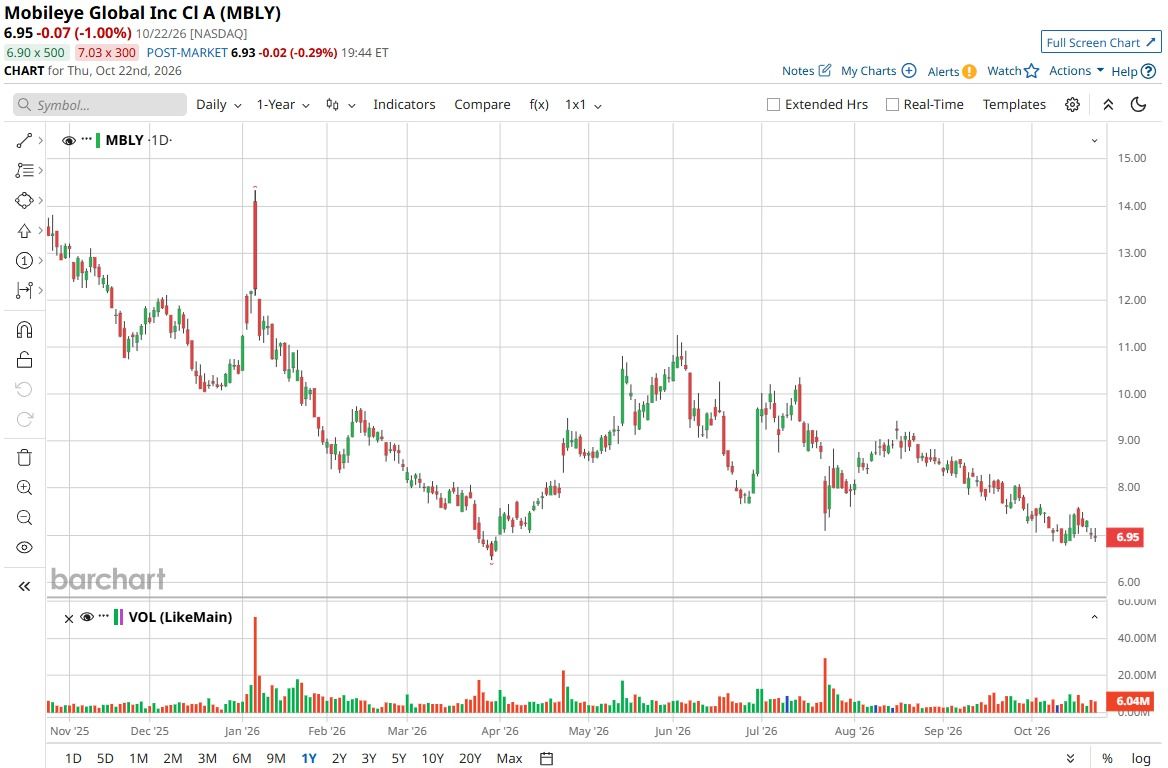
MBLY stock ended Oct. 22 at $6.95, down 33.43% year-to-date (YTD) and 51.43% over 52 weeks, giving it a market value of approximately $5.90 billion.
 www.barchart.com
Separately, Mobileye also announced on Oct. 22 that TÜV SÜD had certified its automatic emergency braking development process against ISO 21448 requirements. The certification gives automakers independent assurance about how Mobileye develops this safety technology, rather than simply relying on the company’s own assessments.
Where Wall Street Stands on MBLY Stock
Mobileye reports earnings on Oct. 29 before the market opens. The average EPS estimate for the September quarter is $0.00, compared with $0.01 a year earlier.
Not everyone shares RBC’s concerns. Citi analyst Michael Ward assumed coverage on Oct. 16 with a “Buy” rating and an $11 price target, a 58.3% upside.
Ward expects automakers’ push for safer driving to support demand for Mobileye’s technology over the next decade. He also expects more advanced systems to launch with global automakers within two years, giving Mobileye a chance to sell more technology per vehicle.
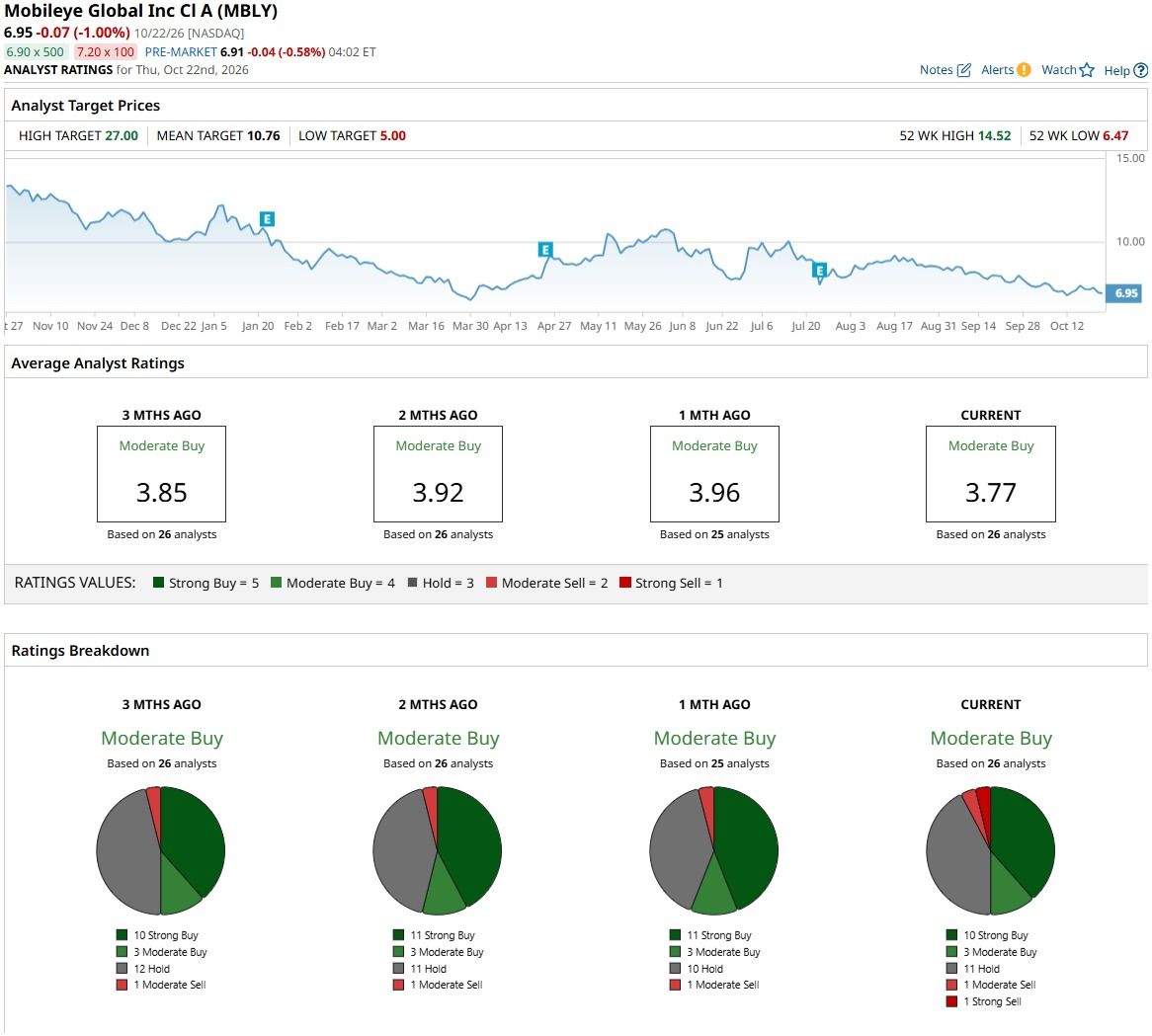
The broader consensus on MBLY stock remains “Moderate Buy” across 26 surveyed analysts, and rather than a unanimous endorsement, analysts cluster around 10 “Strong Buy” ratings and 11 “Hold” ratings, with the rest giving variations of “Buy” and “Sell.” Their average price target of $10.76 implies 55% upside. That leaves a clear divide between RBC’s displacement concerns and Citi’s expectations for expanding demand.
 www.barchart.com
Conclusion
RBC’s downgrade makes MBLY harder to buy on growth expectations alone. Nvidia’s competitive threat matters, especially while Mobileye faces flat revenue and depends heavily on Volkswagen for premium sales. Stronger earnings and bullish analyst targets offer support, but neither settles those concerns. The stock looks more likely to struggle for momentum until further customer wins or improving sales strengthen the growth case. Mobileye still has room to recover, but the next leg higher needs business progress, not simply a cheaper valuation.
On the date of publication, Ebube Jones did not have (either directly or indirectly) positions in any of the securities mentioned in this article. All information and data in this article is solely for informational purposes. For more information please view the Barchart Disclosure Policy here.
More news from Barchart
Allstate’s Unusual Options Activity Sets the Stage for an Income-Generating Wheel Strategy Apple Is About to Overtake Nvidia Again as the World’s Most Valuable Stock as AI Rout Grows RBC Just Downgraded Mobileye, Citing the Threat From Nvidia. What This Means for MBLY Stock. Qualcomm May Be Preparing Another Round of Job Cuts Next Month. Here’s What to Know.