

Intel (INTC) CEO Lip-Bu Tan might have theorized that the sharp downturn in Intel stock had made its shares a value pick, and that his recent move to buy 150,000 shares of INTC stock could rescue it from a further downfall. However, shares fell even further after his Nov. 2 purchase, dropping as much as 10% on Nov. 5 alone before staging a recovery in the following days.
Intel stock now trades at around $59 per share, down roughly 8% from the average price of $64.73 at which Tan purchased his new shares. Notably, the CEO parted with about $9.71 million for the transaction. While a wider market selloff targeting the artificial intelligence (AI) trade could be seen as a reason for the recent downturn, that is not the whole picture. Let's take a closer look.
More Top Stocks Daily: Go behind Wall Street’s hottest headlines with Barchart’s Active Investor newsletter.
About Intel Stock
Founded in 1968, Intel is an integrated semiconductor company that designs, manufactures, packages, and sells processors and other semiconductor products. Its business can broadly be understood through two major segments; Intel Products designs and sells processors and related semiconductor products to customers, while Intel Foundry manufactures and packages semiconductors — from chips designed by Intel itself to those designed by external customers.
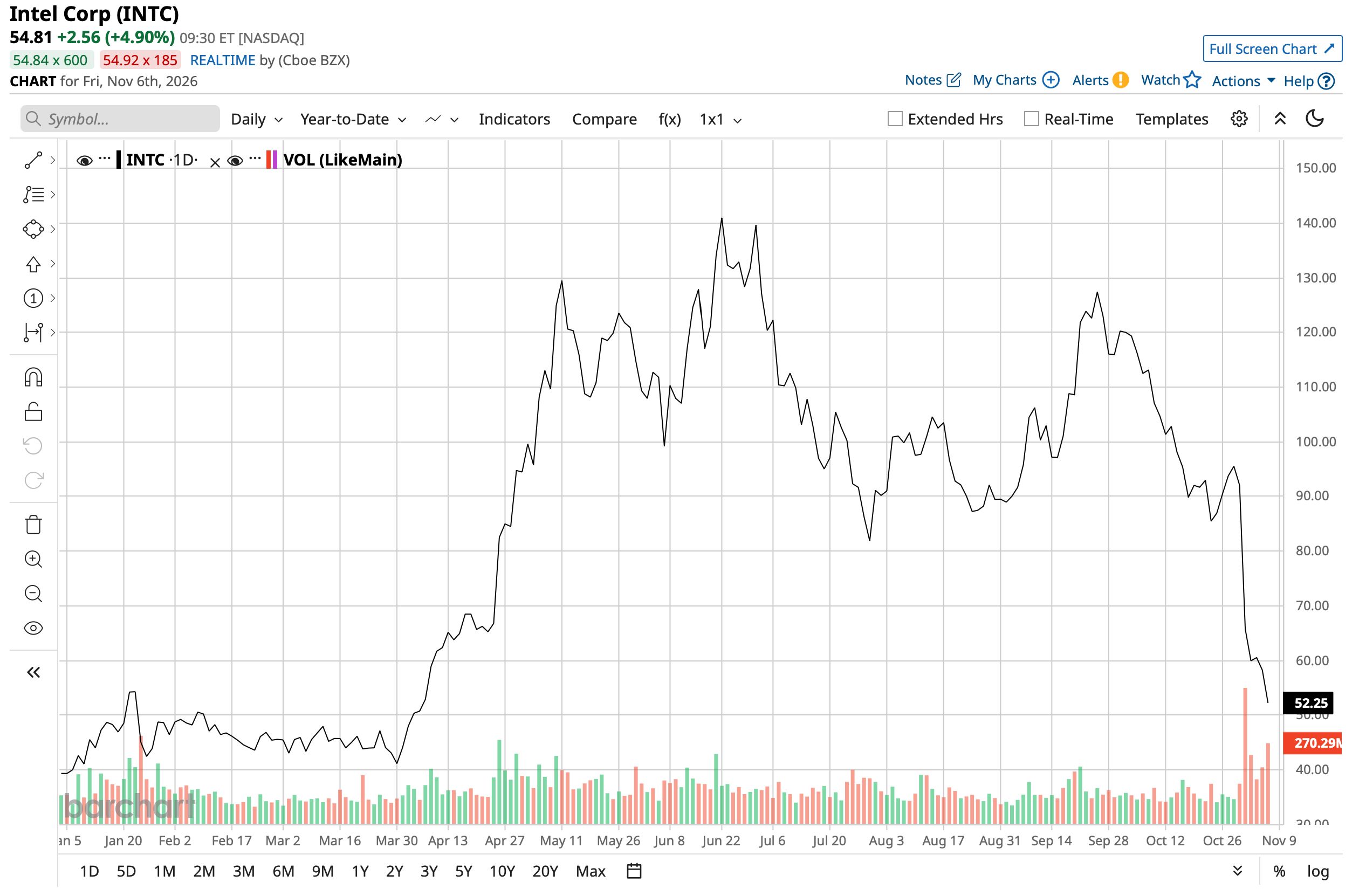
Valued at a market capitalization of $299 billion, INTC stock is up 61% on a year-to-date (YTD) basis. Having said that, the stock's upward momentum so far this year may now be dragging its heels.
 www.barchart.com
How Intel Is Falling Short
Intel's 18A process of making chips was supposed to bring its foundry business to life with external customers. Intel claimed that the 18A methodology delivers up to 18% higher performance at the same power, 38% lower power at the same performance, and 30% greater chip density compared with Intel 3. However, that has not resulted in Intel meaningfully competing with market leader Taiwan Semiconductor (TSM).
At the end of 2025, Taiwan Semiconductor (TSMC) disclosed that it had “deployed 305 distinct process technologies, and manufactured 12,682 products for 534 customers,” with 74% of wafer revenue coming from 7 nanometer-and-below technologies. Although Intel does not disclose comparable figures, the latest quarterly results for both firms bear testament to TSMC's scale.
For the third quarter of 2026, TSMC saw revenue of $46.72 billion, compared to Intel's foundry revenue from external customers of just $411 million during the same period. That's a stark difference. Moreover, TSMC's CoWoS packaging technology has become the industry standard, competing with Intel's own advanced packaging technologies, such as EMIB and Foveros.
Of course, TSMC is a pure-play foundry player, whereas Intel has interests in other aspects of the chip supply chain. Yet, in that regard, Intel is also lagging behind the leading duo of Nvidia (NVDA) and Advanced Micro Devices (AMD).
In GPUs, Nvidia's moat has been its CUDA ecosystem, which has been around for two decades now. On the other hand, Intel's oneAPI and related software initiatives have not achieved comparable developer adoption in AI accelerator workloads. Intel's hardware has also not established the same combination of performance, memory capacity, bandwidth, and system-level scalability that Nvidia offers. AI customers are increasingly buying complete computing systems rather than individual chips, and Nvidia has been particularly successful in offering integrated GPU, networking, and software platforms. Thus, customers who have already invested heavily in Nvidia's ecosystem are not willing to shift to Intel's so easily.
In the realm of CPUs, AMD has also emerged as a serious contender. Intel's historical advantage was its ability to introduce new processor architectures alongside leading-edge manufacturing improvements. But delays in its manufacturing roadmap have meant inconsistent delivery of improvements in transistor density, performance, and power efficiency. Meanwhile, AMD has adopted a fabless model and outsourced manufacturing to TSMC. This has allowed it to use TSMC's advanced manufacturing processes without having to fund its own leading-edge fab facilities.
Specifically, AMD's chiplet approach has been a major competitive advantage because it allows the company to manufacture multiple smaller compute dies rather than relying entirely on a large monolithic die. Although Intel has also adopted chiplets, the distinction is that AMD has demonstrated a successful commercial model around the technology for several generations.
Intel's Q3 Double Beat Was Not Enough
Intel's latest Q3 2026 results were good on the surface, with both revenue and earnings beating estimates. Yet investors were disappointed with Q4 guidance, causing INTC stock to plummet almost 29% in the next trading session.
Revenue for the quarter was $16.5 billion, up 21% from the prior-year period. Data-center revenue continued to show strong momentum, rising 78% on a year-over-year (YOY) basis to $7.3 billion. Total foundry revenue came in at $6.7 billion, up a healthy 58%. Still, only $411 million came from external customers, signaling that Intel still has a long way to go to become a key player in chip manufacturing again.
Earnings jumped to $0.52 per share from $0.23 per share in the prior year, outpacing the consensus estimate of $0.40 per share. However, Q4 guidance of $15 billion to $16 billion in revenue and earnings of $0.25 per share disappointed.
Net cash from operating activities for the nine months ended Sept. 26, 2026 came in at $24.8 billion, a jump from $5.1 billion a year ago. Free cash flow for the three months ended Sept. 26, 2026 was also $1.6 billion, up from $896 million in the prior year. Yet Intel's gross capital expenditures in the period were $4.2 billion, while the company continues to forecast capex of $20 billion for 2026. Accordingly, Intel's cash requirements continue to be substantial. Overall, Intel closed the quarter with a cash balance of $21.8 billion, much higher than its short-term debt of $3.8 billion.
Meanwhile, INTC stock trades at overvalued levels. Its forward price-to-earnings (P/E) ratio of 50.3 times, price-to-sales (P/S) ratio of 5.2 times, and price-to-cash flow (P/CF) ratio of 23.3 times all trade above the respective sector medians.
What Do Analysts Think of Intel Stock?
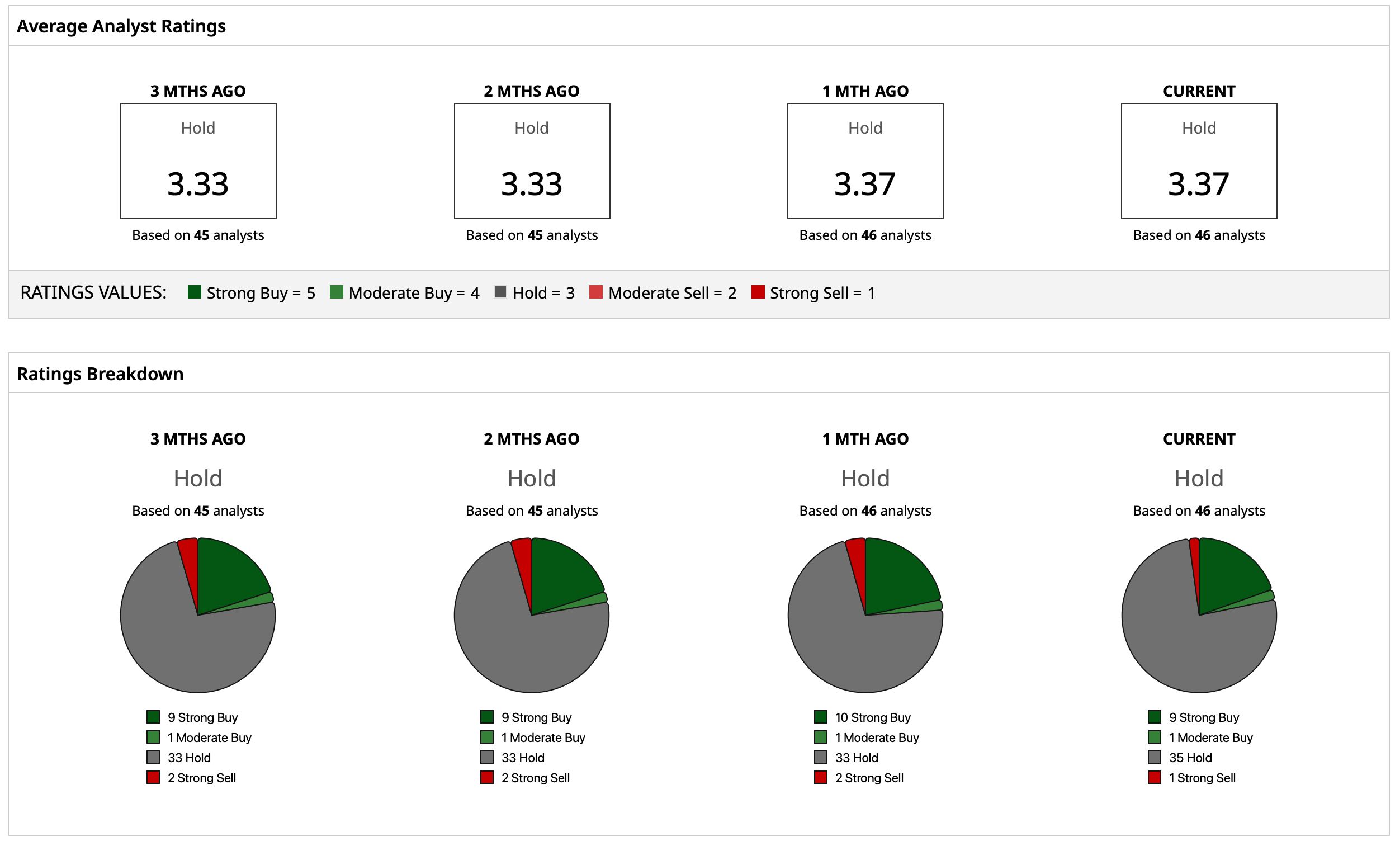
Overall, analysts have a consensus “Hold” rating for INTC stock. Out of 46 analysts covering the stock, nine have a “Strong Buy” rating, one has a “Moderate Buy” rating, 35 have a “Hold” rating, and one analyst has a “Strong Sell” rating. The mean target price of $93.23 denotes potential upside of 57% from current levels.
 www.barchart.com
On the date of publication, Pathikrit Bose had a position in: NVDA . All information and data in this article is solely for informational purposes. For more information please view the Barchart Disclosure Policy here.
More news from Barchart
CEO Lip-Bu Tan’s 150,000-Share Purchase Wasn’t Enough to Stop the Slide in Intel Stock Dear Intuitive Machines Stock Fans, Mark Your Calendars for November 12 McDonald's Stock Is Up 24% in the Last Month - Is MCD Near a Peak? Don’t Chase the Arm Stock Dip Yet. What Patient Investors Should Wait for Before They Buy.