

On Nov. 5, chip stocks had one of the roughest days on record. The PHLX Semiconductor Index ($SOX) fell 12.25% to close at 9,011.14, erasing roughly $1.5 trillion in market value in a single session. The index hadn’t seen a drop that steep since March 16, 2020.
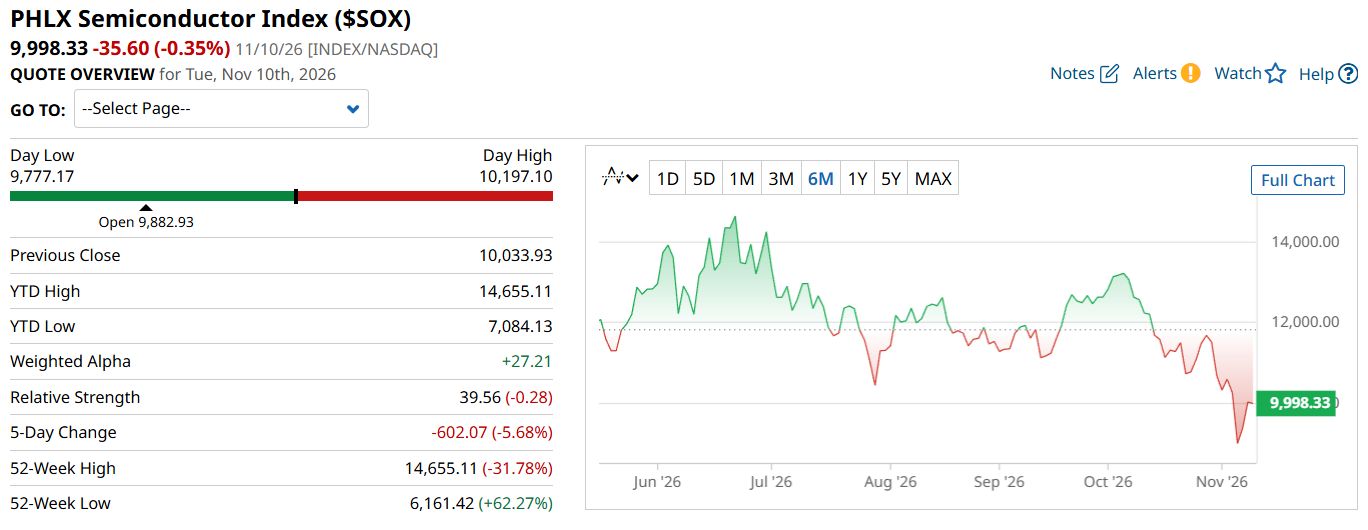 Screenshot courtesy of www.barchart.com
Fast forward to less than a week later, and buyers are already stepping back into semiconductor stocks, so plenty of investors are wondering whether this rebound has staying power or is a trap in disguise. But my view is that the answer comes down to which chip stock an investor owns, because several different forces drove last week’s selloff and the bounce has so far lifted nearly everything at once.
More Top Stocks Daily: Go behind Wall Street’s hottest headlines with Barchart’s Active Investor newsletter.
Before getting to that, let’s rewind to what actually happened last week.
How the Chip Crash and Rebound Unfolded Over Just a Few Days
It all started with the midterms. Democrats took back the House and won a Senate majority by a wider margin than polls had suggested, so investors quickly began to worry that a Democratic Congress could slow the construction of AI data centers.
Chip stocks were the first to react. As the Nasdaq-100 Index ($IUXX) rose about 0.9% on Nov. 4, the SOX fell 3.13% – a gap that, to me, showed the market was already treating chips as the main place to price in political risk.
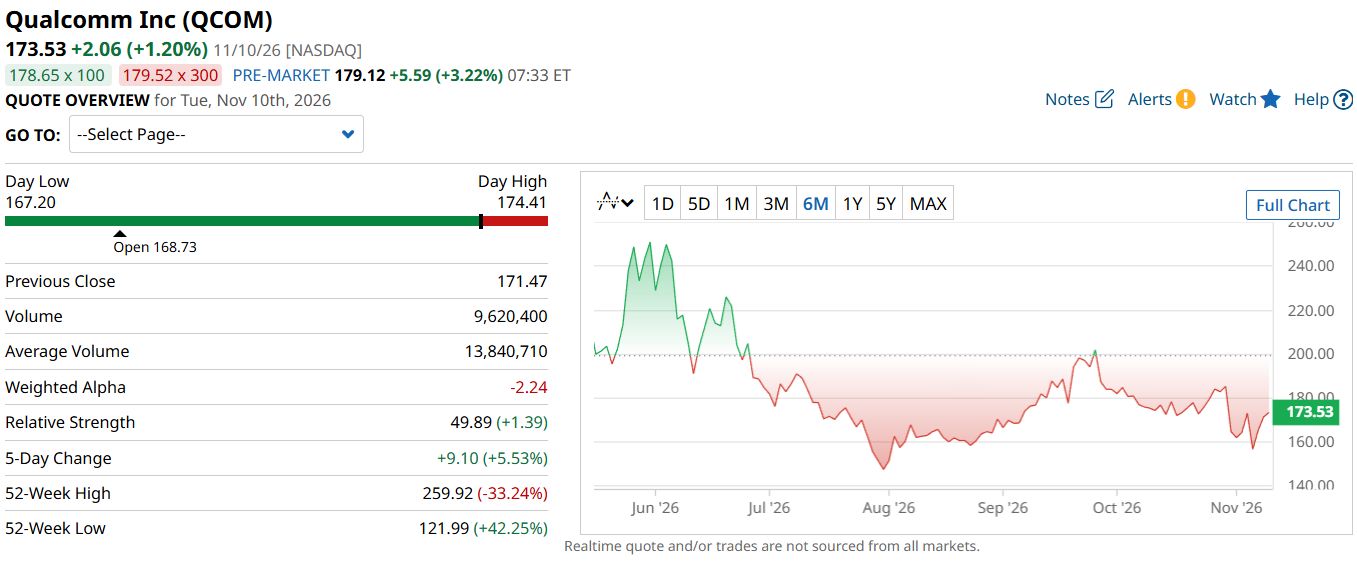 Screenshot courtesy of www.barchart.com
That same evening, Qualcomm (QCOM) guided December quarter earnings below expectations because memory and manufacturing costs were rising faster than the company could raise its own prices.
Arm Holdings (ARM) followed with a similar message, saying pricier memory in phones was weighing on royalty revenue. Since Arm collects a small fee on nearly every smartphone chip built on its designs, a weaker phone market hits Arm directly.
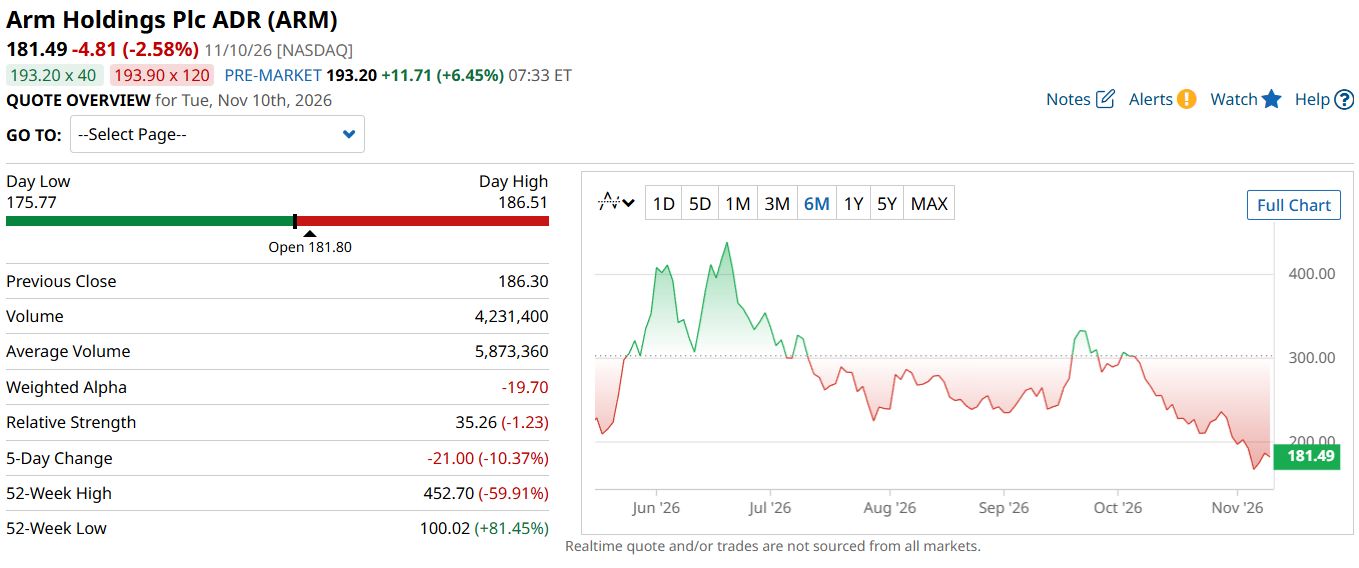 Screenshot courtesy of www.barchart.com
On Nov. 5, Qualcomm fell 9.5%, and Arm’s slide reached about 12% over two sessions.
But the selling didn’t stop there. Advanced Micro Devices (AMD) and Micron Technology (MU) each lost roughly 17%, and Nvidia (NVDA) fell about 9%, leaving the SOX 38.4% below its June 22 record close of 14,634.72.
Then, almost as quickly as they fled, buyers came back. Lam Research (LRCX) and Marvell Technology (MRVL) each rose close to 10% during Friday’s session as chip stocks recovered a good part of the losses. On Monday, President Donald Trump wrote on Truth Social that he fully supports AI infrastructure and called data centers “GOLD,” and by midday, Broadcom (AVGO) was up about 9% and AMD about 11%.
Interestingly, the selling came from very different worries, yet the rebound buying has been spread almost evenly across the sector. Stocks hurt by expensive memory bounced right alongside the companies profiting from it. I read that as traders unwinding bets after an extreme move, with the fundamentals yet to separate the winners from the losers, so it makes sense to start with the good news.
Why Record AI Spending Supports the Chip Recovery
Most of the demand for AI chips traces back to four customers, or the hyperscalers – namely, Microsoft (MSFT), Alphabet (GOOGL), Amazon (AMZN), and Meta Platforms (META). In the third quarter, the four spent a combined $201.9 billion on property and equipment, which is up 108% from a year earlier and 22% from the second quarter. Microsoft did lower its 2026 spending forecast to about $170 billion, but the cut came from outside developers running late on new data centers. So demand had nothing to do with it.
Plus, next year is shaping up to be even busier. Alphabet expects spending to increase significantly in 2027, and Amazon CEO Andy Jassy said his company plans to spend meaningfully more.
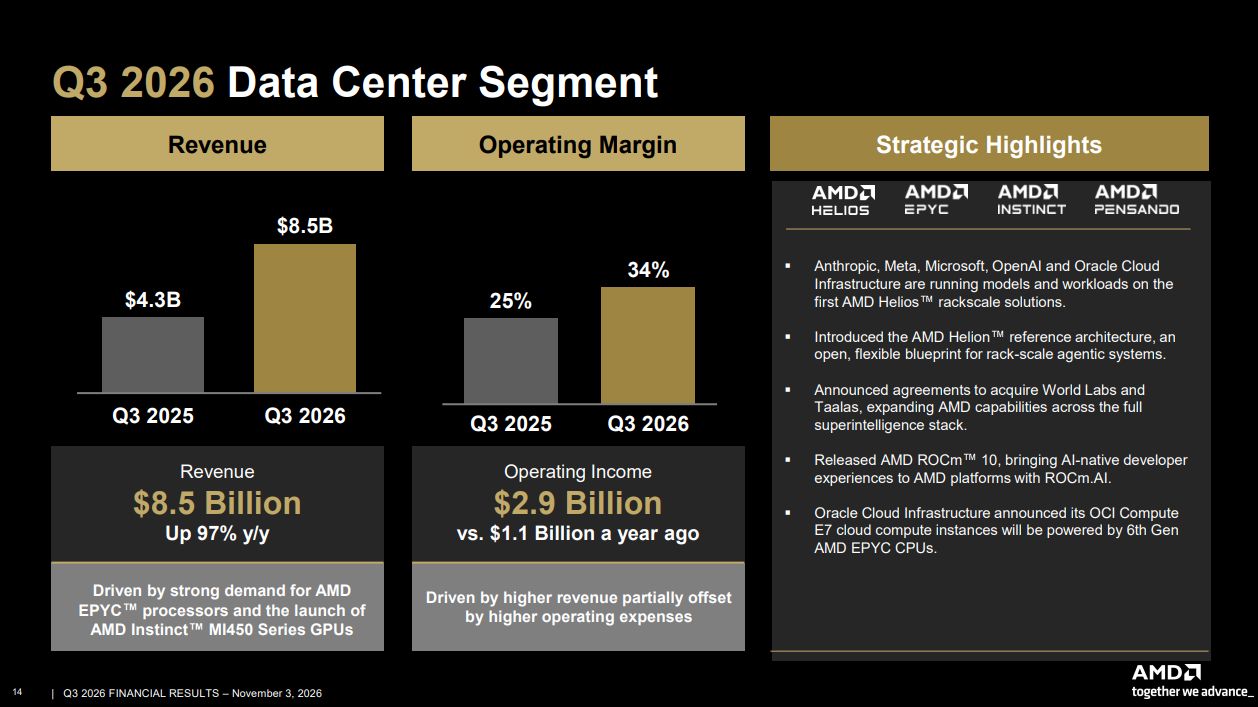
AMD reported its results on Nov. 3, just two days before the crash, and the numbers show the same strong demand from the chipmakers’ side. For example, third-quarter revenue came in at $13.4 billion, up 45% year over year, while the data center segment hit a record $8.5 billion, up 97%. This is the part of AMD that sells processors and AI chips to cloud companies.
 Screenshot courtesy of www.amd.com
For the fourth quarter, management guided revenue to about $17 billion, and CEO Lisa Su said she now expects revenue to grow more than 80% in 2027.
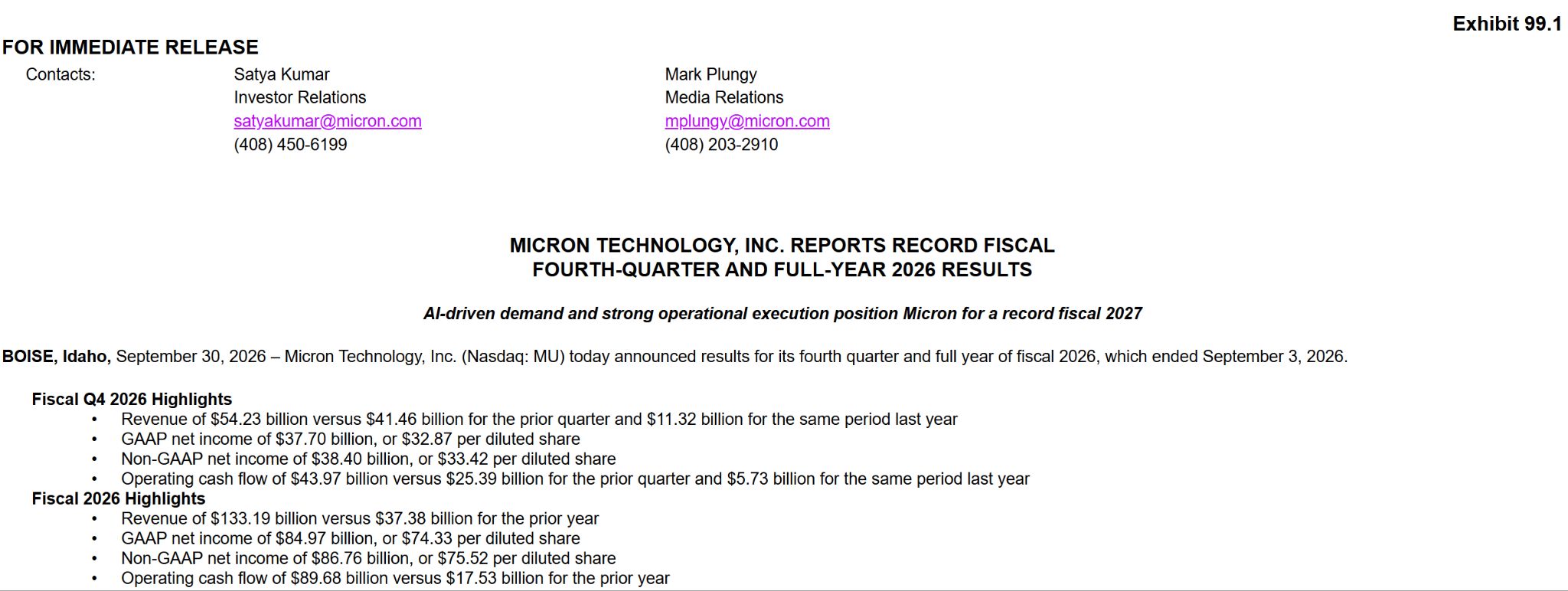
Memory chipmakers are seeing the same kind of demand, with buyers wanting more chips than the industry can produce. Micron posted record quarterly revenue of $54.23 billion in late September, and CEO Sanjay Mehrotra said supply will stay tighter than demand through 2027 and 2028.
 Screenshot courtesy of www.sec.gov
So while the stocks were repriced last week, nothing in the news reduced what these companies are on track to sell in 2026. Investors simply started trusting the 2027 and 2028 numbers less and less, and those years now carry a bigger risk discount than they did a month ago. Personally, I think that discount is too steep for suppliers whose largest customers pay for AI spending out of operating cash flow, especially since those customers keep saying next year will be even busier.
I’m comfortable owning businesses like these after a scare, although the bear case is still worth a serious look.
Politics, Funding Strains, Memory Costs, and Rates All Threaten the Rebound
Now, as far as politics goes, I think the fear is running ahead of what Congress can actually pass. Democrats have called for legislation that would protect consumers from higher power bills tied to data centers, and they also want independent testing of AI systems. But President Donald Trump has promised to veto Democratic bills, so I doubt a sweeping AI law gets passed over the next two years.
Where politics could still hurt is timing. Hyperscalers can move projects to friendlier states or overseas – although a six-month permitting delay can push chip revenue from 2027 into 2028, and for stocks priced on 2027 earnings, a slip like that comes with a real cost.
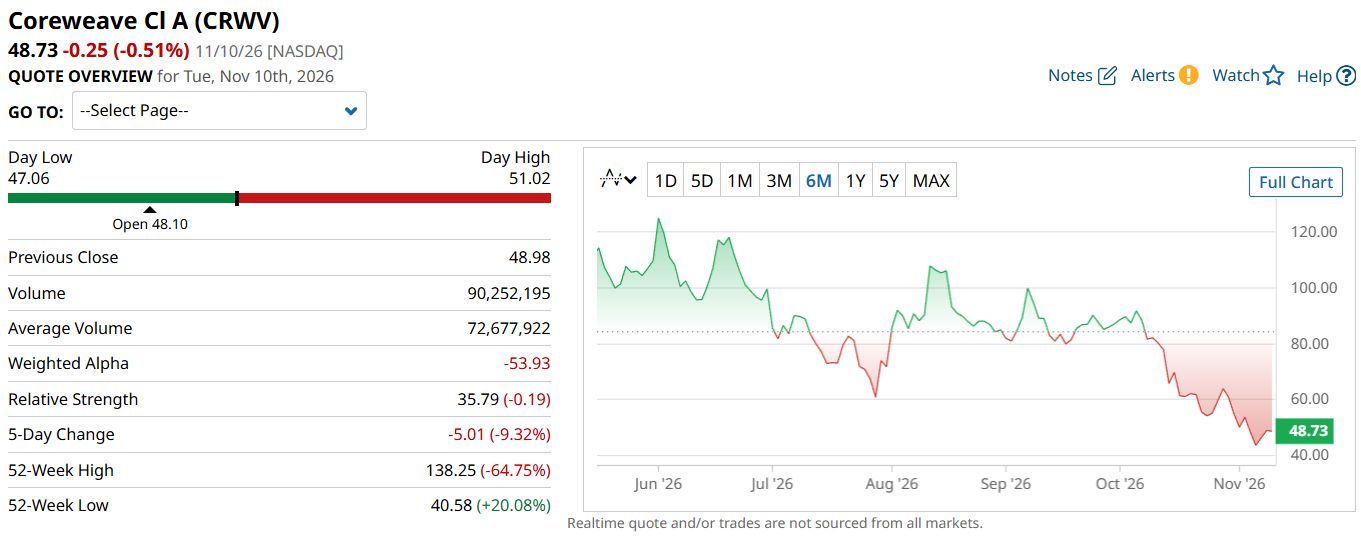
That said, I’d watch how all of this spending gets paid for more closely than I’d be watching what happens in Washington. I think the market is underestimating how much new chip demand depends on borrowed or raised money, mostly from AI labs and neoclouds. Neoclouds are newer cloud companies built specifically to rent out AI computing power, and CoreWeave (CRWV) is the largest of them.
 Screenshot courtesy of www.barchart.com
Take CoreWeave’s latest report, for example. Third-quarter revenue rose 168% to $3.66 billion, and the company raised its full-year outlook, so customers clearly want the capacity. But in that same quarter, CoreWeave also paid $846 million in net interest expense while earning $379 million in adjusted operating income, which means the interest bill was more than twice what the core business made.
Then there’s memory, which cuts both ways. AI servers use so much memory that phone and PC makers are left competing for the scraps at much higher prices, and Qualcomm is feeling it. The company’s smartphone chip revenue fell 26% to $5.14 billion in the September quarter, and Qualcomm expects its chip unit to keep only between 20% and 22% of revenue as pretax profit in the December quarter, down from about 24%.
But Micron is on the winning end of that same shortage. Over the same stretch, Micron’s mobile and client business brought in $13.11 billion, up from $3.8 billion a year earlier. In other words, profit is simply moving from one group of chipmakers to another.
On top of that, the Fed isn’t doing chip stocks any favors. After resuming rate hikes in September for the first time in more than three years, the Federal Reserve could raise rates again in December, especially after a hot October inflation report. Higher rates make borrowing pricier for companies like CoreWeave, and they also tend to hit stocks valued on earnings far in the future the hardest, which describes many chip stocks after this year’s run.
That’s a lot to keep in mind, and it’s why I don’t think every chip stock deserves the same benefit of the doubt right now.
Which Chip Stocks Look Built to Hold Their Rebound Gains
For me, sorting through this comes down to two factors:
One is where the money behind the demand is coming from. Hyperscalers pay for AI chips out of profits from businesses that are already making money, which makes that demand a lot sturdier than orders from customers who have to keep raising money to stay in the game. Two is the memory shortage. Memory makers and the companies selling equipment to memory factories are clearly benefiting from it, while chip designers that depend on phones and PCs are the ones stuck with the higher costs.With those two things in mind, I’m comfortable saying the rebound has staying power for AMD’s data center business, Broadcom and Micron, along with the rest of the memory supply chain.
Qualcomm, on the other hand, is where I’d be a little more careful, along with other chip designers that rely heavily on phones and PCs. But to its credit, Qualcomm has already raised prices to make up for the higher costs. The catch is that the company doesn’t expect those price increases to fully lift its chip profits until the second half of fiscal 2027, so investors will need some patience.
There is a bright spot, though, as Qualcomm’s newer data center business is expected to bring in more than $650 million in the December quarter, and management is aiming for $5 billion in fiscal 2027. Even so, that’s still small compared with a handset business that brought in $24.07 billion in fiscal 2026. Personally, I’d want to see margins stop falling before buying, because a cheaper share price doesn’t fix a cost problem.
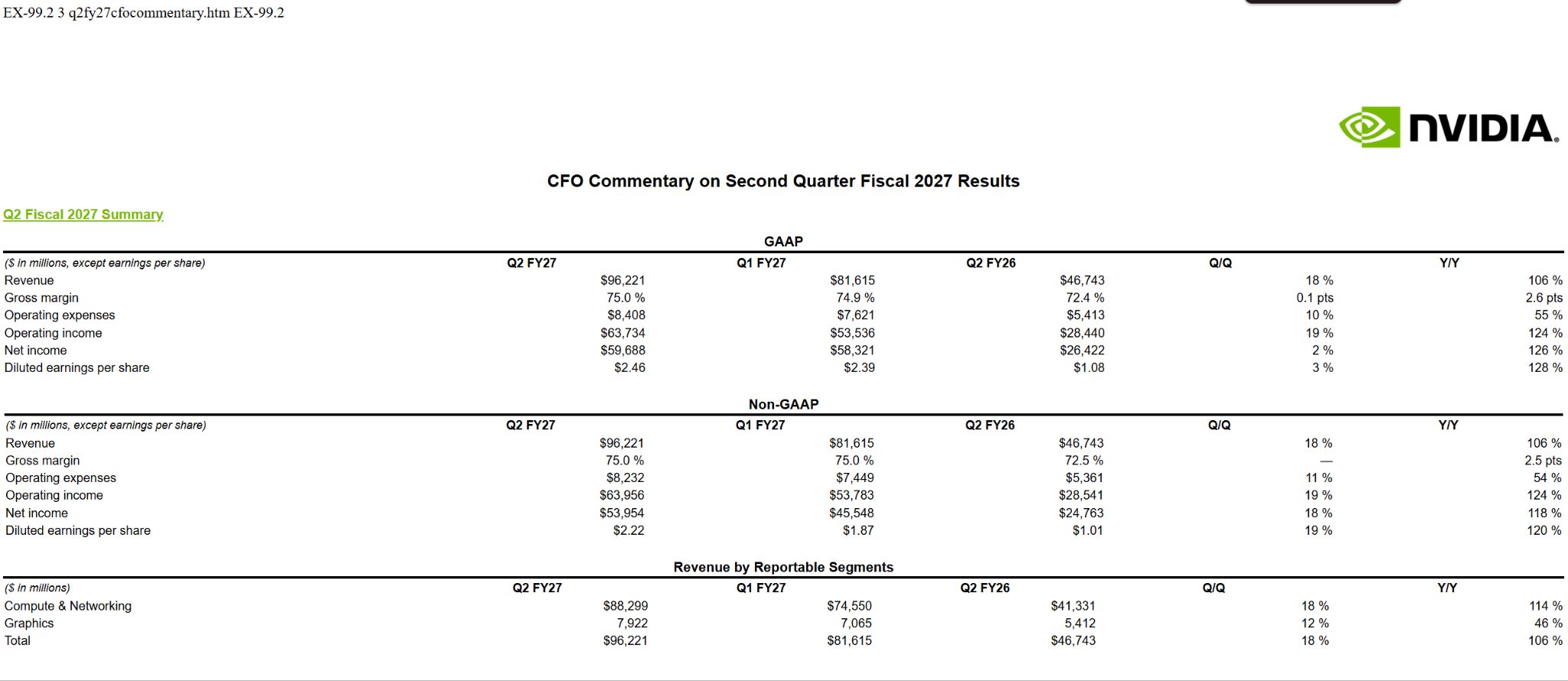
And what about Nvidia? This one is a little difficult to judge, as we'll need to wait and see what happens with the drama unfolding with its CEO. Also, expectations heading into the upcoming earnings report are very high. The company guided fiscal third-quarter revenue to $108 billion, plus or minus 2%, with gross margin of about 74%, and management has already said pricier memory will likely push it down to a low of between 71% and 72% in the fourth quarter.
 Screenshot courtesy of www.sec.gov
Now, the next 60 days should go a long way in showing which camp is right.
Applied Materials (AMAT) reports first, on Nov. 12. After all, this company is one of the world’s largest makers of chipmaking equipment, so its outlook should show whether chipmakers are still ordering new tools. Then Nvidia follows on Nov. 17, and I’ll be paying more attention to the company’s forecast for the current quarter than to the results for the quarter it just wrapped up, because that will show whether customers are still placing orders amid this week's scare.
Beyond earnings, the political side will take a bit longer to play out. Specifically, the new Congress takes office in January, and that’s when we’ll find out whether all the talk about regulating AI and data centers turns into actual bills. Until then, I’ll be keeping an eye on how the SOX holds up compared with where it bottomed on Nov. 5.
If the index can climb back above 10,000 and stay there, I’d read last week’s crash as panic selling. But a close below the Nov. 5 low of 9,011.14 would suggest investors see a slowdown in AI spending coming. So, where does that leave me?
Where I Stand on Chip Stocks After the Rebound
I think this rebound has more room to run for the companies selling to cash-rich buyers, and I’d happily add to those names on weakness. This tale is as old as time. Patient investors don’t often get a chance like this, with prices knocked down while order books keep growing. For investors who want the sturdiest exposure, Broadcom, Micron and AMD’s data center business fit best, along with the rest of the memory supply chain. I'm calling Nvidia a toss-up only becuase of its CEO drama, while Qualcomm is the higher-risk, higher-reward play, best suited to investors with the patience to wait for margins to stop falling.
That said, I’m not brushing off the risks. Funding pressure, memory costs, and higher rates could still knock weaker names lower, and I wouldn’t be surprised to see another rough patch before things settle down. For me, that’s a reason to be choosy about what I buy, and it doesn’t change my overall view. So, with all of that in mind, I’m keeping my ratings on the chip stocks I already cover right where they are, since the recovery looks sturdy for some of them and fragile for others.
On the date of publication, Rick Orford had a position in: GOOGL , MSFT , AMZN , META . All information and data in this article is solely for informational purposes. For more information please view the Barchart Disclosure Policy here.
More news from Barchart
Chip Stocks Rebound After a 12% Crash, But Not All Semiconductor Picks Have Staying Power Anthropic’s Pre-IPO Valuation Has Dropped 30%. Why That’s a Warning for Investors Wanting to Buy ANT Stock After the IPO. Anthropic Is Reserving 20% of Its IPO for Retail Investors. Here’s What Claude Thinks. 3 Ways to Play Stock Market Defense and Avoid Getting Trapped in a Face-Ripping Selloff