


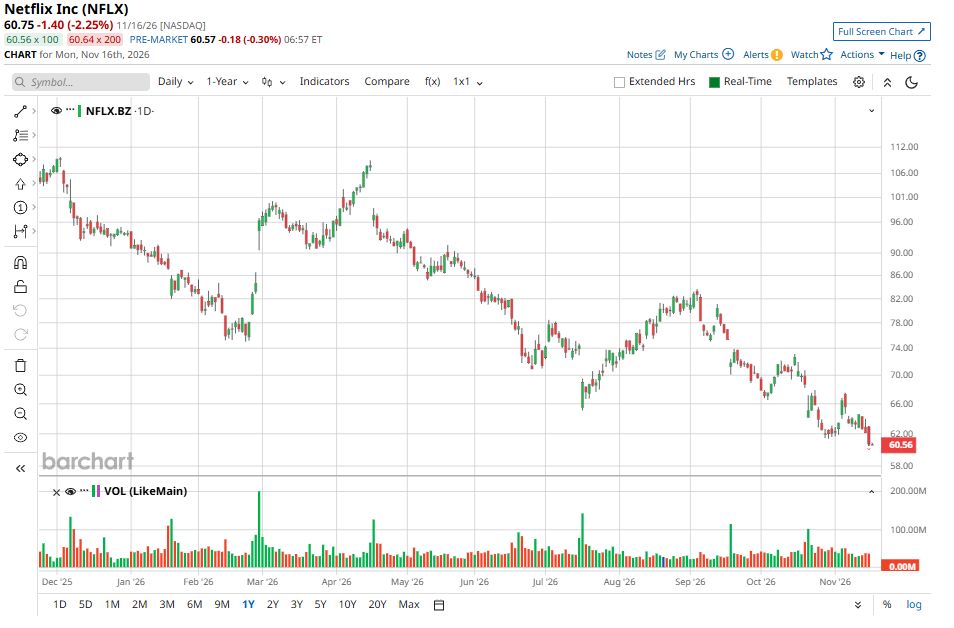
Netflix (NFLX) has faced significant pressure in 2026, with its shares trading close to their 52-week low after losing more than 45% of their value over the past year. The sharp correction reflects growing investor concerns about the company's ability to sustain subscriber engagement, maintain strong revenue growth, and defend its competitive position in a highly competitive digital entertainment market.
However, the steep decline in Netflix stock has not translated into a uniformly bullish outlook among analysts. Wall Street’s sentiment remains mixed, indicating caution ahead.
More Top Stocks Daily: Go behind Wall Street’s hottest headlines with Barchart’s Active Investor newsletter.
 www.barchart.com
Slowdown in Growth Hurting Netflix Stock
One key reason Netflix stock is declining is the gradual deceleration in revenue growth amid growing concerns about engagement. Although Netflix continues to expand its top line, the pace of growth has steadily moderated.
NFLX’s top line increased 17.6% year over year in Q4 2025, before slowing to 16.2% in Q1 2026, 13.4% in Q2, and 11.8% in Q3.
The slowdown also raises broader questions about Netflix's ability to generate incremental growth from its existing subscriber base and newer monetization initiatives.
Netflix is no longer competing exclusively with traditional television networks and subscription-based streaming platforms. Short-form video services, particularly YouTube and Instagram Reels, have become significant alternatives for consumer entertainment. Their continuously updated content libraries, personalized recommendations, and easily accessible viewing formats create a compelling proposition for audiences with limited leisure time.
This shift in consumption patterns could affect Netflix's engagement metrics over time. As viewers distribute their attention across multiple platforms, maintaining viewing hours and strengthening content loyalty may require higher investment in original programming and more consistent content delivery.
Netflix’s Growth Forecast Came Below Expectations
Adding to the challenges, Netflix’s latest financial outlook fell short of estimates. For Q4 2026, Netflix projected revenue of $13.4 billion, falling short of analysts’ consensus expectations. The forecast also implies a further moderation in year-over-year revenue growth to around 11.5%.
Advertising is another area attracting scrutiny. Netflix has reduced its 2026 advertising revenue target to $2.7 billion from its earlier projection of $3 billion, citing a slower-than-expected rollout of certain advertising capabilities. The downward revision raises questions about how quickly the company can scale this emerging business.
Nevertheless, the advertising opportunity remains an important component of Netflix's longer-term growth strategy. A successful advertising business could broaden its revenue base, improve monetization across subscription tiers, and reduce its dependence on subscription price increases.
Analysts’ Sentiment Remains Mixed on NFLX Stock
While Netflix stock is trading near a 52-week low, the company continues to show resilience, supported by its pricing power and loyal subscriber base. During the Q3 conference call, Netflix management said retention remains encouraging across major markets, with both global and U.S. churn rates declining year over year in Q3. This suggests users have responded well to recent price increases.
Also, the significant decline in its stock price has lowered its valuation. Netflix shares are trading at 17.5 times forward earnings, considerably below the premium levels it used to trade at. However, Netflix stock is not undervalued.
For comparison, Disney (DIS) trades at approximately 15.8 times forward earnings, making it relatively cheaper than Netflix. Also, Netflix’s valuation doesn’t appear compelling relative to its earnings growth forecast.
Thus, while Netflix stock is trading near its 52-week low, slowing revenue growth, growing competition, engagement concerns, and a weaker outlook for advertising revenue could pose challenges. Wall Street remains divided on Netflix’s outlook. Analysts currently maintain a “Moderate Buy” consensus rating.
Is Netflix Stock a Buy Near Its 52-Week Low? Not Yet
Although improving retention, pricing power, and the long-term advertising opportunity provide some support, Netflix stock does not yet appear compelling relative to its growth prospects. Furthermore, its “Moderate Buy” consensus rating reflects the uncertainty surrounding its recovery.
Given the mixed analysts’ sentiment and ongoing competitive pressures, investors should adopt a cautious stance rather than rush to buy the dip.
On the date of publication, Amit Singh did not directly have a position in any of the securities mentioned in this article. All information and data in this article is solely for informational purposes. For more information please view the Barchart Disclosure Policy here.
More news from Barchart
‘I Would Be Honored to Answer These Calls and Return as CEO,’ Jensen Huang Says as Employees, Fellow Tech Leaders Rally Behind the Nvidia Founder Billionaire Charlie Munger Called Robinhood ‘A Gambling Parlor Masquerading As a Respectable Business’ and Now They Hold 70 Million Trump Accounts A Strong Q3 Puts Nvidia (NVDA) Stock on Track for a Quick 194% Options Payout As Netflix Stock Hovers Near Its 52-Week Low, Analyst Sentiment Remains Mixed. Here's Why.