

Nvidia's (NVDA) recent troubles have put its share-price decline under the spotlight, particularly following Jensen Huang’s departure as CEO on Thursday, Nov. 12. Shares hit a 52-week low of $148.80 that day, as corporate governance concerns and questions surrounding the chipmaker’s potential relationship with China added to an already difficult backdrop.
Post-election concerns about a possible slowdown in data center spending have also weighed on artificial intelligence (AI) chip stocks. Yet Nvidia’s sizeable capital-return plans offer a compelling counterpoint to the negative sentiment. Last month, the technology heavyweight announced an additional $150 billion in stock buyback authorization, setting a record for the largest repurchase allocation in history.
More Top Stocks Daily: Go behind Wall Street’s hottest headlines with Barchart’s Active Investor newsletter.
The board of directors approved the increase, taking the total authorization to $235 billion. Substantial cash generation backs this commitment, with Nvidia’s latest quarterly revenue and earnings comfortably exceeding Wall Street expectations. The semiconductor giant also spent $28.1 billion on share repurchases and cash dividends in Q3, underscoring its capacity to return capital.
That being said, Jonathan Weber, Investing Group Leader for Cash Flow Club, views the expanded program favorably. Despite lingering leadership uncertainty, he believes buying back shares at current, relatively inexpensive levels could reduce the share count and create meaningful value for Nvidia’s shareholders.
About Nvidia Stock
Based in Santa Clara, California, Nvidia operates globally across AI infrastructure, accelerated computing, and graphics processing. Its product lineup encompasses graphics processing units (GPUs), data center platforms, networking solutions, AI software, and autonomous vehicle technologies.
With a market cap of around $3.7 trillion, the chip designer serves customers across gaming, enterprise, cloud computing, professional visualization, and automotive markets. This broad reach has helped establish Nvidia as a major force in the global technology landscape, although its recent share-price performance has been considerably less impressive.
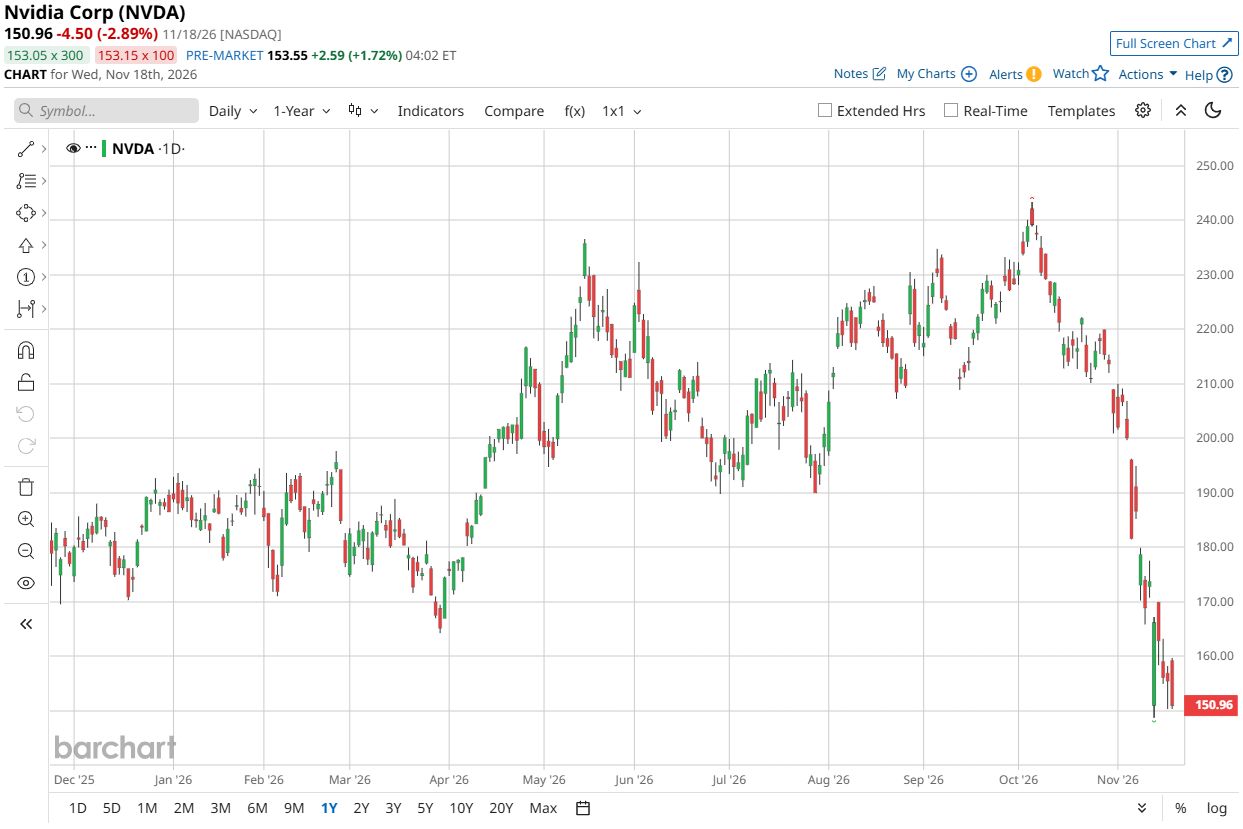
Over the last 52 weeks, NVDA stock has declined 18%, while its year-to-date (YTD) loss stands also at 18%. The weakness has intensified over shorter periods, with shares tumbling 31% in the past six months. The past month has brought another 30% decline, extending an already painful stretch for shareholders.
 www.barchart.com
The selloff has, however, changed the stock’s valuation profile. NVDA stock is currently trading at 15.65 times forward adjusted earnings, a multiple below both the industry average and its own five-year average multiple. The discount is another factor when assessing whether the recent decline has made the shares more attractive.
Beyond buybacks, the Santa Clara-based technology leader also returns cash through dividends. Nvidia currently pays an annual dividend of $1 per share, representing a yield of 0.64%. Its next quarterly cash dividend of $0.25 per share will be paid on Wednesday, Dec. 23, to shareholders of record on Wednesday, Dec. 2.
Q3 Earnings Surpassed Expectations
On Tuesday, Nov. 17, Nvidia reported its Q3 FY2027 results, with revenue jumping 103.2% year-over-year (YoY) to $115.8 billion. The figure exceeded analysts’ estimates of $109.5 billion, reflecting continued spending on AI infrastructure and accelerated computing.
Data Center remained the dominant contributor, generating $107.6 billion in revenue, up 110.2% YoY. Hyperscalers and cloud service providers continued to spend heavily on AI infrastructure, while increasing demand for training and inference workloads provided another important source of momentum for the segment.
The growth pipeline received another boost as shipments of the next-generation Vera Rubin NVL72 platform began during the quarter. Elsewhere, Edge Computing revenue increased 41.4% YoY to $8.2 billion, supported by AI PCs, RTX products, automotive applications, and robotics.
Cash generation was equally impressive, with free cash flow climbing 98.2% YoY to $43.8 billion. Profitability also strengthened, as non-GAAP gross margin expanded 140 basis points to 74.9%. Meanwhile, non-GAAP operating expenses rose 51.7% from the year-ago value to $8.8 billion.
Higher expenses did little to interrupt earnings growth. Non-GAAP operating income increased 115.8% YoY to $77.9 billion, while non-GAAP net income jumped 109.4% to $64.9 billion. Non-GAAP diluted EPS climbed 111% to $2.68, comfortably beating Wall Street’s forecast of $2.47.
Management expects the momentum to continue into Q4 FY2027, projecting revenue of $130 billion, plus or minus 3%, assuming no Data Center compute revenue from China. Non-GAAP gross margin is forecast to range between 71% and 72%, indicating some moderation from the 74.9% achieved in the latest quarter.
On the other hand, analysts estimate Q4 FY2027 EPS to grow 73.3% YoY to $2.72, while full-year FY2027 EPS is expected to increase 102.6% from the previous year to $9.26. For FY2028, the bottom line is projected to rise 67.9% YoY to $15.55.
What Do Analysts Expect for NVDA Stock?
Despite the recent volatility, analyst sentiment remains broadly positive. Rosenblatt analyst Kevin Cassidy is keeping a “Buy” rating and a $300 price target. Commenting on the leadership transition, Cassidy described interim CEO Colette Kress as “cool, calm and confident,” citing her reassuring message, “we got this.” He believes the latest earnings announcement should help restore confidence in the business.
Cassidy also questioned the severity of the recent weakness across AI stocks, arguing that the sector's selloff went too far. “We believe Nvidia’s results demonstrate that the recent sell-off across the AI sector was overdone,” the analyst said, highlighting the contrast between the market reaction and the semiconductor giant’s latest financial performance.
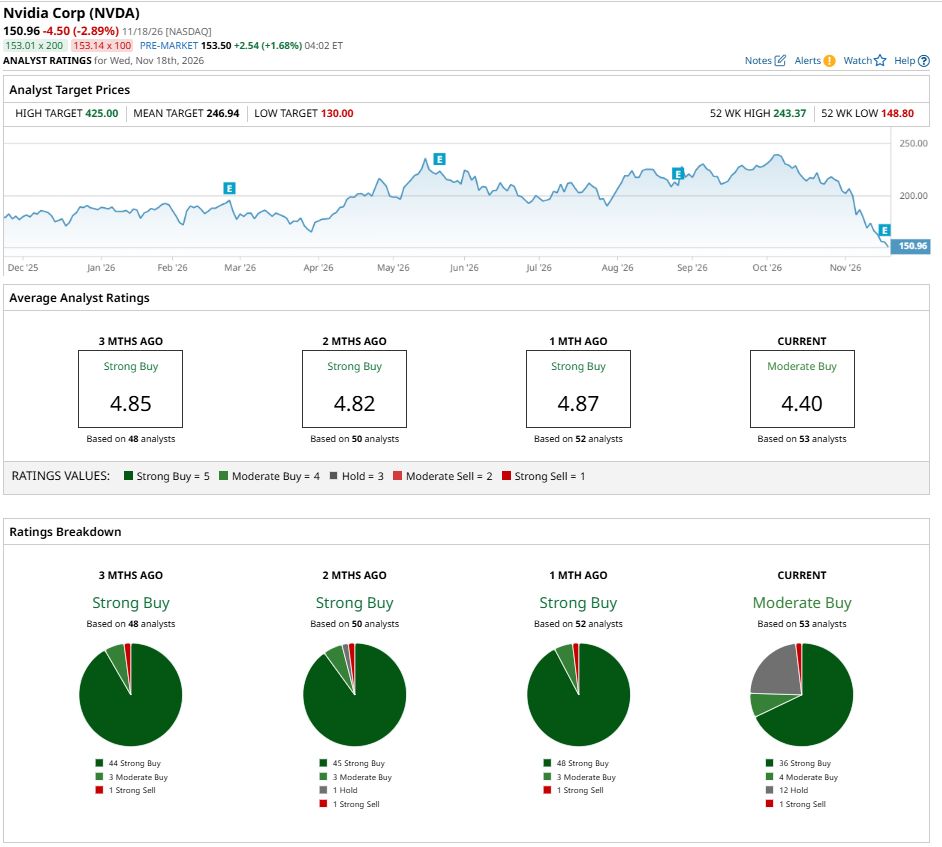
The broader analyst community appears to share much of that optimism. Nvidia currently carries an overall consensus “Moderate Buy” rating, based on coverage from 53 analysts. Of these, 36 recommend a “Strong Buy,” four assign a “Moderate Buy,” 12 maintain a “Hold” rating, and one has issued a “Strong Sell.”
Price targets further indicate how much upside analysts see in the shares. The average price target of $246.94 indicates a potential upside of 64%. Meanwhile, the Street-high target of $425 suggests potential gains of 182% from current levels.
 www.barchart.com
On the date of publication, Aanchal Sugandh did not directly have a position in any of the securities mentioned in this article. All information and data in this article is solely for informational purposes. For more information please view the Barchart Disclosure Policy here.
More news from Barchart
A $150 Billion Reason to Buy the Nvidia Stock Dip Eli Lilly’s Next Weight-Loss Drug Helped Patients Lose Up to 54 Pounds. Why the FDA’s New Warning Didn’t Hurt LLY Stock. Coatue Management Bets on SK hynix Stock as Demand for HBM Chips Accelerates TD Cowen Just Upgraded UnitedHealth Stock. Here’s Why.