

On Nov. 17, Nvidia (NVDA) reported its first earnings without Jensen Huang, and it was a blowout quarter again. Revenue of $115.8 billion jumped 20% from the previous quarter and 103% from a year ago, comfortably beating the $109.1 billion consensus. As I wrote in my earnings preview, management itself had guided for $108 billion, so Nvidia cleared its own forecast by nearly $8 billion. The data center business made most of the revenue, with $107.6 billion, up 110% from a year ago. Adjusted earnings per share of $2.68 also beat the $2.48 expected. Non-GAAP gross margin was 74.9%, and interim CEO Colette Kress also committed to a 72% to 73% gross margin for fiscal 2028.
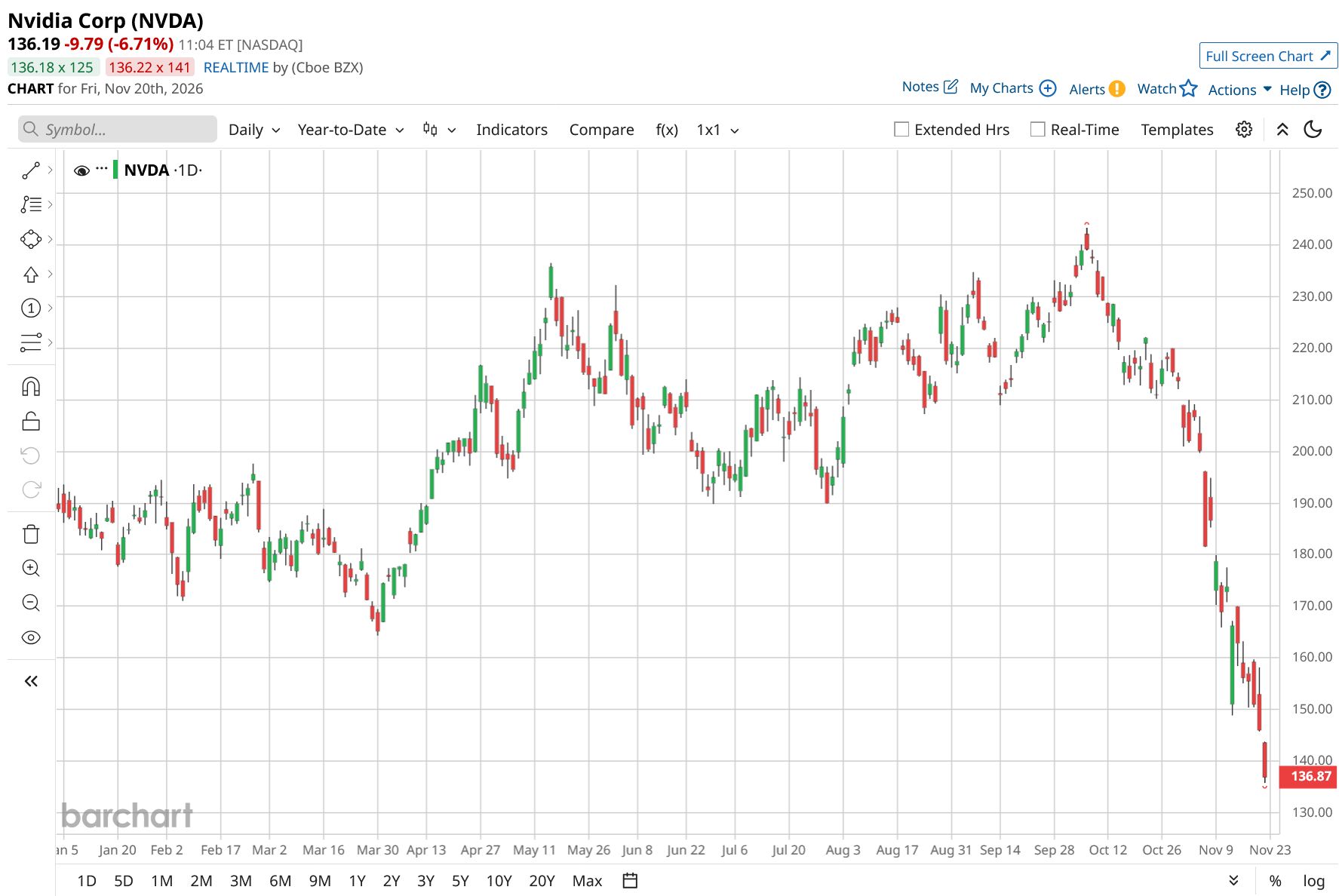
The outlook was strong too, with Nvidia expecting another record quarter with revenue of $130 billion, plus or minus 3%. Once again, the forecast doesn't assume any data center compute revenue from China, which is something I pointed out after its August report as well. So the business keeps growing without one of its biggest markets. But despite all that, NVDA stock is nearly 40% below its all-time high from October.
More Top Stocks Daily: Go behind Wall Street’s hottest headlines with Barchart’s Active Investor newsletter.
About Nvidia Stock
Nvidia is the chipmaker behind most of the world's AI computing, and it's now being run by interim CEO Colette Kress after Jensen Huang's resignation. Its products include GPUs, data center systems like Blackwell and Vera Rubin, networking gear, and its CUDA software. Founded in 1993, the company is headquartered in Santa Clara, California, and the board is still searching for a permanent CEO.
Nvidia's stock is down about 26% this year, well behind the S&P 500's ($SPX) 3.9% gain, with most of that drop coming in the past month alone. It hit an all-time high in early October after a record $150 billion buyback boost and excitement over AI agents. Since then, a spy probe tied to a customer, a broad AI selloff, and Huang's scandal and resignation have all weighed on NVDA stock, pushing it down nearly 40% from its peak.
 www.barchart.com
Nvidia's stock already looked cheap this year compared to its own history, and the discount has gotten a lot steeper after the recent sharp selloff. The forward non-GAAP price-to-earnings (P/E) of 16.64x sits about 60% below its five-year average of 41.20x. Similarly, the forward price-to-sales (P/S) ratio of 9.10x is also about 53% below its five-year average of 19.37x. That's a considerable discount, especially for a company that just doubled its revenue. The EPS outlook makes the discount look even more attractive. Analysts expect earnings to more than double in fiscal 2027 and grow another 72% in fiscal 2028, which would bring the P/E down to about 9x. The balance sheet is solid too, with $62.47 billion in cash against $38.86 billion in debt. So the numbers all favor Nvidia. The discount is mostly due to investors worrying about whether AI spending can last, tougher competition from custom chips, and pushback against new data centers. Huang's exit just added one more worry. But if Nvidia can continue to deliver numbers like this in the upcoming quarters without Huang, I think the discount looks too steep.
The Leadership Question
That said, I think more than the numbers, investors wanted clarity on the firm's leadership after Huang's exit during the quarterly report. Chairman Harvey Jones said that the board does not intend to bring Huang back and that it has hired an outside search firm to help find Huang's replacement. Kress said that from a business standpoint, it was “business as usual” at Nvidia. Regarding Huang's exit, she said that there are “diverse opinions” among employees. The board also formed a new oversight committee for national security and export controls, which matters after the Megaspeed spy investigation that first put Huang under pressure.
Overall, the numbers were extraordinary, which was more or less expected. But I think the quarter itself does not yet prove that Nvidia can perform the same without Huang. He led this quarter from start to finish, even though Kress presented the results. So the $130 billion quarter now underway is the one that, for the most part, will be led by Kress. This is why the next quarter will be the first real test without Huang. Cathie Wood recently said that Nvidia “cannot be just the Jensen show” as ARK bought shares worth $17 million during the dip before earnings.
What Do Analysts Expect for NVDA Stock?
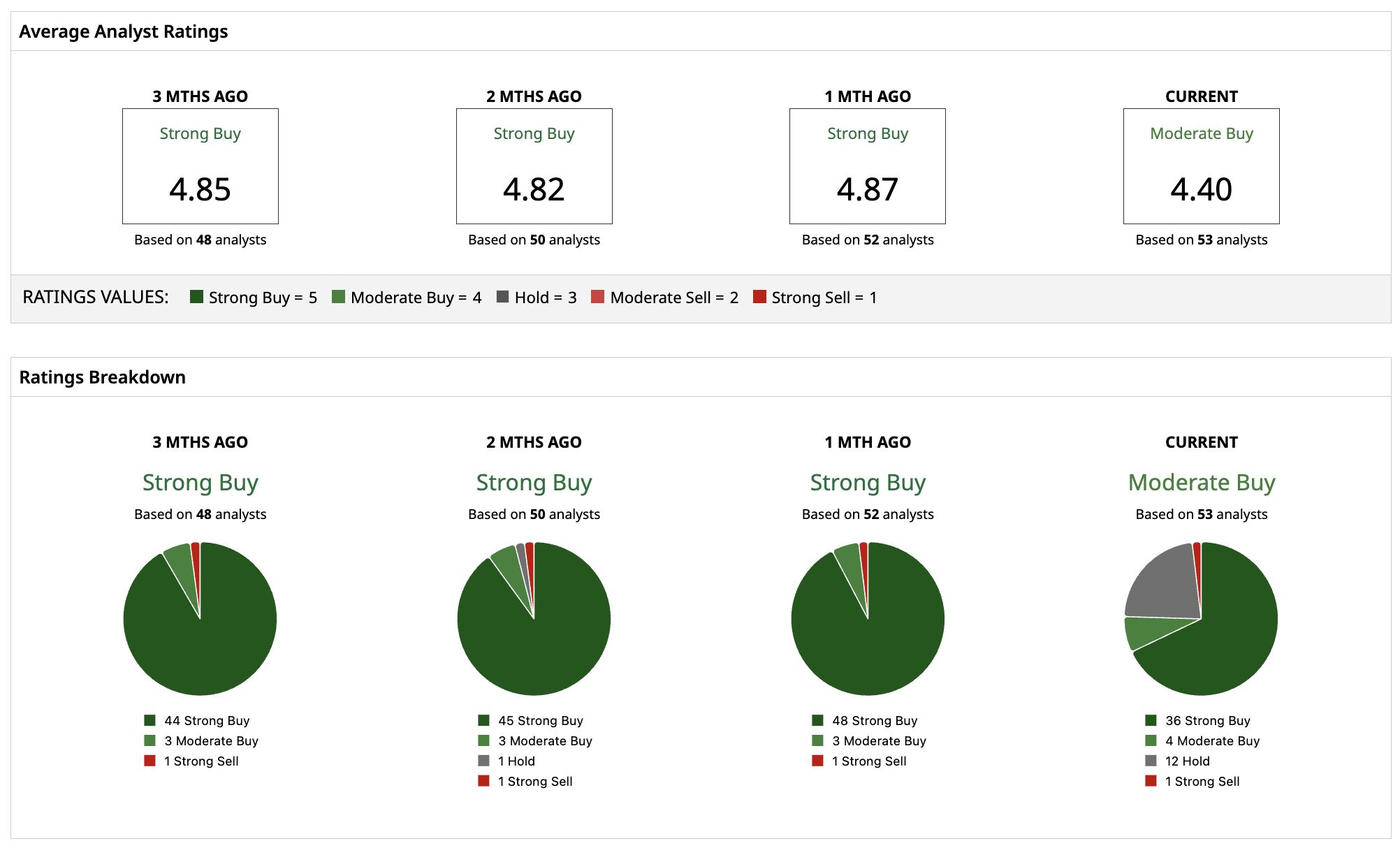
Wall Street has been reigning in the optimism a bit, though. Based on 53 Wall Street analysts, NVDA stock holds a “Moderate Buy” rating, down from a “Strong Buy” a month ago, with a mean price target of $245.72, indicating about 79% upside.
 www.barchart.com
On the date of publication, Jabran Kundi did not directly have a position in any of the securities mentioned in this article. All information and data in this article is solely for informational purposes. For more information please view the Barchart Disclosure Policy here.
More news from Barchart
AMD Gained From Nvidia’s China Scandal. Now a Short Seller Says AMD Has a China Problem Too. Leadership Risk vs. Record Numbers: Nvidia Posted $115 Billion in Revenue in Its First Report Without Jensen Huang. What It Means for NVDA Stock. Tech and AI Sentiment, Thanksgiving and Other Key Things to Watch this Week 2 Energy Stocks Bridgewater Associates Is Buying Right Now