


Charter Communications, Inc. (CHTR) operates as a broadband connectivity and cable operator company serving residential and commercial customers. Valued at $14.7 billion by market cap, the company offers cable broadcasting, internet, voice, and mass media services.
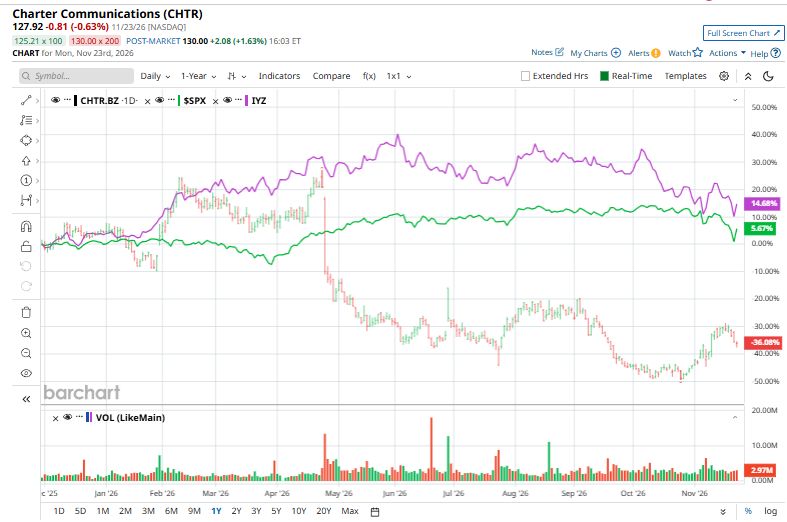
Shares of this broadband giant have considerably underperformed the broader market over the past year. CHTR has declined 37.4% over this time frame, while the broader S&P 500 Index ($SPX) has rallied 9.6%. In 2026, CHTR’s stock fell 12.4%, compared to the SPX’s 5.7% rise.
More Top Stocks Daily: Go behind Wall Street’s hottest headlines with Barchart’s Active Investor newsletter.
Narrowing the focus, CHTR has also trailed the iShares U.S. Telecommunications ETF (IYZ), which has gained about 18.8% over the past year. Moreover, the ETF’s 11% returns on a YTD basis outshine the stock’s losses over the same time frame.
 www.barchart.com
On Nov. 6, Charter Communications reported mixed Q3 2026 results, and its shares dipped 6.2% as broadband subscriber losses, and declining pro forma revenue and EBITDA weighed on performance. While the acquisition of Cox Communications boosted reported revenue and expanded Charter's customer base, underlying operating performance remained under pressure
The company posted pro forma revenue of $16.5 billion, down 1.5% year-over-year, while adjusted EBITDA fell 4% to $6.6. Residential revenue declined 4.1% to $12.2 billion, reflecting a 2.7% decrease in residential customers and a 1.6% decline in average monthly revenue per customer. Internet customers fell by 3.7% to $7 billion on a pro forma basis, while video revenue dropped 9.8% to $3.61 billion. Charter also reported a net loss of $2.40 billion, primarily due to a $6.3 billion non-cash franchise impairment charge.
However, mobile service revenue increased 17.3% to $1.16 billion, supported by subscriber growth, and advertising revenue rose 21% to $487 million, partly benefiting from higher political advertising. Following its acquisition of Cox Communications, the company introduced an Internet-first operating strategy and targeted approximately $2 billion in annualized operating expense savings over 18 months, alongside more than $1 billion in planned Cox synergies. Despite encouraging early signs of improved subscriber trends at Cox, persistent broadband weakness and pressure on underlying profitability remained key concerns.
For the current fiscal year, ending in December, analysts expect CHTR’s EPS to decrease 15.6% to $30.55 on a diluted basis. The company’s earnings surprise history is mixed. It missed the consensus estimates in two of the last four quarters while surpassing the forecast on another occasion.
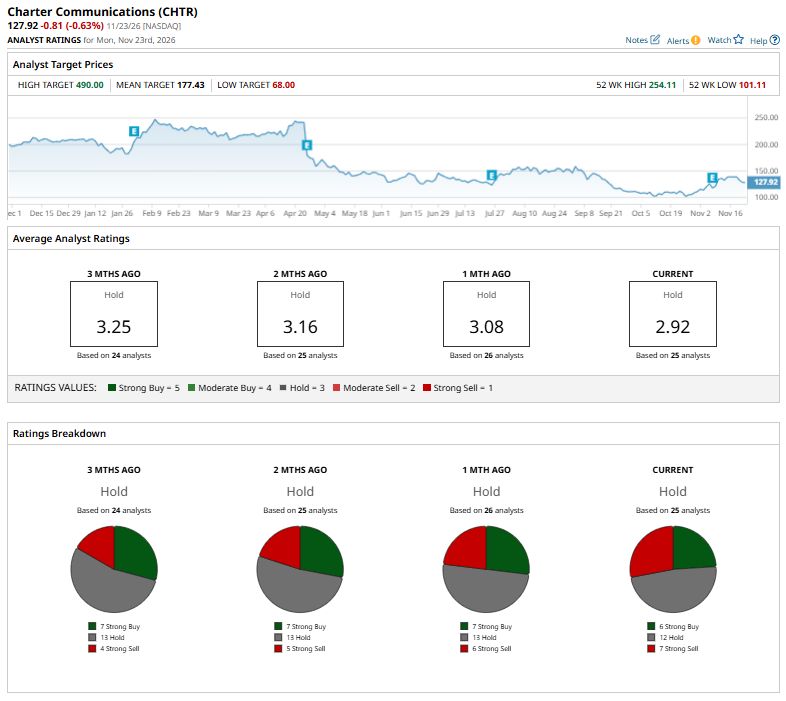
Among the 25 analysts covering CHTR stock, the consensus is a “Hold.” That’s based on six “Strong Buy” ratings, 12 “Holds,” and seven “Strong Sells.”
 www.barchart.com
This configuration is less bearish than a month ago, with seven analysts suggesting a “Strong Sell.”
On Nov. 23, JPMorgan reiterated a “Neutral” rating on Charter Communications and maintained its $150 price target.
The mean price target of $177.43 represents a 38.7% premium to CHTR’s current price levels. The Street-high price target of $490 suggests an ambitious upside potential of 283.9%.
On the date of publication, Kritika Sarmah did not directly have a position in any of the securities mentioned in this article. All information and data in this article is solely for informational purposes. For more information please view the Barchart Disclosure Policy here.
More news from Barchart
Bearish Outlook? Try These 2 Bear Call Spread Trades on Tuesday ‘Rich People Buy the Care They Want’: Dr. Oz Says Medicare for All Is Really Just Medicaid With a $47 Trillion Price Tag Nasdaq Futures Plunge as Nvidia-Fueled Rally Fades This Healthcare Stock Just Raised Its Dividend by 3.5%