

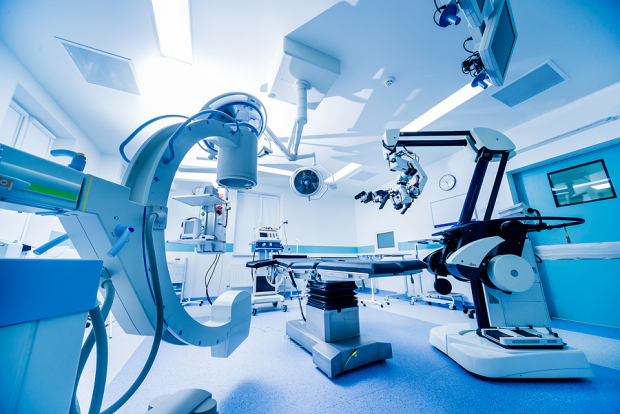
While electric vehicles and tech giants like Tesla TSLA and Alphabet GOOGL dominate headlines in the robotics space, a powerful transformation has reached an inflection point in healthcare. Over the past decade, robotics in medicine has moved from early adoption to mainstream scale.
This acceleration has been driven by an aging global population, a persistent shortage of skilled surgeons and clinical staff, and the increasing push for minimally invasive procedures that offer faster recovery times and better patient outcomes. What was once dominated by the use of robots in a handful of guided surgeries has now expanded into varied branches ranging from orthopedics and pharmacy automation to artificial intelligence (AI)-driven diagnostics.
For investors looking to capitalize on this clinical migration, the challenge lies in differentiation. While standard healthcare funds offer stable dividends, they often dilute the tech-driven upside of advanced engineering.
Broad robotics exchange-traded funds (ETFs), which have historically prioritized factory automation, material handling, and semiconductor equipment suppliers, have expanded their allocation to med-tech innovators like Intuitive Surgical ISRG in the recent past.
Evaluating the true potential of these robotics ETFs requires a ground-up look at the dominant healthcare stocks leading the charge and the clinical market dynamics driving their bottom lines.
Pioneering Stocks in Healthcare Robotics
Several key healthcare stocks demonstrate the broad range of robotics applications across the medical field, a few of which are discussed below.
• Intuitive Surgical: As the pioneer in robotic-assisted surgery, its da Vinci system is a household name, allowing for complex procedures through small incisions. The company continues to show strong performance for this product, with Da Vinci procedures having risen approximately 16% year over year in the first quarter of 2026.
ISRG grew its da Vinci surgical system installed base to 11,395 systems as of March 31, 2026, reflecting an increase of 12%. The new da Vinci 5 platform is driving higher utilization, and its data-rich ecosystem is creating a long-term competitive advantage in AI.
• Illumina ILMN: While best known for its gene-sequencing technology, Illumina is a prime example of robotics in lab automation. The company developed robotic systems like the Infinium Automated Pipetting System, which automates highly labor-intensive sample preparation workflows, as well as Digital Microfluidics, which is a droplet-based automation technology that moves, merges, and mixes liquid droplets using electrical signals. This minimizes human error and dramatically reduces processing time, which are critical for large-scale genomic studies and clinical diagnostics.
• Stryker SYK: A major player in medical devices, Stryker is a leader in orthopedic robotics. Its Mako system is used for robotic-arm assisted total knee, partial knee, and total hip replacements, offering surgeons enhanced precision and control. This technology has benefited the company's financial performance.
From surgical precision to laboratory efficiency, these examples illustrate how robotics is becoming integral to modern healthcare delivery across multiple specialties.
Industry Outlook and the Role of ETFs
As technology advances, we are moving closer to AI-enhanced surgical systems that improve decision-making, micro-robotic devices capable of navigating the human body for targeted therapy, and autonomous diagnostic tools that assist in early disease detection.
Against this backdrop, the outlook for healthcare robotics is exceptionally bright. According to a report published by Johns Hopkins University in May 2025, the global healthcare robotics market is expected to increase from approximately $14.9 billion in 2023 to $57.0 billion by 2032.
While picking a single winner in this rapidly growing $57 billion market can be challenging, investing in a specialized robotics ETF provides a more balanced entry point. Rather than relying on a single clinical breakthrough, these funds grant investors exposure to the entire robotics value chain.
This diversified approach can potentially boost profits by capturing growth across industrial automation, logistics, and other sectors, while mitigating the risk associated with any single company or sub-sector.
Robotics ETFs to Consider
For investors looking to tap into the robotics industry’s pioneering growth prospects, the following ETFs stand out:
Global X Robotics & Artificial Intelligence ETF BOTZ
This fund, with net assets worth $3.43 billion, offers exposure to 62 companies that potentially stand to benefit from increased adoption and utilization of robotics and AI, including those involved in industrial robotics and automation, non-industrial robots, and autonomous vehicles. Keyence Corp holds the first spot in this fund, with 9.69% weightage, while ISRG holds the fifth position with 6.72% weightage.
BOTZ has rallied 13.1% over the past year. The fund charges 68 basis points (bps) as fees and traded at a good volume of 1.33 million shares in the last trading session.
ROBO Global Robotics and Automation Index ETF ROBO
This fund, with net assets worth $2.09 billion, offers exposure to 79 companies that are driving transformative innovations in robotics, automation, and artificial intelligence (RAAI), including companies that create technology to enable truly intelligent systems that can sense, process, and act, and companies that apply those technologies to deliver RAAI-enabled products, including robots, to businesses and consumers. Harmonic Drive Systems holds the first spot in this fund, with 1.92% weightage, while ISRG holds the fourth position with 1.77% weightage. ILMN holds the sixth spot in this fund, with 1.69% weightage.
ROBO has surged 36.2% over the past year. The fund charges 95 bps as fees and traded at a volume of 0.29 million shares in the last trading session.
First Trust NASDAQ Artificial Intelligence and Robotics ETF ROBT
This fund, with net assets worth $728.2 million, offers exposure to 114 companies engaged in AI, robotics and automation. Palo Alto Networks holds the first spot in this fund, with 1.87% weightage, while ILMN holds the fourth position with 1.75% weightage.
ROBT has risen 15% over the past year. The fund charges 65 bps as fees and traded at a volume of 0.03 million shares in the last trading session.
Boost Your Portfolio with Our Top ETF Insights
Zacks' exclusive Fund Newsletter delivers actionable information, top news and analysis, as well as top-performing ETFs, straight to your inbox every week.
Don’t miss out on this valuable resource. It’s free!
Get it now >>Want the latest recommendations from Zacks Investment Research? Today, you can download 7 Best Stocks for the Next 30 Days. Click to get this free report
Stryker Corporation (SYK): Free Stock Analysis Report
Intuitive Surgical, Inc. (ISRG): Free Stock Analysis Report
Illumina, Inc. (ILMN): Free Stock Analysis Report
Tesla, Inc. (TSLA): Free Stock Analysis Report
Alphabet Inc. (GOOGL): Free Stock Analysis Report
ROBO Global Robotics and Automation Index ETF (ROBO): ETF Research Reports
Global X Robotics & Artificial Intelligence ETF (BOTZ): ETF Research Reports
First Trust NASDAQ Artificial Intelligence and Robotics ETF (ROBT): ETF Research Reports
This article originally published on Zacks Investment Research (zacks.com).