

FedEx Corporation FDX, a leading parcel delivery company with a market capitalization of around $75 billion, has seen its shares jump more than 10% so far this year. Improved operational efficiency driven by prudent cost-cutting measures has buoyed the company’s shares. Strong cash flows, a disciplined approach to capital expenditure and resilience in demand in the U.S. domestic package network, despite global uncertainties, have been boosting the company's prospects.
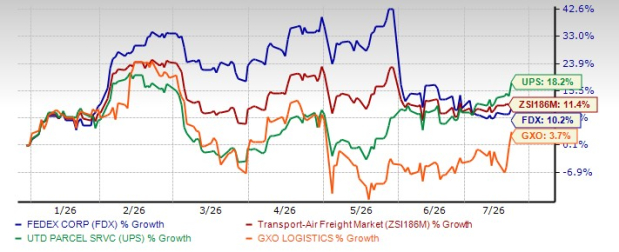
Despite the double-digit gain (% wise) year to date, the stock has marginally underperformed the Zacks Transportation—Air Freight and Cargo industry and rival United Parcel Service UPS. FDX has, however, outperformed fellow industry player GXO Logistics GXO.
YTD Price Comparison
Given the stock’s double-digit price gain on the back of the company’s ongoing cost-cutting initiatives aimed at boosting bottom-line growth, investors may be questioning whether it is a buy at present. Let’s take a closer look to address this question.
FDX Performs Well in Q4 FY26 & Gives Bullish Outlook
In the fourth quarter of fiscal 2026, results of which were released last month, FedEx’s earnings (excluding 29 cents from non-recurring items) of $6.31 per share beat the Zacks Consensus Estimate of $5.91 as well as improved 3.9% year over year. The company’s bottom line benefited from share repurchase activity.
Revenues of $25 billion came ahead of the Zacks Consensus Estimate of $24.1 billion and improved 12.5% from the year-ago quarter. In the quarter, the majority of the revenue growth was driven by business-to-business (“B2B”) services and the three-month period was the brightest quarter within fiscal year 2026 from a B2B perspective. This is in line with the company’s continuous efforts to move away from low-margin parcel traffic.
To bolster margins, FedEx is shifting its focus toward high-margin B2B segments — specifically healthcare, aerospace, automotive and data centers. In Europe, the company achieved its 12th consecutive quarter of international revenue share gains, driven by the strong value proposition and improving service levels.
Apart from focusing on AI tools to improve efficiency and customer experience, the transportation giant is keeping CapEx low to boost profitability. As part of its cost discipline, the company aims to achieve a CapEx of $3.9 billion in calendar year 2026. We note that the company has changed its fiscal year-end from May 31 to Dec. 31. The fiscal year change became effective for the period beginning June 1, 2026.
For the calendar year 2026, FedEx anticipates revenue growth of approximately 11%, including about 3 percentage points of assumed fuel price-driven surcharge benefit. The outlook is likely to be supported by continued momentum within base pricing and increased demand for premium B2B and high-value B2C services. This translates to an adjusted EPS range of $16.90 to $18.10. Robust free cash flow is expected to be generated in the period, with the company intending to repurchase up to $1 billion worth of shares. The company expects to generate cost savings worth $2 billion by the end of calendar 2027.
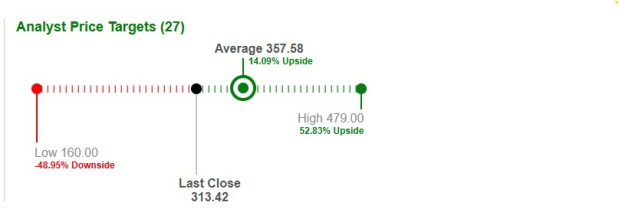
Driven by the cost-cutting initiatives and the impressive outlook, the consensus price target for FDX stock is $357.58, implying an upside of more than 14% from current levels.
Near-Term Headwinds Persist
No doubt, FedEx is seeing consistent improvement, largely supported by efficiencies driven by artificial intelligence, but its near-term outlook remains somewhat uneven. Rising fuel prices, regulatory shifts and wider macroeconomic challenges continue to act as significant obstacles.
With the United States and Iran once again exchanging fire, the already fragile ceasefire is under renewed strain. The uptick in oil prices, following the renewed hostilities, is putting pressure on transportation companies like FedEx.
Since fuel is a major cost component for such businesses, higher prices directly impact profitability. The disruption of the Strait of Hormuz — an essential oil transit route under Iran’s control — has further intensified the situation. Nearly 20% of the world’s traded oil moves through this passage and the disturbance has pushed diesel and jet fuel costs higher, raising expenses across FedEx’s global delivery operations. Moreover, the increase in hostilities in the Ukraine-Russia conflict has accentuated the uncertain global scenario.
In addition, evolving global trade policies are weighing on FedEx’s short-term outlook. The United States has eliminated the “de minimis” exemption for low-value shipments, leading to higher international shipping costs. FedEx now encounters increased brokerage expenses and operational challenges as it must handle formal customs procedures for shipments that were previously exempt from duties. These factors are likely to weigh on margins in the near term, even as FDX works to offset some of the impact through pricing and cost controls.
Valuation Check
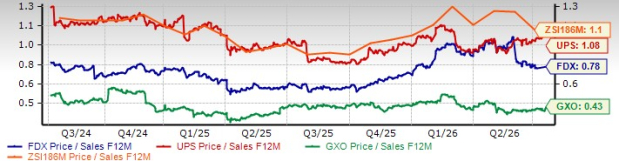
FDX stock is trading at 0.78X forward sales, lower than the industry. Its closest peer, United Parcel Service, has a P/S ratio of 1.08. Meanwhile, GXO Logistics is trading at a forward sales multiple of 0.43. FedEx has a Value Score of B, like United Parcel Service and GXO Logistics
FDX Shares Don’t Appear to be Pricey
Our Take: Hold for Now
FDX’s long-term outlook is becoming increasingly favorable, supported by its emphasis on higher-margin B2B segments, which enhances earnings visibility and margin expansion potential. The company’s commitment to strengthening its bottom line through cost-reduction initiatives is particularly encouraging and could become an increasingly important driver of the long-term investment thesis.
That said, the near-term outlook remains somewhat mixed. Elevated fuel costs, challenges stemming from the removal of the de minimis exemption and broader external uncertainties may continue to weigh on earnings momentum over the next few quarters. Currently, the risk-reward profile does not appear attractive enough to justify a new investment. We believe the stock remains worth holding for investors with a long-term horizon. Potential investors may prefer to wait for a more attractive entry point.
FedEx currently carries a Zacks Rank #3 (Hold). You can see the complete list of today’s Zacks #1 Rank (Strong Buy) stocks here.
7 Best Stocks for the Next 30 Days
Just released: Experts distill 7 elite stocks from the current list of 220 Zacks Rank #1 Strong Buys. They deem these tickers "Most Likely for Early Price Pops."
Since 1988, the full list has beaten the market more than 2X over with an average gain of +23.9% per year. So be sure to give these hand picked 7 your immediate attention.
See them now >>Want the latest recommendations from Zacks Investment Research? Today, you can download 7 Best Stocks for the Next 30 Days. Click to get this free report
FedEx Corporation (FDX): Free Stock Analysis Report
United Parcel Service, Inc. (UPS): Free Stock Analysis Report
GXO Logistics, Inc. (GXO): Free Stock Analysis Report
This article originally published on Zacks Investment Research (zacks.com).