


Shares of Empire Petroleum Corporation EP have risen 16.2% since reporting results for the second quarter of 2026. This compares with the S&P 500 index’s 0.9% decline over the same time frame. Over the past month, the stock has gained 28.2% compared with the S&P 500’s 0.8% return.
Earnings & Revenue Performance
Empire Petroleum reported second-quarter product revenues of $11.1 million, up 27% from $8.7 million a year earlier. After a $1.6-million loss on derivatives, total revenues were $9.5 million, up 8.6% from $8.8 million in the prior-year quarter. The net loss narrowed 63% to $1.9 million from $5.1 million, while the loss per share improved to 5 cents from 15 cents in the prior-year quarter. Adjusted EBITDA turned positive at $365,000 against a loss of $1.2 million in the prior-year period.
Empire Petroleum Corporation Price, Consensus and EPS Surprise
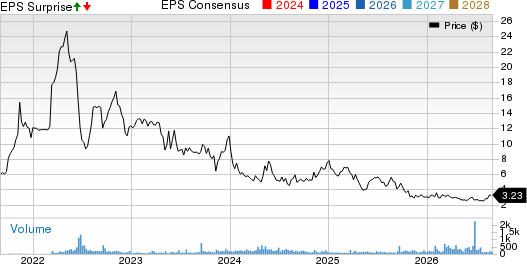
Empire Petroleum Corporation price-consensus-eps-surprise-chart | Empire Petroleum Corporation Quote
Other Key Business Metrics
Average daily equivalent sales fell 23% year over year to 1,825 barrels of oil-equivalent per day. Oil sales volumes declined 14% to 1,278 barrels per day, while natural gas liquids and natural gas represented 18% and 12%, respectively, of the production mix. The realized equivalent price inched up 1% to $41.33 per barrel of oil equivalent. The realized oil price slipped 1% to $58.26 per barrel, including hedging effects, while the natural gas liquids price climbed 58% to $21.08 per barrel. The realized natural gas price was negative $4.22 per thousand cubic feet because deductions exceeded depressed New Mexico gas prices.
Lease operating expenses decreased 21% year over year to $5 million, reflecting lower production and cost-reduction efforts, partly offset by higher New Mexico workover spending. Depreciation, depletion, amortization and accretion fell 36% to about $2 million. The operating loss narrowed to $1.5 million from $4.9 million in the prior-year quarter.
Empire Petroleum ended June with $3.1 million in cash and about $2 million of credit availability, while working capital was negative $16.3 million and first-half operations used $3.7 million. A March rights offering raised $10 million gross; no shares had been issued under a May at-the-market program for up to $7.5 million. Management expects related-party support to supplement liquidity.
Management Commentary
Management characterized the quarter as a period of converting project activity into operational progress. In Texas, compression capacity rose to roughly seven times its initial level, lifting throughput capability to 9.5 million cubic feet per day. Five wells were placed online through reactivations, recompletions and deepening work, while four more moved toward initial production. After the quarter-end, evaluation of the Wakefield-Harrison reached 21,006 feet and identified hydrocarbon indications, although the well had not been completed or production-tested.
In North Dakota, Empire Petroleum completed a major retrofit for its second-generation thermal recovery program and advanced facility upgrades. Louisiana drilling and logging progressed across three wells, which remained drilled but uncompleted at the quarter-end.
Factors Influencing Results
Higher market oil pricing lifted product revenues despite lower output. Production was constrained by natural decline and downtime at certain North Dakota wells undergoing steam-unit enhancement work. Lower lease operating costs and DD&A also helped narrow the loss; the DD&A reduction reflected fourth-quarter 2025 impairments and reduced volumes.
Those benefits were partly tempered by a $1.6-million derivative loss, primarily because market prices exceeded the company’s contracted hedge prices. Production and ad valorem taxes rose to $938,000 from $768,000, alongside higher product revenues, while workover costs increased to roughly $700,000 from $500,000.
2026 Outlook
Empire Petroleum expects Texas activity to build through the second half, with additional reactivations, recompletions and drilling intended to raise gas volumes. The company expects Louisiana to begin generating revenues during the remainder of 2026, with completions targeted for the fourth quarter.
In North Dakota, steam injection from the retrofitted thermal unit is planned for the third quarter, followed by performance monitoring and additional well reactivations. Empire Petroleum also expects a resolution concerning its New Mexico residual-oil-zone rights to reduce operating costs, though timing was not specified.
Other Developments
Empire Petroleum acquired a 25% working interest in a three-well Louisiana development program involving related parties. It issued 1.8 million shares at $3 apiece to fund participation and had accrued about $1 million of additional related costs by quarter-end. A roughly $100,000 purchase of undeveloped North Dakota property interests, initiated in January, completed regulatory procedures during the quarter.
Zacks' Research Chief Names "Stock Most Likely to Double"
Our team of experts has just released the 5 stocks with the greatest probability of gaining +100% or more in the coming months. Of those 5, Director of Research Sheraz Mian highlights the one stock set to climb highest.
This top pick is a little-known satellite-based communications firm. Space is projected to become a trillion dollar industry, and this company's customer base is growing fast. Analysts have forecasted a major revenue breakout in 2025. Of course, all our elite picks aren't winners but this one could far surpass earlier Zacks' Stocks Set to Double like Hims & Hers Health, which shot up +209%.
Free: See Our Top Stock And 4 Runners UpWant the latest recommendations from Zacks Investment Research? Today, you can download 7 Best Stocks for the Next 30 Days. Click to get this free report
Empire Petroleum Corporation (EP): Free Stock Analysis Report
This article originally published on Zacks Investment Research (zacks.com).