

Novo NVO recently entered a new chapter by adopting “Novo” as its day-to-day name, as it seeks to sharpen its focus and competitiveness amid slowing growth and intensifying market competition. The move comes as the stock faces growing investor concerns over its outlook, with shares declining about 5% over the past week and Morgan Stanley’s downgrade of the stock to “Underweight” from “Equal-weight,” adding fresh pressure.
Morgan Stanley retained its $40 (DKK 250) price target but raised concerns that Novo’s valuation does not fully reflect muted medium-term growth and the longer-term risk from the semaglutide patent cliff. The concern is particularly significant given Novo’s heavy dependence on semaglutide-based franchises, including Wegovy for obesity, Ozempic for type II diabetes (T2D) and Rybelsus for T2D, which together accounted for roughly 75.5% of adjusted first-half 2026 sales. With key semaglutide patents set to expire in the early 2030s, questions remain over whether Novo can build new growth drivers quickly enough. The company’s heavy reliance on semaglutide products makes it critical for newer obesity and diabetes treatments to offset potential market-share and pricing pressure on its existing portfolio.
Adding to these concerns, competition from Eli Lilly LLY is intensifying across the GLP-1 market. Mounjaro, approved for T2D, and Zepbound, approved for obesity, have rapidly gained ground in the U.S. GLP-1 market, putting further pressure on Novo’s Ozempic and Wegovy franchises. Lilly’s newly launched GLP-1 pill, Foundayo, has added another competitive threat to the Wegovy pill in the oral obesity market. As a result, investors are increasingly skeptical about Novo’s ability to defend its market position while successfully developing newer obesity and diabetes treatments to offset competitive pressures and prepare for the eventual erosion of its semaglutide franchise.
However, not all is negative for Novo. The company has a broad cardiometabolic pipeline spanning diabetes and obesity, supported by internal innovation, partnerships and acquisitions. With the global obesity market still underpenetrated, Novo retains long-term growth opportunities. To better assess the stock’s investment appeal, let us weigh these long-term opportunities against its near-term competitive, pricing and pipeline challenges.
Semaglutide Franchise Remains NVO’s Top-Line Backbone
As Ozempic, Wegovy and Rybelsus remain Novo’s primary top-line drivers, the company is pursuing broader indications and new formulations to sustain revenues and extend the commercial potential of the semaglutide franchise. Wegovy is approved not only for obesity but also to reduce the risk of major cardiovascular events in certain adults with obesity or overweight and established cardiovascular disease. The company has also secured approvals for higher-dose Wegovy injections in the United States and Europe. At the same time, oral Wegovy for weight management is approved in the United States and the EU.
Novo is similarly seeking to expand semaglutide’s reach in diabetes. Ozempic is indicated to reduce the risk of kidney disease progression and cardiovascular death in certain T2D patients, while the company is pursuing additional label expansions. Rybelsus is approved for cardiovascular-risk reduction in T2D patients in the United States and Europe, and the launch of oral Ozempic for adults with T2D further expands Novo’s oral GLP-1 offering. Positive late-stage data in pediatric T2D and potential label-expansion filings for Rybelsus and oral Ozempic could provide additional avenues to broaden the franchise and support revenue growth.
NVO’s Competition Heating Up in the Obesity Space
Competition in obesity treatment is intensifying as Eli Lilly has emerged as Novo’s biggest rival. Lilly now competes in both injectable and oral obesity therapies with Zepbound and Foundayo, respectively. Novo has sued Eli Lilly over allegedly misleading U.S. GLP-1 advertising that compares Lilly’s Mounjaro and Zepbound with lower doses of Novo’s Ozempic and Wegovy, respectively, while omitting newer, higher-dose data.
The obesity space has drawn much of the spotlight over the past year because of the sizeable and still underpenetrated market opportunity. Smaller biotech firms, such as Viking Therapeutics VKTX and Structure Therapeutics GPCR, are also advancing GLP-1–based therapies to challenge the incumbents. Viking Therapeutics’ dual GIPR/GLP-1 receptor agonist (RA), VK2735, is being developed in both oral and subcutaneous formulations to treat obesity. Viking Therapeutics plans to advance oral VK2735 into phase III development for obesity in the fourth quarter of 2026.
Structure Therapeutics’ phase II ACCESS program on its orally administered small molecule GLP-1 RA, aleniglipron, demonstrated significant weight loss across all doses. Based on such encouraging results, Structure Therapeutics has initiated dosing patients in its late-stage ACCOMPLISHprogram to evaluate aleniglipron for chronic weight management.
NVO Expands Footprint in Rare Diseases and Liver Care
Beyond its GLP-1 portfolio, Novo is broadening its presence in rare diseases. Its regulatory filings for denecimig (Mim8) in the United States and the EU are currently under review, with decisions expected soon, potentially offering a more convenient once-weekly or monthly dosing option for hemophilia A. It has also secured U.S. and EU approvals for Alhemo to treat hemophilia A and B with or without inhibitors, with its prefilled subcutaneous pen designed to reduce reliance on intravenous infusions.
Additionally, Wegovy injectable is approved in the United States for noncirrhotic metabolic dysfunction-associated steatohepatitis (MASH) in adults with moderate-to-advanced liver fibrosis, along with certain other geographies. Meanwhile, Novo has submitted MASH data for the Wegovy pill to the FDA, with a decision expected in first-quarter 2027. Novo’s once-daily oral etavopivat remains a key late-stage rare-disease candidate for sickle cell disease, with the first regulatory filing expected in fourth-quarter 2026.
NVO Focuses on Next-Generation Drugs
Novo is also developing several next-generation obesity candidates in its pipeline, especially targeting the lucrative U.S. market. NVO has submitted a regulatory filing seeking approval of CagriSema injection, a follow-up drug to Wegovy, for obesity. A decision is expected in the fourth quarter. It is also gearing up to launch a dedicated late-stage program evaluating cagrilintide as a monotherapy for obesity.
Another key candidate for T2D and obesity is zenagamtide (formerly known as amycretin), a novel long-acting GLP-1 and amylin receptor agonist, in phase III. The company has also bolstered its pipeline through several major collaborations and acquisition deals. Beyond GLP-1s, Awiqli (once-weekly insulin icodec) is approved in the EU and several other countries for adults with Type 1 and Type 2 diabetes, as well as in the United States for T2D.
NVO’s Stock Price, Valuation & Estimates
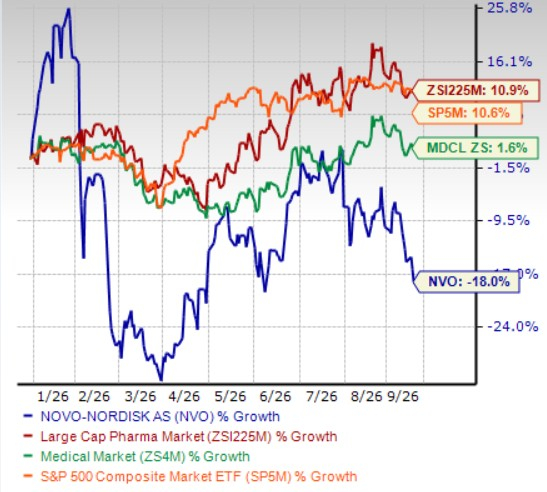
Year to date, Novo shares have lost 18% against the industry’s 10.9% growth. The company has also underperformed the sector and the S&P 500 during the same time frame, as seen in the chart below.
NVO Stock Underperforms the Industry, Sector & the S&P 500
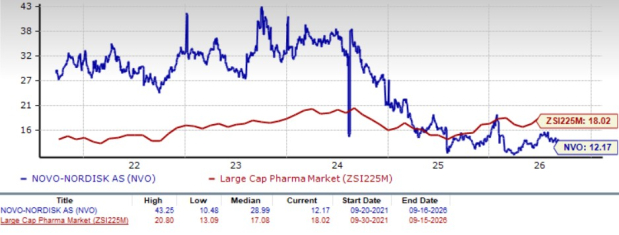
Novo is trading at a discount to the industry, as seen in the chart below. Going by the price/earnings ratio, the company’s shares currently trade at 12.17 forward earnings, which is lower than 18.02 for the industry. The stock is trading much below its five-year mean of 28.99.
NVO Stock Valuation
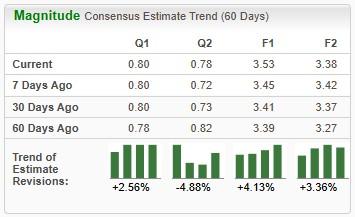
Earnings estimates for 2026 have increased from $3.41 per share to $3.53 per share over the past 30 days. During the same time frame, Novo’s 2027 earnings estimates have increased from $3.37 to $3.38.
NVO Estimate Movement
Here’s How to Play NVO Stock
Novo, currently carrying a Zacks Rank #3 (Hold), faces several near-term challenges, including intensifying competition from Eli Lilly, pricing pressure on its GLP-1 portfolio, heavy reliance on semaglutide and questions over whether its newer drugs can generate enough growth to offset the eventual patent-driven erosion of the franchise. The recent Morgan Stanley downgrade to “Underweight” adds to the pressure, while weaker market-share trends and a challenging competitive environment could weigh on earnings visibility. Given these headwinds, short-term investors may be better off staying clear of NVO stock until there are clearer signs of stabilization in growth, market share and pricing. You can see the complete list of today’s Zacks #1 Rank (Strong Buy) stocks here.
For long-term investors, holding existing positions remains reasonable given Novo’s broad cardiometabolic pipeline, established market position and the significant long-term opportunity in the global obesity market. Its investments in next-generation obesity therapies, oral GLP-1s and other cardiometabolic treatments provide potential avenues for growth beyond the current semaglutide franchise. However, NVO will need to demonstrate stronger pipeline execution, defend its market position and manage pricing and competitive pressures before the longer-term growth story gains greater visibility.
Beyond Nvidia: AI's Second Wave Is Here
The AI revolution has already minted millionaires. But the stocks everyone knows about aren't likely to keep delivering the biggest profits. AI’s second wave is moving from infrastructure to implementation and these companies are at the forefront of this transition, positioned to become what Amazon and Google were to the internet era.
See Stocks Now >>Want the latest recommendations from Zacks Investment Research? Today, you can download 7 Best Stocks for the Next 30 Days. Click to get this free report
Novo Nordisk A/S (NVO): Free Stock Analysis Report
Eli Lilly and Company (LLY): Free Stock Analysis Report
Viking Therapeutics, Inc. (VKTX): Free Stock Analysis Report
Structure Therapeutics Inc. Sponsored ADR (GPCR): Free Stock Analysis Report
This article originally published on Zacks Investment Research (zacks.com).