


I asked if wheat prices were too low in a February 26, 2026, Barchart article, when I concluded with the following:
CBOT wheat futures have a bullish bias in late February 2026, but weather, production, and logistics from the Black Sea region will be critical factors in determining the path of least resistance for wheat prices over the coming weeks and months during the 2026 crop year.
Don’t Miss a Day: From crude oil to coffee, sign up free for Barchart’s best-in-class commodity analysis.
Nearby CBOT soft red winter wheat futures traded at $5.65 per bushel on February 25, 2026, and the nearby contract was higher in late May 2026.
Wheat prices are trending higher
The CBOT soft red winter wheat futures contract is highly liquid and serves as a benchmark for global wheat prices.
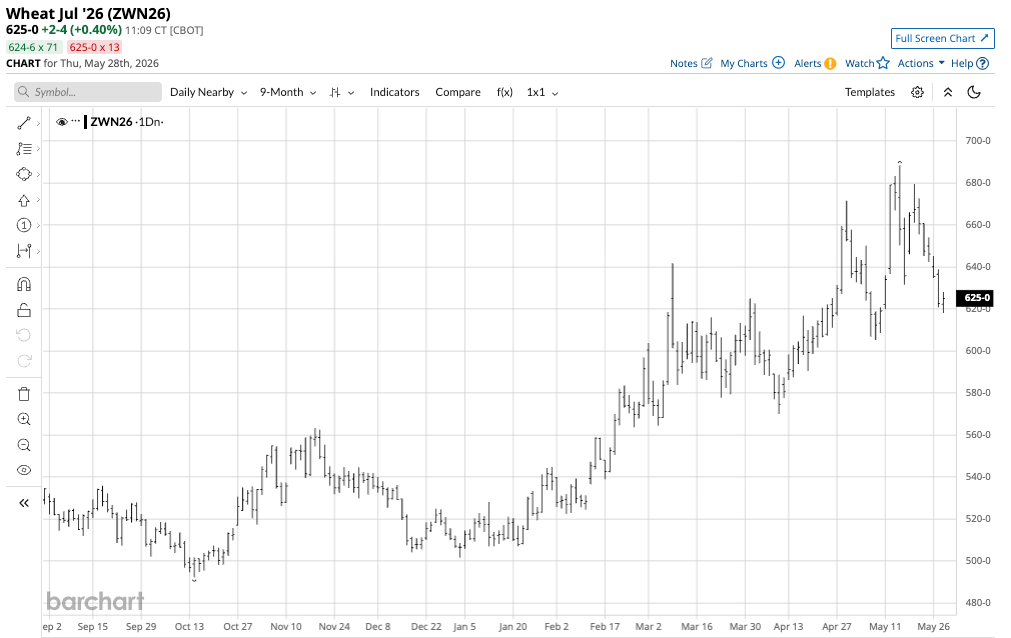
The daily continuous contract chart shows that after falling to a low of $4.9225 per bushel on October 14, 2025, CBOT wheat futures have made higher lows and higher highs, reaching $6.8825 per bushel on May 14, 2026. At $6.25 per bushel in late May, the wheat futures remain in a bullish trend.
The May WASDE report was bullish
On May 12, 2026, the U.S. Department of Agriculture released its May World Agricultural Supply and Demand Estimates Report. The May WASDE told the wheat market the following:
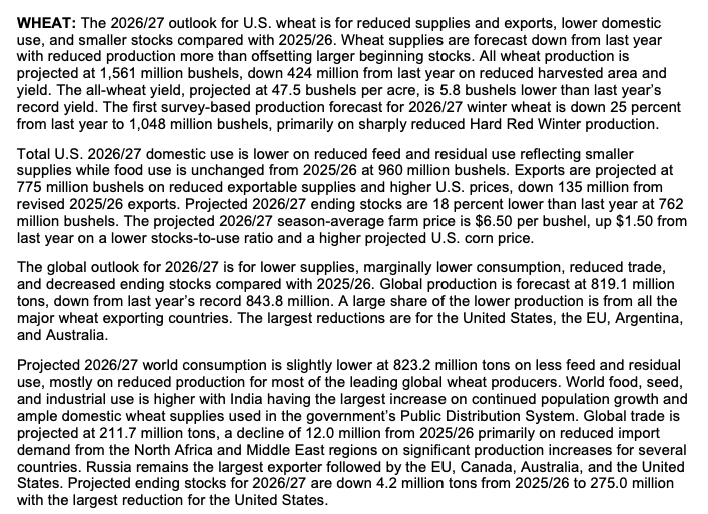 Source: USDA May WASDE Report
 The May WASDE forecast for U.S. and global wheat inventories in 2026/2027, compared to the 2025/2026 crop year.
I reached out to Jake Hanley, the Chief Growth Officer and Director of Investments at the Teucrium family of agricultural commodity ETFs, including the WEAT ETF. Jake’s take on the May WASDE report was as follows:
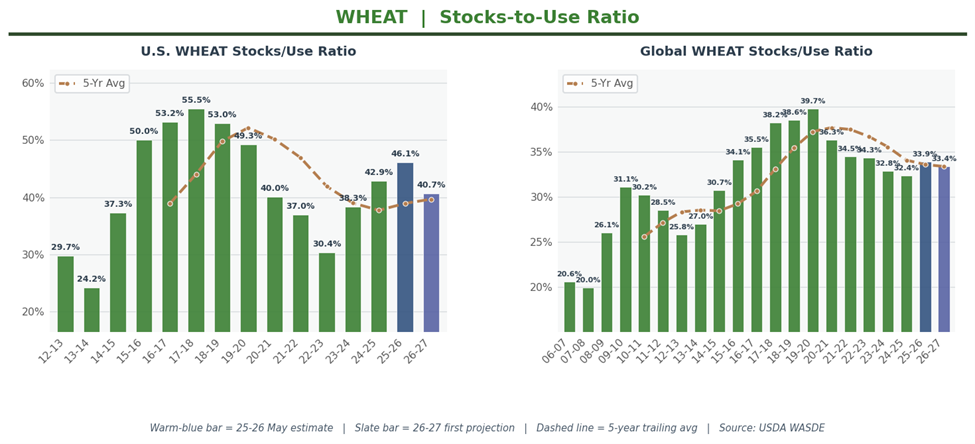
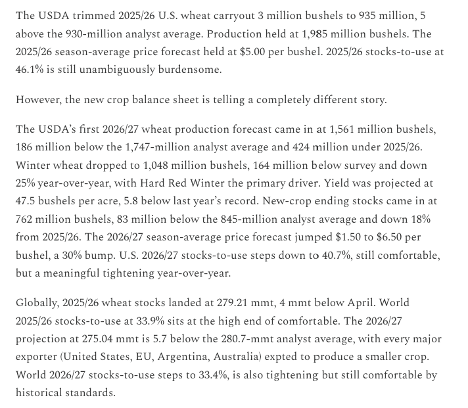 Source: Teucrium
 The bottom line is that wheat’s global balance sheet is tightening, supporting the rally from under $5.00 in 2025 to nearly $6.90 per bushel in 2026.
On May 28, I heard from Jake again, after Rabobank cut Australia's 2026/2027 wheat forecast to 21.3 million tons, 41% below the 35.8 million just harvested. El Niño and increased fertilizer prices account for the substantial reduction, further tightening wheat's global balance sheet. His full comments are available through this link.
The KCBT-CBOT spread is at a bullish reading
A spread that provides insight into how U.S. consumers view the wheat market is the differential between KCBT hard red and CBOT soft red winter wheat. U.S. bread manufacturers typically price their requirements based on the KCBT wheat futures price.
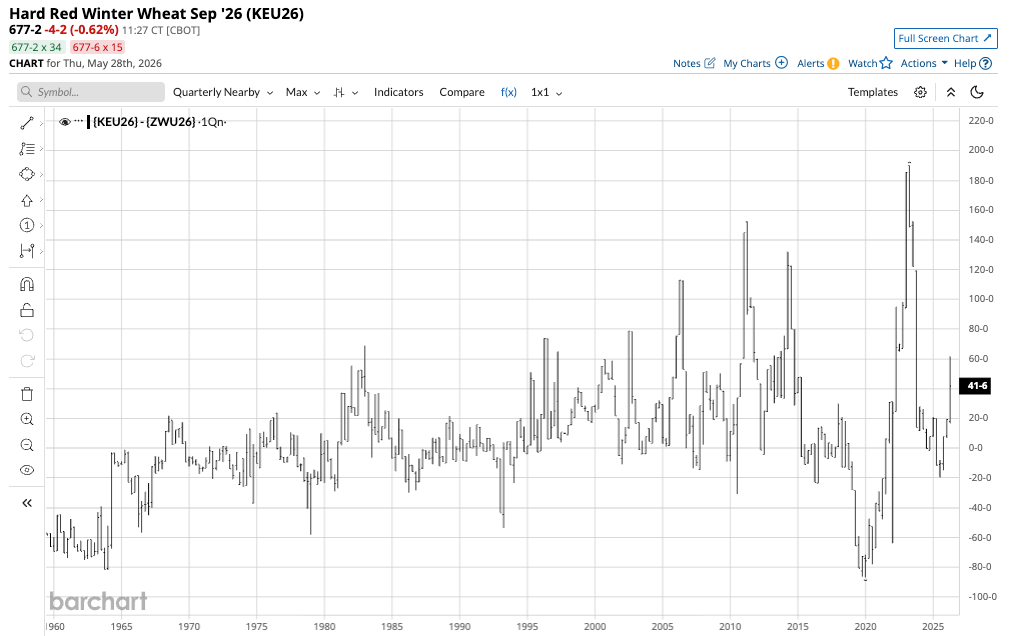
The long-term quarterly chart of KCBT minus CBOT wheat futures ({KEU26}-{ZWU26}) shows that the median level for the spread is between a 20 and 30-cent premium for KCBT wheat over CBOT wheat.
Readings below 20 cents or when KCBT trades at a discount to CBOT tend to occur when wheat prices are under pressure, and consumers (bread manufacturers) buy their requirements on a hand-to-mouth basis. Readings above 30 cents often occur when wheat prices rally and consumer hedging demand increases.
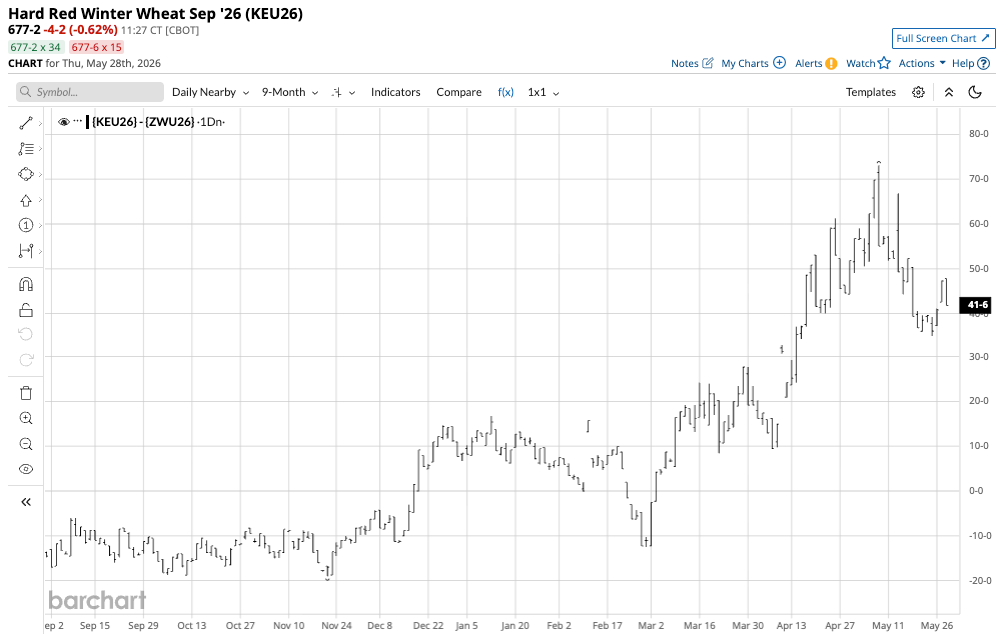
The short-term daily continuous contract chart of KCBT minus CBOT wheat futures ({KEU26}-{ZWU26}) shows the bullish trend with KCBT wheat moving from a discount to a premium to CBOT wheat, validating the current bullish trend. While the KCBT premium rose to 73 cents per bushel on May 7, 2026, it has since declined to an over 40-cent premium on May 28, which remains above the median.
Fertilizer prices and supplies support wheat prices
The hostilities in the Middle East that have interrupted traffic through the Strait of Hormuz have impacted wheat and other agricultural commodities for two reasons. First, higher energy prices increase production costs. Second, because a substantial amount of fertilizer flows through the Strait, the lack of strategic fertilizer stockpiles has led to supply concerns and higher prices for the critical ingredient in agricultural crop production.
Higher energy and fertilizer prices, and the potential for fertilizer shortages, support wheat prices. Meanwhile, prices dropped below $5 per bushel in October 2025, which was too low given that Russia has been the third-leading wheat-producing country, and Ukraine the eleventh. The ongoing war since 2022 caused supply concerns, driving wheat prices to record highs in March 2022. Any escalation around the Black Sea ports could ignite another rally.
Moreover, the global population grows each year. More people require more food, and wheat is a staple. Therefore, production must keep pace with the rising demand. Any weather or other events that cause production declines could send wheat prices higher.
WEAT is a liquid ETF that tracks a portfolio of CBOT wheat prices
The Teucrium Wheat ETF (WEAT) holds a portfolio of three actively traded CBOT soft red winter wheat futures contracts, excluding the nearby contract to minimize roll risk. Since volatility tends to be highest in the nearby contract, WEAT often underperforms it during rallies and outperforms it during downside corrections.
At $23.84 per share, WEAT had $270.9 million in assets under management. WEAT trades an average of more than 900,000 shares per day, making it a liquid agricultural ETF.
Nearby CBOT wheat futures rallied 39.8% from $4.9225 on October 14, 2025, to $6.8825 on May 14, 2026. The price has corrected 10.2% to a low of $6.18 on May 28.
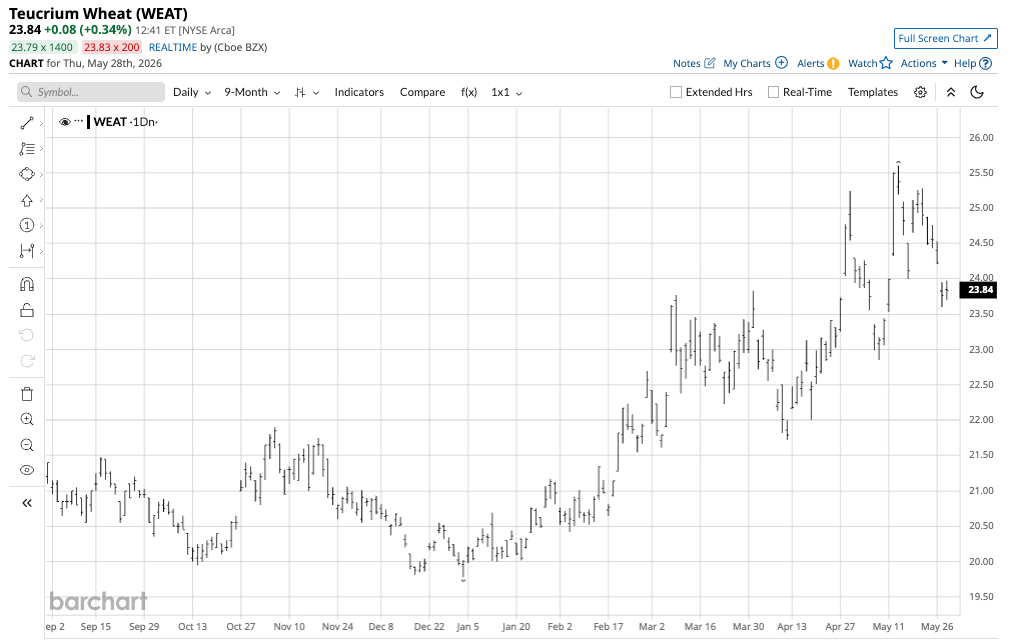
The chart shows that over the same period, the WEAT ETF rose 28.3% from $19.95 to $25.60 per share, then corrected by 7.8% to $23.60 per share. WEAT underperformed CBOT wheat futures on the upside but outperformed during the most recent correction, thanks to its holdings of three actively traded futures contracts, excluding the nearby contract. Meanwhile, another factor to watch is that while CBOT wheat futures trade during extended hours, WEAT only trades during U.S. stock market hours. WEAT can miss highs or lows when the stock market is closed.
The weather, fertilizer supplies and prices, energy prices, Australian El Niño, and geopolitical events will determine wheat’s price path over the coming weeks and months. In late May 2026, wheat remains in a bullish trend.
On the date of publication, Andrew Hecht did not have (either directly or indirectly) positions in any of the securities mentioned in this article. All information and data in this article is solely for informational purposes. For more information please view the Barchart Disclosure Policy here.