


I asked if the ICE cotton futures had run out of upside steam in a May 22, 2026, Barchart article, where I concluded with the following:
Risk-reward dynamics should always reflect the current price, not the level at inception of the trade. Cotton prices have backed off from the May 13 high of 88.88 cents, but remain in a bullish trend. The higher they rise, the greater the odds of a more significant correction. Time will tell whether 88.88 cents per pound proves to be the 2026 seasonal high.
Don’t Miss a Day: From crude oil to coffee, sign up free for Barchart’s best-in-class commodity analysis.
Nearby cotton futures had pulled back from the 88.88 cents per pound high on May 22, and were trading around 77.62 cents. The price eclipsed the May 88.88 high in August and remains in a bullish trend in September 2026.
A reversal in February 2026 was a clue
ICE cotton futures have been rallying since the 2026 low of 60.90 cents per pound in February.
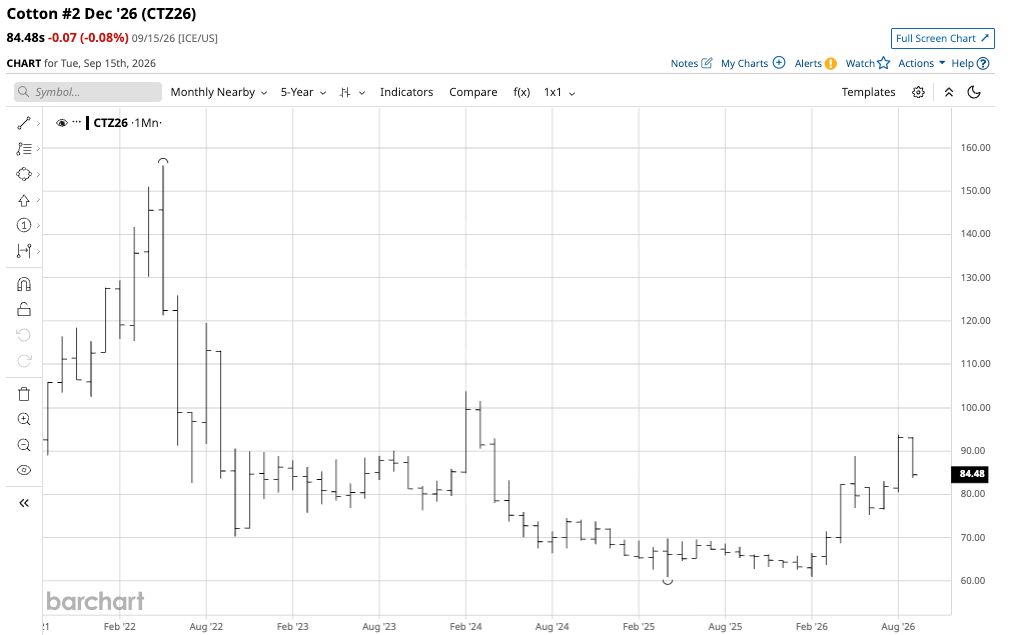
The monthly continuous contract ICE cotton futures chart shows that the range in January 2026 was from 62.55 to 65.76 cents per pound. In February, cotton futures fell to a lower low of 60.90 cents than in January and closed the month at 65.51 cents, just 0.25 cents shy of a bullish key reversal pattern. While futures did not form that bullish pattern, cotton futures reversed and have made mostly higher lows and higher highs over the past months, reaching 93.74 cents per pound on August 31, a 53.9% rally from the 2026 low. The February reversal signaled that cotton prices were heading higher.
The September WASDE report was slightly bullish for cotton.
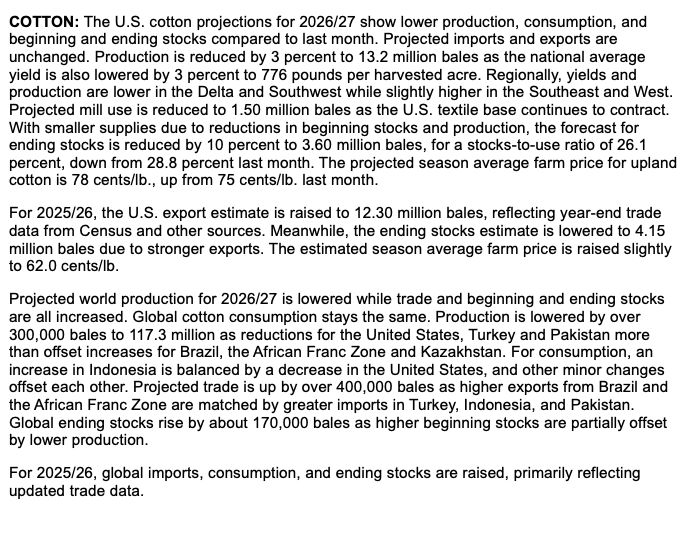
The USDA’s September World Agricultural Supply and Demand Estimates Report told the cotton market the following:
 Source: September USDA WASDE Report
 Key takeaways included that U.S. cotton production was lower than the August forecast and almost 300,000 bales smaller than the previous year’s crop. The USDA increased its season-average farm price by 3 cents.
Globally, production decreased, but consumption was unchanged. Global ending stocks rose by 170,000 bales, after declining by 900,000 bales in the August WASDE report. Cotton’s stock-to-use ratio fell 28.8% from the previous month. The bottom line is that the September WASDE was slightly bullish after a very bullish August WASDE report.
Cotton’s rally in late August was not seasonal; it was driven by supply and demand fundamentals, as prices tend to reach annual peaks amid uncertainty in spring planting and growing conditions.
Cotton rallied because of weather and crop damage, fertilizer shortages, and shrinking global production acreage.
Cotton has rallied for the following reasons:
Expectations point to tighter supplies during the coming crop year. Hostilities around the Persian Gulf have curtailed fertilizer and crude oil shipments, causing shortages and higher prices. Since petroleum is a primary raw material for synthetic fibers like polyester, cotton alternatives have become more expensive, driving textile and apparel manufacturers to increase demand for natural cotton. China is the world's largest cotton producer, and hot, dry conditions in Xinjiang province and elsewhere have hurt cotton crops. Short positions in the cotton futures market have likely fueled the rally. South American production is smaller than in past years. Brazil is the world’s third-largest cotton producer. Inflation and higher fertilizer and energy prices have raised production costs. A super El Niño event has brought hot, dry weather to the U.S. cotton belt. The U.S. is the world’s fourth-leading cotton-producing country. Farmers have a choice when planting crops. Low cotton prices, below 70 cents per pound from January 2025 through February 2026, have incentivized farmers to reduce cotton acreage and switch to more profitable crops.These factors have lifted cotton prices in recent months as the fundamental equation has shifted to a supply deficit.
Cotton is trading at the highest price since 2024. El Niño could push cotton prices higher.
The long-term trend in cotton futures appears to have bottomed in April 2025 at 60.80 cents per pound.
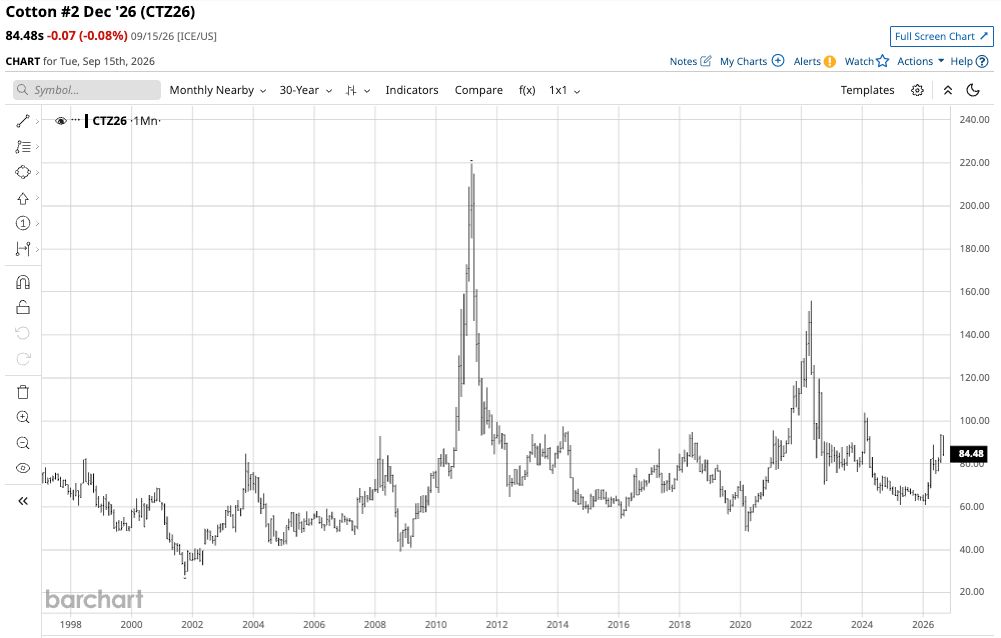
The monthly continuous ICE cotton futures chart shows that cotton prices made a slightly higher low of 60.90 cents per pound in February 2026, and rose to the highest price since March 2024 in August 2026.
Meanwhile, the developing Super El Niño, driven by warmer-than-average Pacific Ocean temperatures along the equator, is likely to trigger atmospheric changes and influence global weather patterns that could affect crop production in 2027. The current El Niño has a 70% chance of becoming the strongest El Niño on record. Extreme weather can devastate crops, and cotton is no exception.
Cotton is already experiencing several bullish factors, and a Super El Niño could cause prices to soar over the coming months and in 2027.
Levels to watch in the cotton futures market. No ETF or ETN products track cotton
Cotton prices reached a record high of $2.1970 per pound in Q1 2011. A strong El Niño in 2009-2010 peaked in winter and lasted through spring of 2010.
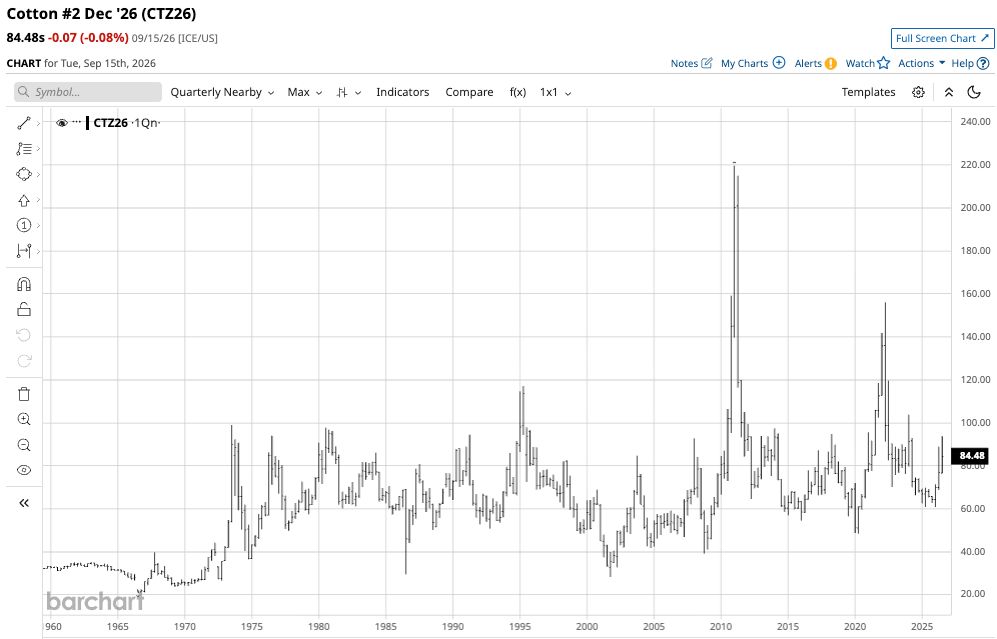
The quarterly chart shows that the rally to a record high in 2011 began during the second half of 2010, as the impact of the El Niño pushed cotton and other agricultural commodity prices higher.
While technical resistance in the cotton futures market is at the early 2024 high of $1.0380, cotton traded to a high of $1.5595 per pound in Q2 2022. The current deficit, rising input costs, and the potential for a Super El Niño to disrupt weather patterns could ignite a bullish fuse in the cotton market in 2027. At below $1 per pound, cotton could be a bargain, despite its over 50% rally from the February 2026 low.
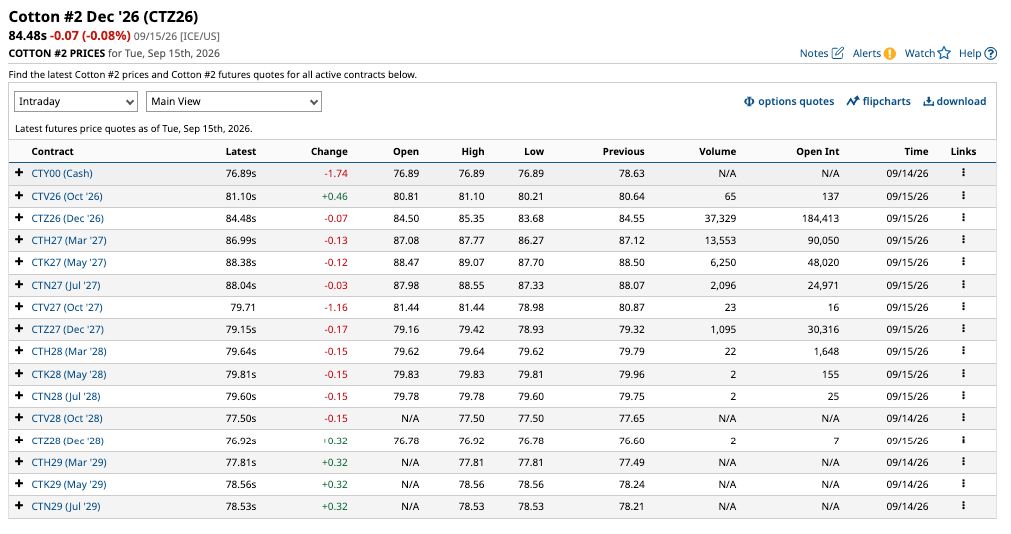
The forward curve shows cotton for December 2026 delivery around 84.50 cents per pound, while prices rose for March, May, and July 2027 delivery, reflecting the potential for a super El Niño to devastate next year’s crops. However, prices remain below 90 cents, which could be inexpensive if a weather event causes a significant supply-demand deficit in 2027.
The only route for a risk position in cotton is ICE futures and futures options. Each cotton futures contract contains 50,000 pounds of the fluffy fiber. At 84.50 cents per pound, the contract value is $42,250. ICE currently has a $2,343 per contract margin requirement, meaning a market participant can control $42,250 worth of cotton for a 5.55% down payment. If equity declines below $2,130 per contract, the exchange requires maintenance margin payments. If cotton volatility increases, as it did in 2011 and 2022, the exchange will increase margin requirements.
Cotton has rallied from the 2026 low. The potential for an El Niño and other factors pushed cotton prices higher, even though seasonality does not currently support a continued bullish trend. Meanwhile, cotton’s price action suggests prices will be higher in 2027 than at current levels, and an explosive rally could be on the horizon. The odds favor cotton rising above $1 per pound next year, and the current price could be inexpensive given the potentially bullish cocktail surrounding the fluffy fiber in September 2026.
On the date of publication, Andrew Hecht did not have (either directly or indirectly) positions in any of the securities mentioned in this article. All information and data in this article is solely for informational purposes. For more information please view the Barchart Disclosure Policy here.
More news from Barchart
Is Cotton Going to Eclipse $1 per Pound? 1 Trade to Make Now as the Weakness in Cotton Prices Continues How to Trade the Selloff in Cotton Prices Here Cotton Prices Are Headed Higher. How to Trade Them Here.