

The fight for the next generation of smartphones is increasingly being decided by chips measured in billionths of a meter, and MediaTek has just raised the stakes. On Sept. 15, 2026, Taiwan’s MediaTek unveiled the Dimensity 9600 Pro, its first flagship smartphone chip built on TSMC’s (TSM) 2nm process.
The announcement is more than a routine product launch. It marks a deliberate push into the premium Android handset market, where performance, battery efficiency, gaming, imaging, and on-device AI features can determine which chip a phone maker selects.
More Top Stocks Daily: Go behind Wall Street’s hottest headlines with Barchart’s Active Investor newsletter.
MediaTek already leads the global smartphone chipset market by volume, holding roughly a 32% share in the first quarter of 2026, compared with Qualcomm’s (QCOM) 23%, according to Counterpoint Research.
Now, with a 2nm flagship platform designed to compete more directly for high-end Android design wins, the question for Qualcomm shareholders is straightforward. Can MediaTek’s latest chip weaken Qualcomm’s Snapdragon position and put additional pressure on QCOM’s handset revenue and margins? Let’s dive in.
Does MediaTek’s 2nm Push Matter for Qualcomm?
MediaTek is using TSMC’s 2nm manufacturing process to push further into premium Android smartphones, a segment where Qualcomm’s Snapdragon chips have historically held a stronger position. Its new Dimensity 9600 Pro is MediaTek’s first 2nm smartphone system-on-chip.
MediaTek is making on-device AI the center of its premium pitch. Their Dimensity 9600 Pro has a dual-NPU design that supports AI models with up to 30 billion parameters on-device.
Still, this development matters for QCOM. MediaTek is attempting to replace its lower-cost alternative image with a credible flagship platform. If major Android manufacturers use the Dimensity 9600 Pro in high-volume premium phones, Qualcomm could face more pressure on Snapdragon design wins and chip pricing.
The largest risk sits with Chinese Android OEMs, where MediaTek already has customer relationships and price sensitivity remains high. A competitive 2nm chip could encourage manufacturers to use MediaTek in more flagship models or divide their premium portfolios between MediaTek and Qualcomm.
That does not mean Qualcomm is suddenly displaced. Snapdragon has a deep premium Android installed base, established OEM support, strong software integration, and extensive global carrier certification.
Qualcomm receives high-margin revenue of $1.28 billion from its Qualcomm Technology Licensing (QTL) patent-licensing segment, which is less exposed to an individual Snapdragon design win. Its automotive, IoT, PC, connectivity, and AI data center businesses further reduce its long-term reliance on smartphones.
Nvidia (NVDA) reported a $3.5 billion investment in MediaTek’s AI chip efforts, adding strategic backing to the company’s broader AI ambitions. The investment is separate from the Dimensity launch and does not, by itself, establish smartphone-chip share gains.
QCOM investors should be concerned, but not alarmed. The launch warrants monitoring, but it does not show that Qualcomm has lost revenue, share, or pricing power.
Qualcomm’s Latest Financial Strength
Qualcomm reported Q2 CY2026 results on July 29 that showed solid execution outside smartphones, even as its core mobile business faced demand and margin pressures. Revenue totaled $9.95 billion, exceeding analysts’ $9.66 billion estimate by 3%, though it declined 4% from the prior-year quarter.
Their adjusted EPS was $2.21, broadly in line with the $2.22 consensus estimate. Adjusted operating income reached $2.78 billion, 1.2% above the $2.74 billion forecast, and represented a 27.9% adjusted operating margin.
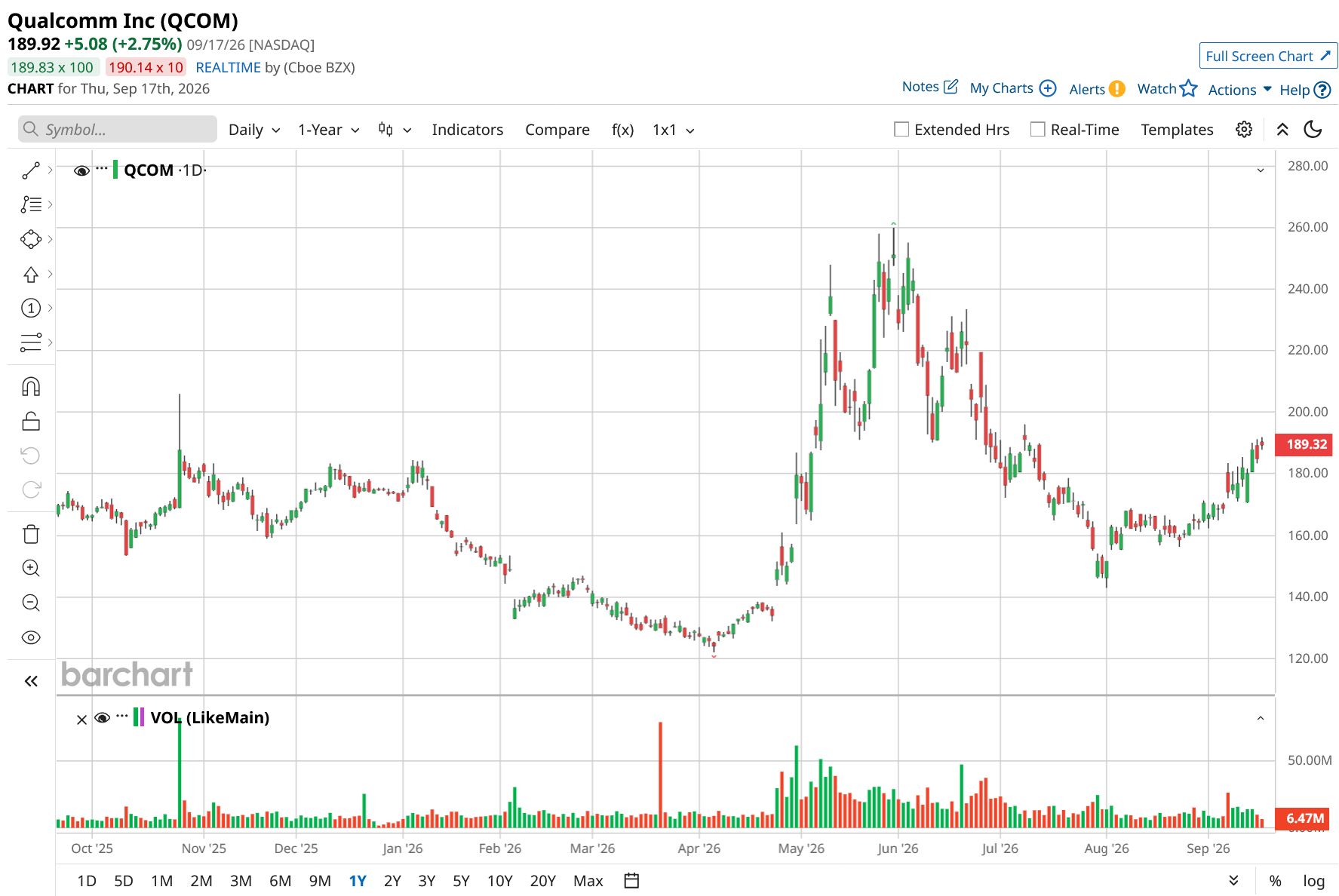
Those results have helped support QCOM’s share-price performance, with the stock closing at $184.84 on Sept. 16, it as of this writing, sits up 10% year-to-date (YTD) and 14% over the past 52 weeks.
 www.barchart.com
 At a $189.2 billion market capitalization, Qualcomm trades at 20.58 times trailing earnings, below the sector median of 32.36 times. Its 4.32 price-to-sales ratio (P/S), however, is above the sector median of 3.34 times. QCOM also offers a forward annual dividend of $3.68 per share, or a 2.02% yield.
The next part of the financial picture is less favorable. The reported operating margin fell to 16.3% from 26.6% a year earlier, while inventory days outstanding rose to 163 from 146 in the preceding quarter.
QCOM guided for Q3 CY2026 revenue of $10.1 billion at the midpoint, above Wall Street’s $10 billion expectation. Its midpoint-adjusted EPS outlook of $2.15, however, fell below the $2.38 consensus.
What Analysts Are Saying About QCOM Stock
Analysts expect Qualcomm to report September quarter results on Nov. 4, with a consensus EPS of $1.47. That would mark a 42.58% decline from $2.56 per share a year earlier, keeping attention on handset demand and margins.
Wedbush analyst Matt Bryson views Qualcomm’s price increases as a double-edged sword. Higher prices could support near-term revenue and margins as customer contracts reset. However, they could also make MediaTek more attractive to price-sensitive Android phone makers. That risk is relevant as MediaTek targets premium devices with its new 2nm Dimensity 9600 Pro.
Qualcomm is pursuing growth outside smartphones through its multigenerational Amazon (AMZN) agreement. RBC Capital Markets called the agreement a “foothold” in data center AI. Analyst Srini Pajjuri raised his QCOM target to $180 from $160 and maintained a “Sector Perform” rating.
RBC estimates the deal could generate roughly $6 billion in incremental annual revenue over 10 years, assuming full vesting and execution.
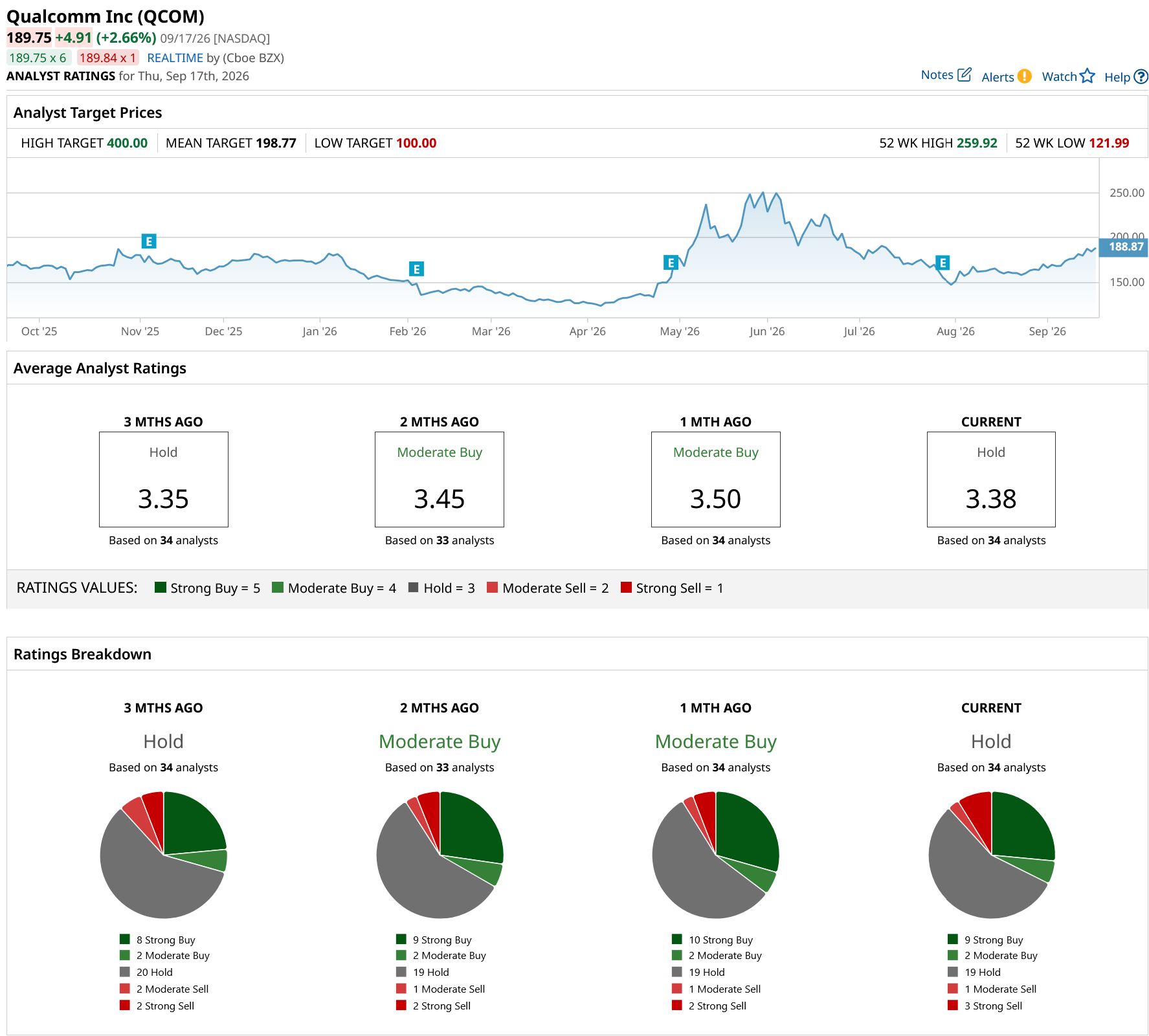
Wall Street’s consensus view of QCOM stock is a “Hold,” based on 34 analyst ratings. Their $198.77 average price target implies roughly 8% upside from the Sept. 16 closing price.
 www.barchart.com
 Conclusion
MediaTek’s 2nm Dimensity 9600 Pro makes it a more credible contender in premium Android phones, but Qualcomm does not face an immediate business disruption. The real test is whether MediaTek can secure high-volume flagship wins and match Snapdragon in real-world performance, connectivity, and battery life. Qualcomm’s handset margins may face more pressure, yet its licensing business and diversification efforts should limit the impact. For now, QCOM looks more likely to face tougher competition than a major market share loss.
On the date of publication, Ebube Jones did not have (either directly or indirectly) positions in any of the securities mentioned in this article. All information and data in this article is solely for informational purposes. For more information please view the Barchart Disclosure Policy here.
More news from Barchart
MediaTek Is Stepping Up Competition Against Qualcomm With a New 2-Nanometer Chip. What This Means for QCOM Stock. Amodei, Altman, and Musk Called for an AI Slowdown. Here’s Why It’s a Warning Sign for ASML Shareholders. Before You Conclude the AI Era Won’t End Like the Dot-Com Era Did, Check Out These 2 Charts 1 Year Into the Microsoft Deal, IREN Is Delivering and a Rally May Follow Soon