

The U.S. Securities and Exchange Commission (SEC) is reported to have started a civil probe into chip giant Nvidia (NVDA) over potentially misleading investor disclosures, per a report from the Wall Street Journal. The report did not go into further detail on the questions being asked of the company or the progress of the investigation so far.
This adds to the regulatory scrutiny Nvidia is facing following the resignation of former CEO Jensen Huang, who stepped down after news broke of multiple affairs, including one with an alleged Chinese spy. Huang has been replaced by CFO Colette Kress as interim CEO, who recently attended her first earnings call in the new position.
More Top Stocks Daily: Go behind Wall Street’s hottest headlines with Barchart’s Active Investor newsletter.
Current Status and Possible Implications
The U.S. government's oversight of Megaspeed — the cloud company with which the alleged spy from Huang's affair was associated — has not been a recent development. The U.S. Department of Commerce began investigating Megaspeed over the suspected diversion of sensitive semiconductors and potential export-control violations in 2024, with Nvidia putting the company on its internal "no sell" list in June 2025. That did not stop MegaSpeed from purchasing $4.8 billion worth of advanced artificial intelligence (AI) equipment with Nvidia technology between June 2024 and February 2026.
Nvidia recently sprang into action on Nov. 8, when the board announced an independent investigation after reports that a foreign intelligence operation had targeted now former CEO Jensen Huang. The board said it would examine all available information, including whether Nvidia's secrets or national-security interests were compromised. On Nov. 17, Nvidia also announced a new board committee for the oversight of Nvidia's national-security policies and export-control compliance. The committee will meet at least quarterly and use independent outside experts in law, national security, and trade compliance.
However, it must be acknowledged that apart from the latest SEC probe, no investigations on behalf of the U.S. government or its nodal agencies have been initiated or are ongoing with regard to this matter against Nvidia. Having said that, the U.S. Department of Justice and the Department of Commerce have identified Megaspeed as the subject of their ongoing investigation, although the latter previously sought records from Nvidia concerning its direct and indirect sales to the company. Separately, the Federal Bureau of Investigation (FBI) is investigating reports concerning the purported spy's alleged links to Chinese intelligence, while the House Energy and Commerce Committee has initiated congressional oversight of Nvidia's actions in the matter.
So, what next? For starters, Jensen Huang has agreed to appear before Congress. Huang will appear before House committees on Dec. 1 — namely the House Foreign Affairs Committee, the Select Committee on the Chinese Communist Party, and the House Intelligence Committee. Separately, Huang has also agreed to testify publicly before the Senate Banking Committee, although a date has yet to be finalized.
Aside from that, the House Energy and Commerce Committee has requested briefings from interim CEO Colette Kress, Commerce Secretary Howard Lutnick, and Under Secretary for Industry and Security Jeffrey Kessler to examine Nvidia's compliance with federal export-control laws and the robustness of its security controls.
That brings us to the long-term implications. Nvidia's potential missteps and Huang's scandal could result in stricter requirements for customer verification, overseas data-center access, and monitoring of advanced AI hardware for the wider AI industry.
Nvidia Posts Superb Q3 Results Despite Issues
Amid this news, Nvidia's financial performance has remained blissfully oblivious to everything happening around it. Nvidia reported another routine double beat and guidance above expectations for the third quarter of fiscal 2027. In fact, Kress raised Nvidia's revenue growth guidance for fiscal 2028 to 75% from 70%.
Revenue for the quarter was $115.8 billion, marking a year-over-year (YOY) rise of 103% and coming in ahead of consensus estimates. Within that, data-center revenue soared 110% YOY to $107.6 billion, driven by a $20 billion revenue contribution from its latest rack-scale system, Vera Rubin, making it the “fastest product ramp in the company’s history.”
Crucially, Nvidia also revealed that it has stopped licensed Hopper GPU sales to China; Q4 revenue guidance of $130 billion, plus or minus 3%, does not include any revenue from China Hopper sales. Investors may recall that some GPUs from Nvidia's Hopper family have been allowed to be sold to China. The company generated $2.4 billion in Hopper sales to China during Q3.
Gross margin came in above expectations in Q3 at 74.9% versus 73.5% a year ago. Meanwhile, net income more than doubled from the year-ago period to $64.9 billion while EPS rose to $2.68 from $1.27 in the prior year. Notably, EPS also came in higher than the consensus estimate of $2.47.
On the earnings call, Kress also clarified that Nvidia would be putting up some guardrails for vendor financing. Financing guarantees will now depend on the extent of the progression in projects, completion of the necessary data-center infrastructure, and finally purchases and deployment of Nvidia equipment. Personally, I reckon this was Kress' call as CFO and interim CEO, and a prudent one considering the uncertain pace of the data-center buildout in the coming years as the political landscape changes following midterms.
Meanwhile, the trend of doubling key metrics was not just restricted to the income statement. Net cash from operating activities jumped to $48.3 billion in Q3 from $23.8 billion a year ago. Overall, Nvidia closed the quarter with a cash balance of $29.1 billion and no short-term debt on its books.
Valuations also seem reasonable for NVDA stock. Its forward price-to-earnings (P/E) ratio of 15.9 times is below the sector median of 19 times, while the price-to-sales (P/S) multiple of 16.8 times and price-to-cash flow (P/CF) multiple of 31.9 times are higher than their respective sector medians.
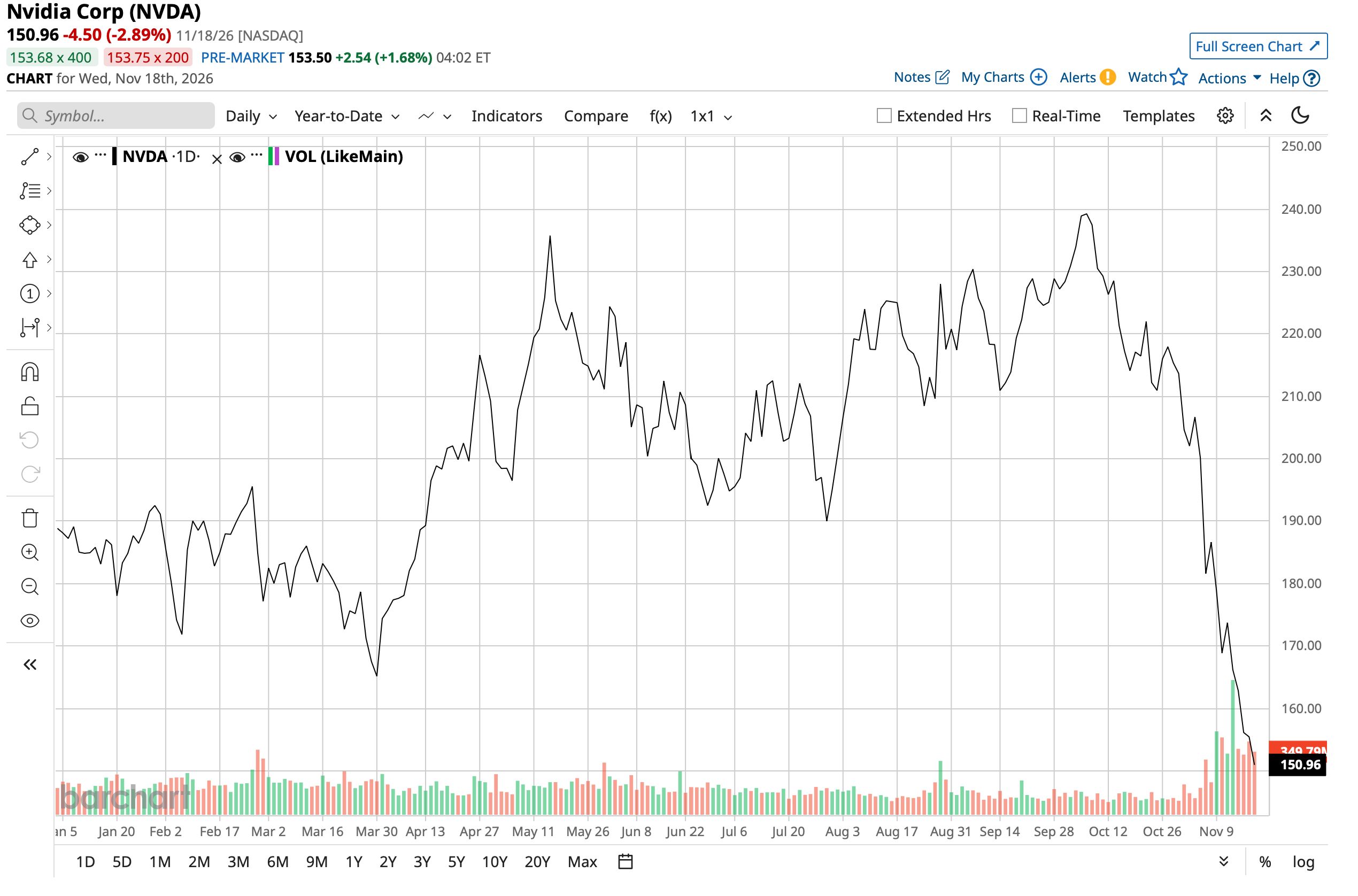
As of this writing, NVDA stock is down 33% on a year-to-date (YTD) basis.
 www.barchart.com
What Do Analysts Think of Nvidia Stock?
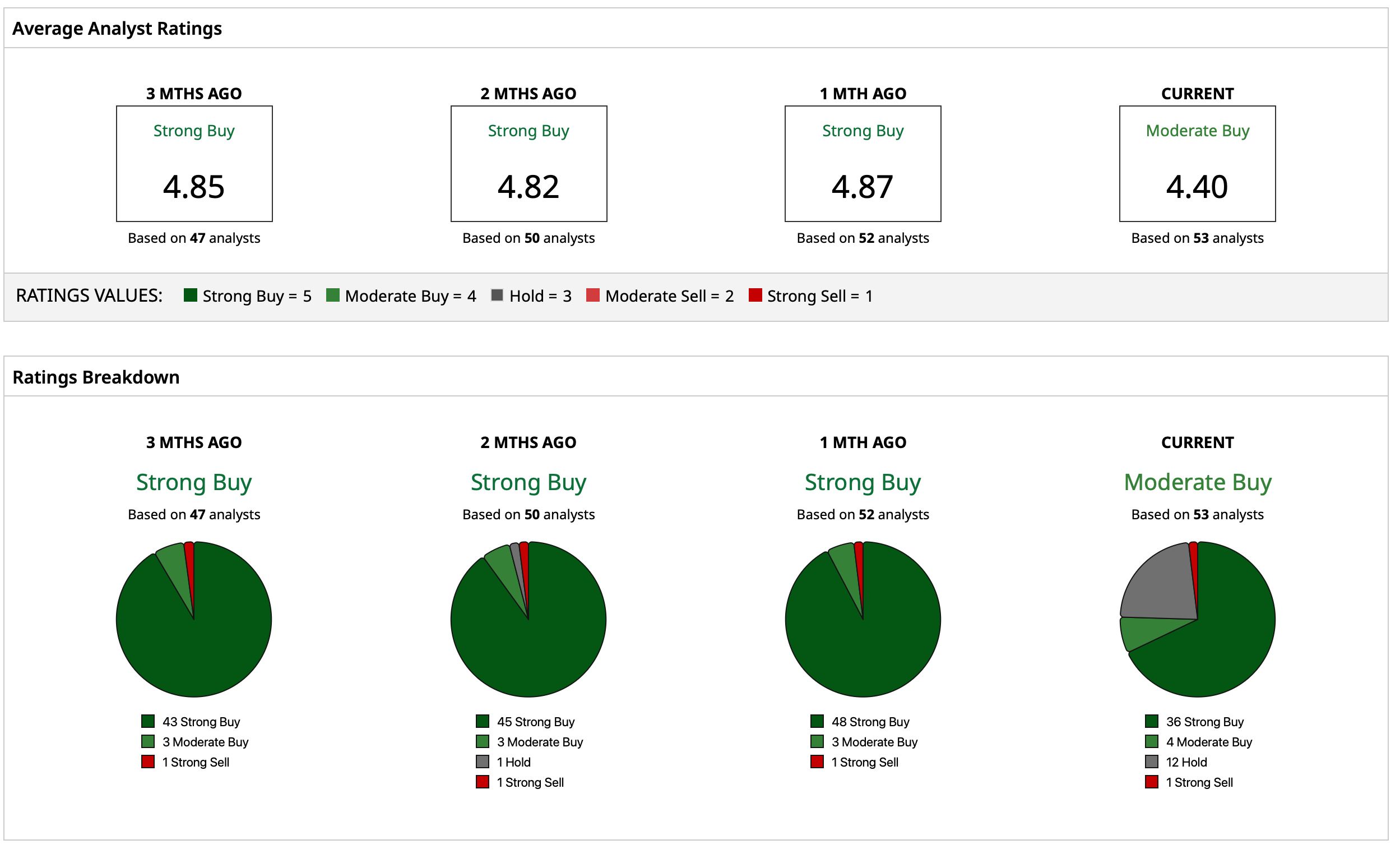
Overall, analysts have a consensus “Moderate Buy” rating for NVDA stock. Out of 53 analysts covering the stock, 36 have a “Strong Buy” rating, four have a “Moderate Buy” rating, 12 have a “Hold” rating, and one has a “Strong Sell” rating. The mean target price of $245.72 indicates potential upside of 96% from current levels.
 www.barchart.com
On the date of publication, Pathikrit Bose did not directly have a position in any of the securities mentioned in this article. All information and data in this article is solely for informational purposes. For more information please view the Barchart Disclosure Policy here.
More news from Barchart
TD Cowen Just Upgraded UnitedHealth Stock. Here’s Why. Apple Is Now Worth Over $5 Trillion Without Betting Big on AI Data Centers. AAPL Stock Now Trades Near Wall Street’s Targets. 2 ETFs to Consider in a Market Where Nearly All Stocks Look Dangerous SEC Investigates Nvidia Over Potential Misleading Investor Disclosures. That Should Not Be a Deterrent for Owning NVDA Stock.