


Ericsson ERIC reported second-quarter 2026 results, wherein earnings met the Zacks Consensus Estimate, while revenues missed the same. Adjusted earnings were SEK 1.22 (13 cents) per share, in line with the consensus estimate. Revenues were SEK 52.7 billion ($5.62 billion), down 6% year over year and 2.56% below the Zacks Consensus Estimate of $5.77 billion.
Organic sales declined 1% year over year primarily due to lower IPR licensing revenues following a non-recurring benefit in the prior-year quarter. However, the company delivered a solid adjusted gross margin of 48.4%, reflecting disciplined execution and improved profitability in its core businesses.
Ericsson Price, Consensus and EPS Surprise
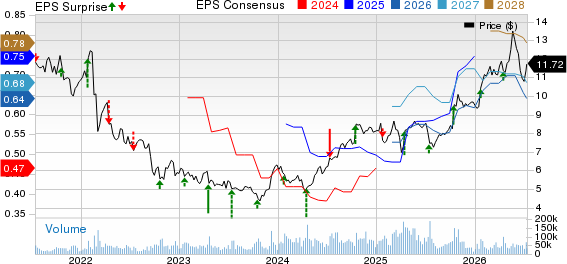
Ericsson price-consensus-eps-surprise-chart | Ericsson Quote
Ericsson Delivers Solid Margin Performance
ERIC generated SEK 52.7 billion ($5.62 billion) in revenues compared with SEK 56.1 billion in the year-ago quarter. Currency headwinds and lower IPR licensing revenues weighed on reported sales, although organic growth remained relatively resilient.
Adjusted gross income declined to SEK 25.5 billion ($2.72 billion) from SEK 27 billion a year ago. Nevertheless, the adjusted gross margin improved to 48.4% from 48%, supported by improved margins in Networks and Cloud Software and Services, partly offset by unfavorable currency movements.
ERIC Sees Mixed Segment Trends
The Networks segment generated SEK 33 billion ($3.52 billion), down 8% year over year on a reported basis. Organic sales declined 4%, mainly reflecting lower IPR licensing revenues. Excluding IPR licensing, organic sales were broadly stable as growth in North East Asia and South East Asia, Oceania and India partly offset weakness in other regions. The adjusted gross margin improved to 50.4% from 49.5%.
Cloud Software and Services revenues increased 3% year over year to SEK 14.7 billion ($1.57 billion). Organic sales rose 5%, driven by growth across all market areas, including higher software demand and core network upgrades. The adjusted gross margin expanded to 44.1% from 43.2%, while adjusted EBIT increased 33% to SEK 1.8 billion ($192 million).
Ericsson Enterprise Business Faces Pressure
Enterprise revenues declined 19% year over year to SEK 4.5 billion ($480 million), primarily reflecting the divestment of iconectiv completed in 2025. On an organic basis, however, sales increased 3%, supported by growth in Global Communications Platform and Enterprise Wireless Solutions.
The adjusted gross margin narrowed to 50.9% from 54.9%, reflecting the portfolio change following the divestment and shifts in product mix. The adjusted EBITA loss widened to SEK 0.8 billion ($85 million) from SEK 0.5 billion despite ongoing cost-reduction efforts.
ERIC Posts Broad Regional Performance
The Americas remained Ericsson's largest market, generating SEK 18.8 billion ($2 billion) in sales, down 5% year over year, while organic sales slipped 1%. Europe, Middle East and Africa posted stable reported sales of SEK 16.3 billion ($1.74 billion), with organic growth of 2%, supported by ongoing 5G deployments and core network upgrades.
South East Asia, Oceania and India reported SEK 5.4 billion ($576 million) in revenues, down 2% on a reported basis but up 4% organically due to project delivery timing. North East Asia generated SEK 3.7 billion ($395 million) in revenues, with organic growth of 8% driven by stronger deliveries in Japan.
Ericsson Maintains Strong Financial Position
Adjusted EBITA totaled SEK 6.9 billion ($736 million), down 7% year over year, while the adjusted EBITA margin remained largely stable at 13.1% compared with 13.2% a year ago. Lower operating expenses resulting from ongoing efficiency initiatives partly offset weaker gross income and currency headwinds.
The free cash flow before mergers and acquisitions declined to SEK 0.4 billion ($43 million) from SEK 2.6 billion a year earlier, mainly because of lower earnings and higher inventories ahead of planned third-quarter deliveries. Ericsson ended June 30, 2026, with net cash of SEK 59.8 billion, equivalent to $6.15 billion using the quarter-end exchange rate. During the quarter, the company returned SEK 8.2 billion to shareholders, including SEK 3.2 billion through share repurchases.
Management noted that component cost inflation remains a near-term challenge and expects some pressure on Networks' adjusted gross margin during the third quarter due to higher network rollout activity. However, the company believes that its strengthened portfolio and continued investments in AI-driven connectivity position it well to capture growth opportunities.
ERIC’s Zacks Rank & Stocks to Consider
Ericsson currently has a Zacks Rank #4 (Sell).
HubSpot HUBS currently sports a Zacks Rank #1 (Strong Buy). It delivered an earnings surprise of 4.97% in the trailing four quarters. You can see the complete list of today’s Zacks #1 Rank (Strong Buy) stocks here.
HubSpot continues to witness rising adoption among larger customers as businesses consolidate marketing, sales and service workflows on a unified AI-enabled platform. Management expects platform consolidation and AI adoption trends to remain key long-term growth drivers.
Ubiquiti Inc. UI has a Zacks Rank #2 (Buy) at present. In the last reported quarter, it delivered an earnings surprise of 22.021%.
Ubiquiti spends significantly on research and development activities for developing innovative products and state-of-the-art technology to expand its addressable market and remain at the cutting edge of networking technology. The company believes its new product pipeline will help it increase average selling prices for high-performance, best-value products, thus raising the top line. Ubiquiti is witnessing healthy traction in the Enterprise Technology segment.
Corning Incorporated GLW currently carries a Zacks Rank #2. It delivered an earnings surprise of 2.41% in the trailing four quarters.
Corning’s competitive strength lies in its focus on innovation. The growing adoption of innovative optical connectivity products for generative AI applications is expected to be a key growth driver in its Optical Communication segment. Some of its businesses stand to benefit from government regulations. For example, the fiber optic business is a direct beneficiary of the government-mandated bridging of the digital divide across the United States.
Beyond Nvidia: AI's Second Wave Is Here
The AI revolution has already minted millionaires. But the stocks everyone knows about aren't likely to keep delivering the biggest profits. AI’s second wave is moving from infrastructure to implementation and these companies are at the forefront of this transition, positioned to become what Amazon and Google were to the internet era.
See Stocks Now >>Want the latest recommendations from Zacks Investment Research? Today, you can download 7 Best Stocks for the Next 30 Days. Click to get this free report
Ericsson (ERIC): Free Stock Analysis Report
Corning Incorporated (GLW): Free Stock Analysis Report
HubSpot, Inc. (HUBS): Free Stock Analysis Report
Ubiquiti Inc. (UI): Free Stock Analysis Report
This article originally published on Zacks Investment Research (zacks.com).