


Restaurant companies continue to operate amid evolving consumer preferences, inflationary cost pressures and increasing demand for convenient dining options. Against this backdrop, Flanigan's Enterprises, Inc. BDL and Portillo's Inc. PTLO are two restaurant operators serving customers through distinct dining concepts. BDL operates casual dining restaurants, sports bars and package liquor stores under the Flanigan's Seafood Bar and Grill and Big Daddy's Liquors brands. In contrast, PTLO operates a chain of restaurants specializing in Chicago-style street food, offering a menu that includes hot dogs, Italian beef sandwiches, burgers, salads and desserts across multiple service channels.
While both companies operate in the restaurant industry, they differ in their operating scale, geographic presence and business model. These differences create distinct operating characteristics, financial profiles and market positioning, ultimately shaping each company's investment appeal. This raises an important question: which stock is better positioned for investors today? Let's take a closer look.
Stock Performance & Valuation: BDL vs. PTLO
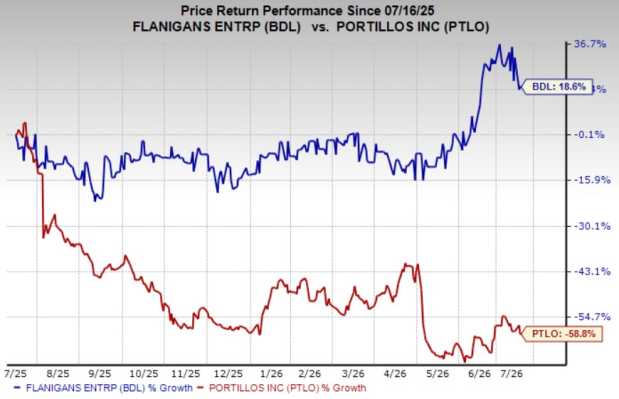
BDL (up 29.9%) has outperformed PTLO (down 19.1%) over the past three months. In the past year, Flanigan's has gained 18.6% against Portillo's decline of 58.8%.
Image Source: Zacks Investment Research
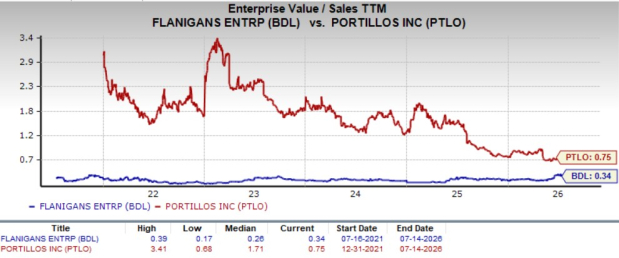
Meanwhile, BDL is trading at a trailing 12-month enterprise value-to-sales (EV/S) ratio of 0.34X, above its median of 0.26X over the past five years. PTLO’s trailing 12-month EV/S multiple sits at 0.75X, below its last five-year median of 1.71X. BDL and PTLO both appear to be cheap when compared with the Zacks Retail-Wholesale sector average of 1.72X.
Image Source: Zacks Investment Research
Factors Driving Flanigan's Stock
Flanigan's benefits from a diversified business model that extends beyond company-owned restaurants. Along with its casual dining operations, the company operates package liquor stores and generates recurring revenues through franchise royalties, restaurant management agreements and licensing arrangements. This diversified structure reduces dependence on a single revenue source and provides greater stability across different business cycles, supporting consistent financial performance.
BDL remains focused on preserving margins through prudent pricing actions and efficient procurement practices. Centralized purchasing, long-term supply agreements for key commodities and relationships with multiple suppliers help manage input cost volatility and ensure supply continuity. At the same time, investments in technology and operational controls enhance efficiency across its restaurant and liquor store operations, supporting earnings despite an inflationary operating environment.
Flanigan's follows a measured expansion strategy by using limited partnerships to fund new restaurant development while retaining operational control. This approach allows the company to expand its footprint without placing significant pressure on its balance sheet, while also creating additional streams of management fee and royalty income as restaurants mature. The strategy provides flexibility to pursue growth while maintaining financial discipline.
Factors Driving Portillo's Stock
Portillo's continues to pursue measured restaurant expansion with a strong emphasis on capital efficiency and long-term returns. The company is refining its development approach through smaller-format prototypes, including in-line and airport locations, while maintaining a disciplined site selection process. This strategy allows PTLO to enter new markets more efficiently, optimize development costs and expand its footprint without sacrificing restaurant-level economics.
PTLO continues to capitalize on its well-established Chicago-style brand through menu innovation, targeted promotions and digital engagement initiatives. The Portillo's Perks loyalty program, localized marketing efforts and limited-time menu offerings are designed to strengthen customer relationships, encourage repeat visits and enhance brand relevance as Portillo's expands beyond its core markets.
Management is prioritizing consistent restaurant execution by focusing on service quality, team member development and operational efficiency. Investments in restaurant technology, improved operating processes and guest experience are intended to strengthen throughput and support margin expansion over time. Although higher operating costs weighed on recent earnings, Portillo's emphasis on operational discipline is expected to support sustainable profitability and long-term shareholder value.
Choose BDL Over PTLO Now
Both Flanigan's and Portillo's are well-positioned to capitalize on long-term demand in the restaurant industry, but their investment propositions differ. Flanigan's benefits from a diversified operating model, disciplined cost management and a capital-efficient expansion strategy that supports steady, profitable growth. Portillo's, meanwhile, is leveraging its strong brand equity, measured restaurant expansion and focus on operational excellence to strengthen its long-term growth platform.
From a valuation perspective, both stocks continue to trade at discounts to the broader sector, indicating that investors can gain exposure to fundamentally sound restaurant companies without paying a significant premium. However, Flanigan's is trading above its historical valuation range, suggesting the market has already recognized its consistent execution and resilient business model. In contrast, Portillo's remains valued below its historical levels, reflecting investor caution despite its long-term growth opportunities.
While Portillo's offers an attractive long-term expansion story, Flanigan's stronger recent execution, resilient operating model and consistent profitability make it the more compelling choice for long-term investors.
Radical New Technology Could Hand Investors Huge Gains
Quantum Computing is the next technological revolution, and it could be even more advanced than AI.
While some believed the technology was years away, it is already present and moving fast. Large hyperscalers, such as Microsoft, Google, Amazon, Oracle, and even Meta and Tesla, are scrambling to integrate quantum computing into their infrastructure.
Senior Stock Strategist Kevin Cook reveals 7 carefully selected stocks poised to dominate the quantum computing landscape in his report, Beyond AI: The Quantum Leap in Computing Power .
Kevin was among the early experts who recognized NVIDIA's enormous potential back in 2016. Now, he has keyed in on what could be "the next big thing" in quantum computing supremacy. Today, you have a rare chance to position your portfolio at the forefront of this opportunity.
See Top Quantum Stocks Now >>Want the latest recommendations from Zacks Investment Research? Today, you can download 7 Best Stocks for the Next 30 Days. Click to get this free report
Flanigan's Enterprises, Inc. (BDL): Free Stock Analysis Report
Portillo's Inc. (PTLO): Free Stock Analysis Report
This article originally published on Zacks Investment Research (zacks.com).