

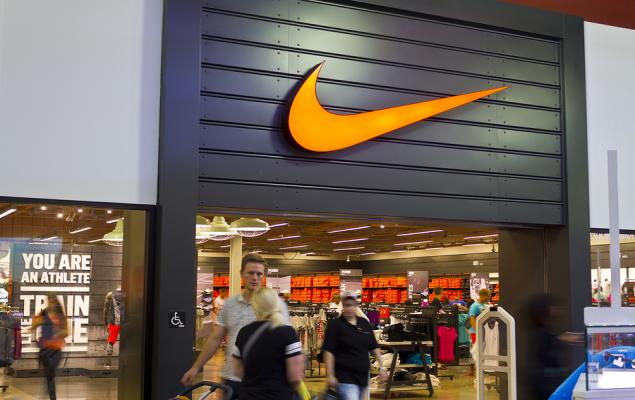
NIKE Inc. NKE is reshaping its marketplace strategy to create a healthier balance between broad consumer reach and stronger full-price profitability. The company is rebuilding wholesale relationships while simultaneously upgrading its direct-to-consumer presence, with a sharper focus on premium brand presentation across digital and physical channels. In fiscal 2026, NIKE refreshed more than 15,000 spaces across wholesale doors globally and elevated more than 150 company-owned stores with sport-led experiences. At the same time, it has been reducing promotional intensity on NIKE Digital and closing stores that no longer fit its long-term marketplace strategy.
Wholesale is becoming an increasingly important part of this integrated approach. Fiscal 2026 wholesale revenues grew 4%, led by double-digit growth in North America, while the company continues to deepen relationships with key retail partners and selectively expand distribution. In North America, fourth-quarter wholesale revenues rose 10%, while NIKE and retail sales at Foot Locker turned positive together for the first time in four years. Importantly, management indicated that the improvement reflected not only sales growth but also lower discounts, cancellations, returns and sales-related reserves, suggesting that NIKE is prioritizing healthier economics alongside wider marketplace exposure.
The profitability side of the strategy hinges on tighter inventory management and a greater proportion of full-price sales. NIKE has been reducing promotions, tightening buys and moderating future sell-in where consumer demand remains soft, particularly in Sportswear. In EMEA, off-price digital sales fell more than 50%, contributing to a 15-percentage-point improvement in full-price realization, while Greater China is also showing better full-price realization after aggressive promotional reductions. Management expects these actions, together with supply-chain efficiencies, to support margin expansion over time. However, the approach may constrain near-term revenues as NIKE deliberately trades some volume for cleaner inventories, stronger pricing and a more premium marketplace.
How Are ADDYY and LULU Managing Marketplace Growth?
adidas AG ADDYY and lululemon athletica inc. LULU are NKE’s key competitors in the global market.
ADDYY is pursuing a balanced marketplace strategy that combines strong direct-to-consumer momentum with disciplined wholesale distribution. In the first half of 2026, DTC revenues advanced 23% on a currency-neutral basis, supported by a 26% increase in e-commerce and 21% growth in own retail, while wholesale revenues rose 7%. At the same time, adidas maintained a conservative wholesale sell-in approach, particularly in Europe, to protect key franchises and sustain full-price realization in a promotional environment. This discipline, coupled with healthy product sell-through and a favorable business mix, is helping the company broaden consumer reach without sacrificing pricing quality or margin potential.
LULU is taking a more measured approach to marketplace growth as it works to strengthen full-price sales and preserve its premium brand positioning. lululemon continues to expand its store network and enhance digital and in-store experiences, ending the second quarter of fiscal 2026 with 825 company-operated stores. However, softer demand, particularly in the Americas, has increased the importance of disciplined inventory and promotional management. Management has identified improving full-price sales, especially in North America, as a key priority, while simultaneously investing in product innovation, marketing and international expansion. This approach could support healthier long-term margins, though weaker comparable sales suggest that balancing broader reach with profitability remains an ongoing challenge.
NKE’s Price Performance, Valuation & Estimates
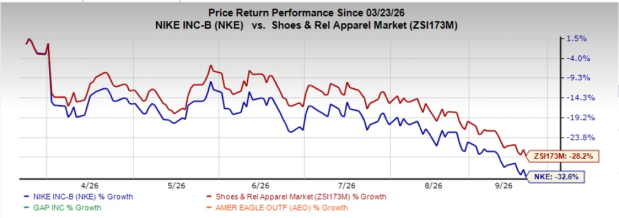
Shares of NIKE have lost 32.6% in the past three months compared with the industry’s decline of 28.2%.
Image Source: Zacks Investment Research
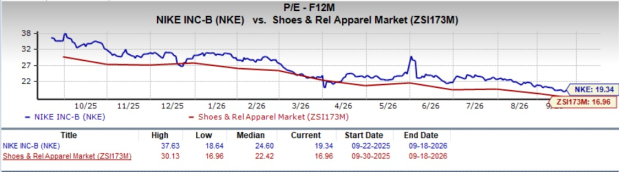
From a valuation standpoint, NKE trades at a forward 12-month price-to-earnings ratio of 19.34X compared with the industry’s average of 16.96X.
Image Source: Zacks Investment Research
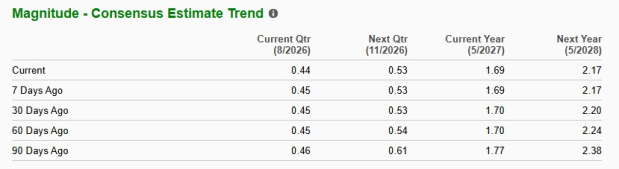
The Zacks Consensus Estimate for NKE’s fiscal 2026 earnings implies a year-over-year increase of 6.7%, while that for fiscal 2027 indicates growth of 28.6%. The company’s EPS estimates for fiscal 2026 and 2027 have been stable in the past seven days.
Image Source: Zacks Investment Research
NIKE stock currently carries a Zacks Rank #4 (Sell).
You can see the complete list of today’s Zacks #1 Rank (Strong Buy) stocks here.
Beyond Nvidia: AI's Second Wave Is Here
The AI revolution has already minted millionaires. But the stocks everyone knows about aren't likely to keep delivering the biggest profits. AI’s second wave is moving from infrastructure to implementation and these companies are at the forefront of this transition, positioned to become what Amazon and Google were to the internet era.
See Stocks Now >>Want the latest recommendations from Zacks Investment Research? Today, you can download 7 Best Stocks for the Next 30 Days. Click to get this free report
NIKE, Inc. (NKE): Free Stock Analysis Report
lululemon athletica inc. (LULU): Free Stock Analysis Report
Adidas AG (ADDYY): Free Stock Analysis Report
This article originally published on Zacks Investment Research (zacks.com).