

Thanks to the Iran conflict and the subsequent global energy crisis, the typically reliable but boring midstream specialist Kinder Morgan (KMI) has enjoyed a surge of cynical relevance. Since the start of the year, KMI stock gained nearly 16%, which really isn’t the norm. Basically, Kinder Morgan is the toll booth of the North American energy sector.
It doesn’t have the high-risk, high-reward profile of your pureplay upstream business or those entities involved in drilling and exploration. It also lacks the volatile edge of the downstream (refining) sector that can deliver either blistering gains or agonizing losses. Instead, Kinder Morgan operates a massive infrastructure that connects the two.
Can’t Get Enough Options?: Join the list for Barchart’s daily unusual options report, delivered free.
With KMI stock, you’re not playing the high-stakes game of guessing which team will win the competition. But you are selling the tickets to the game so you’re more reliably making money. Still, with the tense geopolitical hotspots, KMI has found itself enjoying a 40% Buy rating from the Barchart Technical Opinion indicator.
Certainly, the optimism toward Kinder Morgan makes sense. Fundamentally, the midstream giant is benefitting from artificial intelligence — specifically rising power needs from data centers. Further, the company has justified the enthusiasm with a stronger-than-expected first-quarter earnings report. Finally, shareholders can take confidence in the latest dividend increase due to KMI’s strong free cash flow.
Of course, these are known talking points that have likely been priced into the KMI stock price. On the less glorious side, it’s worth pointing out that the smart money appears somewhat fixated on the energy firm’s high leverage risk and dependence on stable cash flows. A quick look at the volatility skew gives you a sentiment reality check.
Volatility Skew Broadcasts Both a Warning and an Opportunity for KMI Stock
While the specific details surrounding the volatility skew may be intimidating for some retail traders, the basic premise behind this screener is that it operates much like an insurance market. If demand for risk protection was perfectly in equilibrium across the strike price spectrum of a given options chain, the skew of implied volatility (IV) would be flat. However, that’s not how the options market usually works.
With a popular security like KMI stock, it’s expected that certain strike price zones will attract greater risk protection demand than others. If traders anticipate a blowoff move, they may position their trades for upside convexity. On the flipside, if traders anticipate a steep correction, demand for downside insurance may rise.
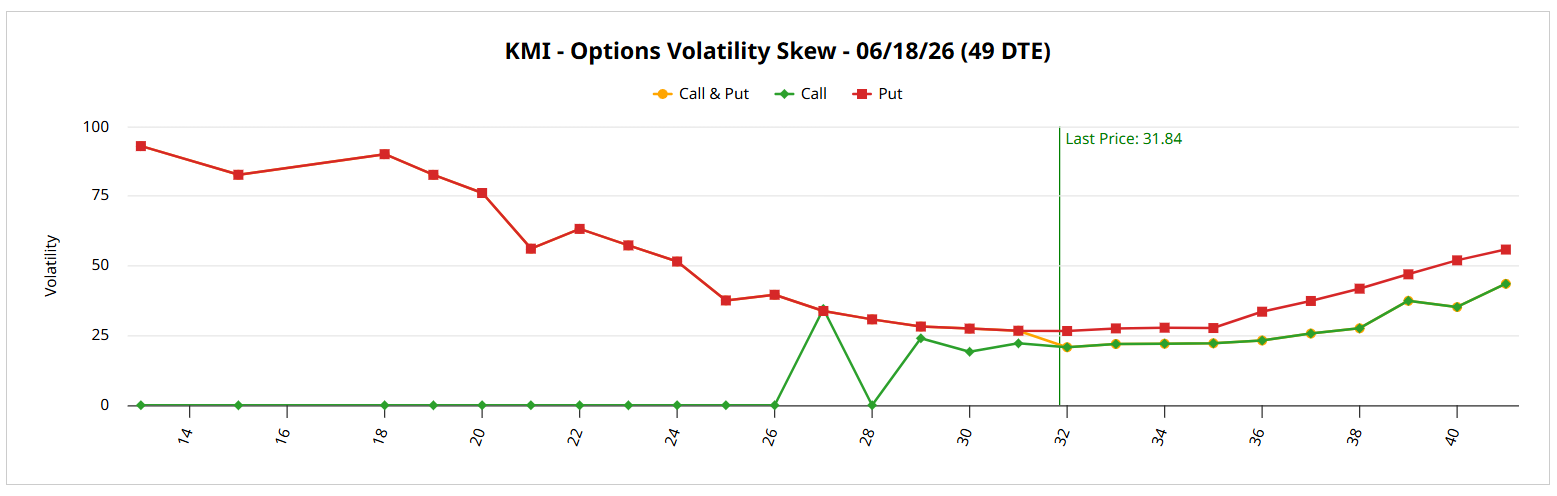
What does that mean for KMI stock? For the June 18 expiration date, the volatility skew is clearly accelerating toward the lower strikes. To put it in simple terms, the smart money is paying a higher premium than normal for accident insurance. However, we have to be careful here — just because the pros are paying more for insurance doesn’t necessarily mean an accident is more likely to happen.
To make that leap, you would have to presuppose that the smart money is more prescient than the public. While I’d say that’s a rational inference, we can use other methodologies to better justify the inference for this particular trade.
Also, a ‘bearish’ volatility skew isn’t exactly the end of the world. If traders are paying more for downside insurance, then on a relative basis, contrarians are paying less for upside exposure (for the same distance from spot per volatility unit). That’s where things get interesting for KMI stock.
Using an Inductive Model to Narrow Down a Trade
Under basic Markovian logic, the probability of a public security reaching a specific near-term state depends solely on the current state. Essentially, we’re going to explore the observed tendencies of KMI stock using a basic ‘if this, then that’ inductive framework.
Of course, when we talk about states in the context of inductive models, it’s best to use discretized inputs or inputs with hard endpoints. In this manner, we can keep what goes into our model consistent and objective. I prefer defining a state as a 10-week period. As such, in order to find the probability of the next state (10-week period), we must consider the current state.
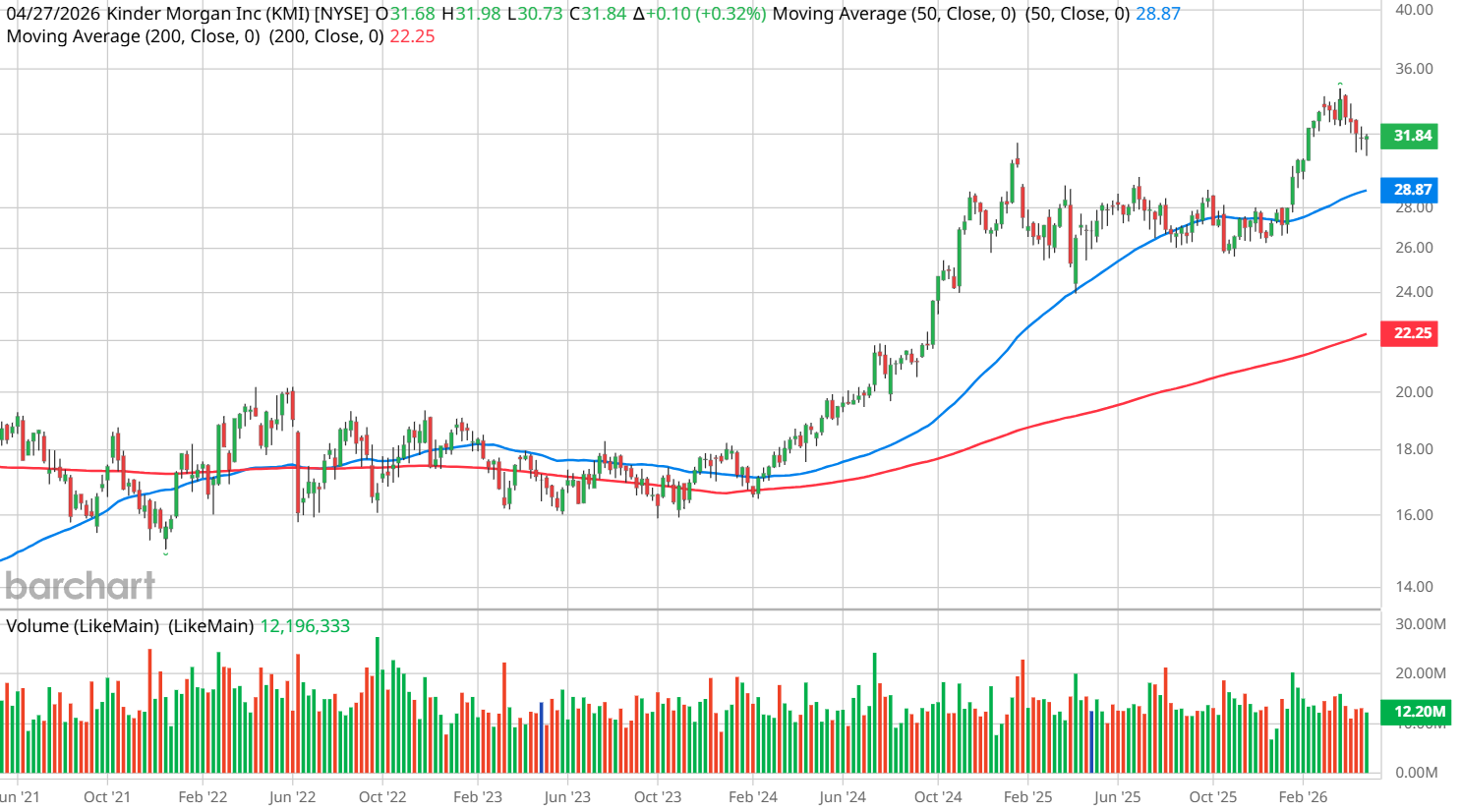
Using a dataset going back to January 2019, a random 10-week long position in KMI stock yields an exceedance ratio of 56.5%. Specifically, out of 363 rolling 10-week sequences, 205 of them pop above the starting price. Looking at the expected outcomes, the forward distribution would likely range between $31.60 and $32.80 (assuming a starting price of $31.84).
However, we’re not interested in trading KMI stock randomly. Instead, we’re focused on the current signal. In the last 10 weeks, KMI printed only three up weeks, leading to an overall downward slope. Under this state, the forward distribution would be expected to land between $31 and $34.50.
Aggressive traders may then consider the 32/33 bull call spread expiring June 18. For the trade to be fully profitable, KMI stock must rise through the $33 strike at expiration. If so, the maximum payout is over 127%. The breakeven price sits at $32.44, which is a realistic target given the projected outcome distribution.
On the date of publication, Josh Enomoto did not have (either directly or indirectly) positions in any of the securities mentioned in this article. All information and data in this article is solely for informational purposes. For more information please view the Barchart Disclosure Policy here.
More news from Barchart
Kinder Morgan Stock Is Normally Boring, but the Iran War Just Created an Exciting Short-Term Trade in KMI These Low IV Stocks May Be Setting Up for an Explosive Move Intel Corp Has Unusual Long-Term Call Options Activity - Investors Bullish on Intel Stock? This IBM Stock Bull Spread Allows You to Take Advantage of the Market’s Fear