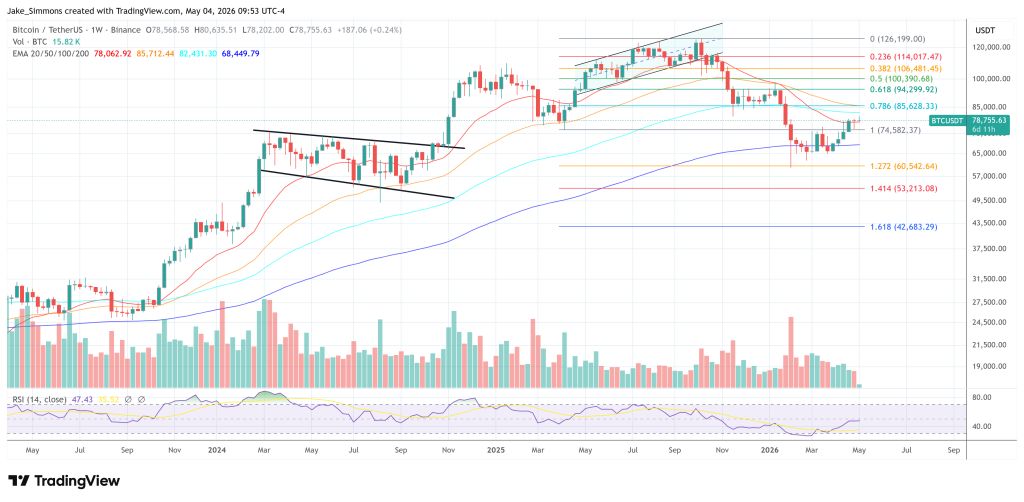
Bitcoin’s May setup is drawing fresh attention after two consecutive green months, with Trader_XO pointing to seasonality data that leaves BTC on the edge of a rare three-month streak. The question is whether the historical pattern has real market weight this time, or whether the latest geopolitical shock has already complicated the signal.
Bitcoin Eyes Rare Three-Month Winning Streak
The Coinglass data shared by Trader_XO shows Bitcoin’s monthly returns by year, with 2026 so far marked by a sharp early-year drawdown followed by a recovery phase. BTC fell 10.17% in January and another 14.94% in February, before turning higher with a 1.81% gain in March and an 11.87% advance in April. May is shown up 3.18% so far, keeping the month positive at the time of the snapshot.
“Bitcoin seasonality, with context,” Trader_XO wrote. “May stats: Positive ~60% of the time (8/13 years). Avg return: ~+8%. Median return: ~+3%. Only once has BTC had March, April, May all green (2019). This year so far: March: +1.81%. April: +11.87%. May opened at 76.3s. Does May end up being positive by month end?”
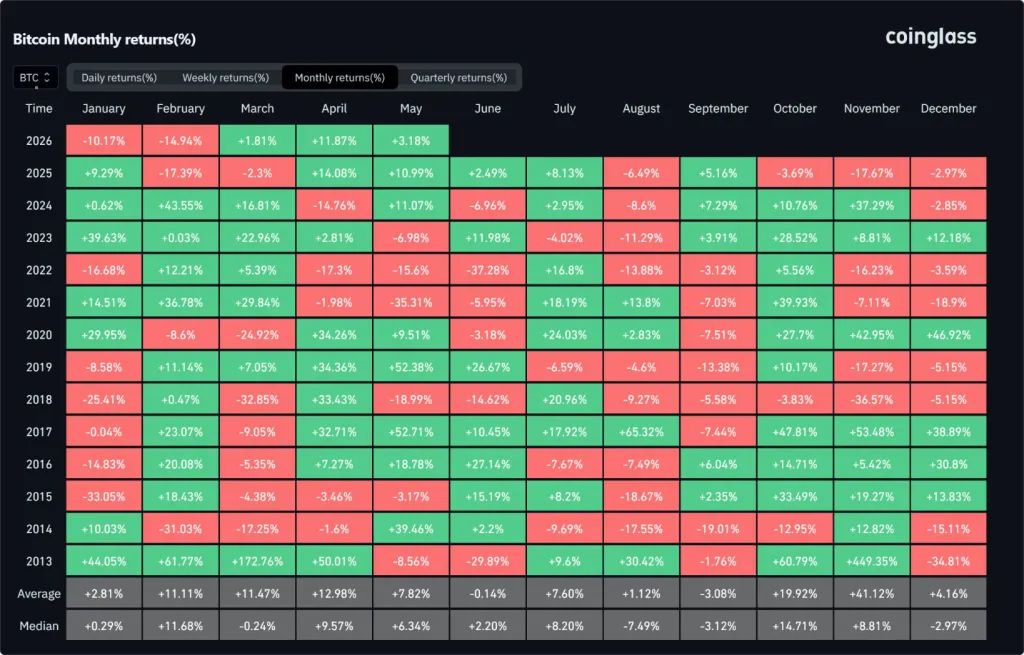
The Coinglass table gives the seasonal argument some structure. Its visible average row lists May at +7.82%, making it one of Bitcoin’s stronger months historically, behind October, November and April in the displayed data. The median row shows May at +6.34%, while the broader table highlights how uneven the month has been: May delivered outsized gains in 2017 and 2019, both above 52%, but also saw deep losses in 2021 and 2022, at -35.31% and -15.6%.
That dispersion matters. May’s green bias is not the same as a reliable monthly trade. The chart shows positive May returns in eight of the past 13 completed years, but the losses, when they arrived, were large enough to make context more important than a simple seasonal read.
That was also the point raised in the replies. StrongHedge argued that “context matters alongside data,” noting that in 2019 the market had “pico bottomed” and was beginning a new uptrend. Trader_XO agreed, responding: “Yep — exact same thoughts.” The comparison is important because 2019 remains the only year in the dataset where Bitcoin posted gains in March, April and May in sequence.
For 2026, the market is now testing whether the same three-month pattern can repeat after a very different start to the year. The rebound from February’s drawdown has been strong enough to restore upside momentum , but not clean enough to remove macro and geopolitical risk from the equation.
That became clear in Monday’s price action. Bitcoin climbed above $80,000 for the first time since late January , reaching an intraday high around $80,529, after Donald Trump announced “Project Freedom,” a US effort tied to the Strait of Hormuz. Reuters reported that the US deployed Navy guided-missile destroyers to help escort commercial vessels, while AP reported that CENTCOM said two American-flagged merchant ships transited the strait with Navy support.
The relief move did not hold. Later, Iran’s Fars news agency reported that missiles had hit a US warship near Jask Island after it ignored Iranian warnings, while US officials denied that any Navy vessel had been struck. Bitcoin quickly lost the $80,000 breakout and slipped back toward the high-$78,000s.
At press time, BTC traded at $78,755.