


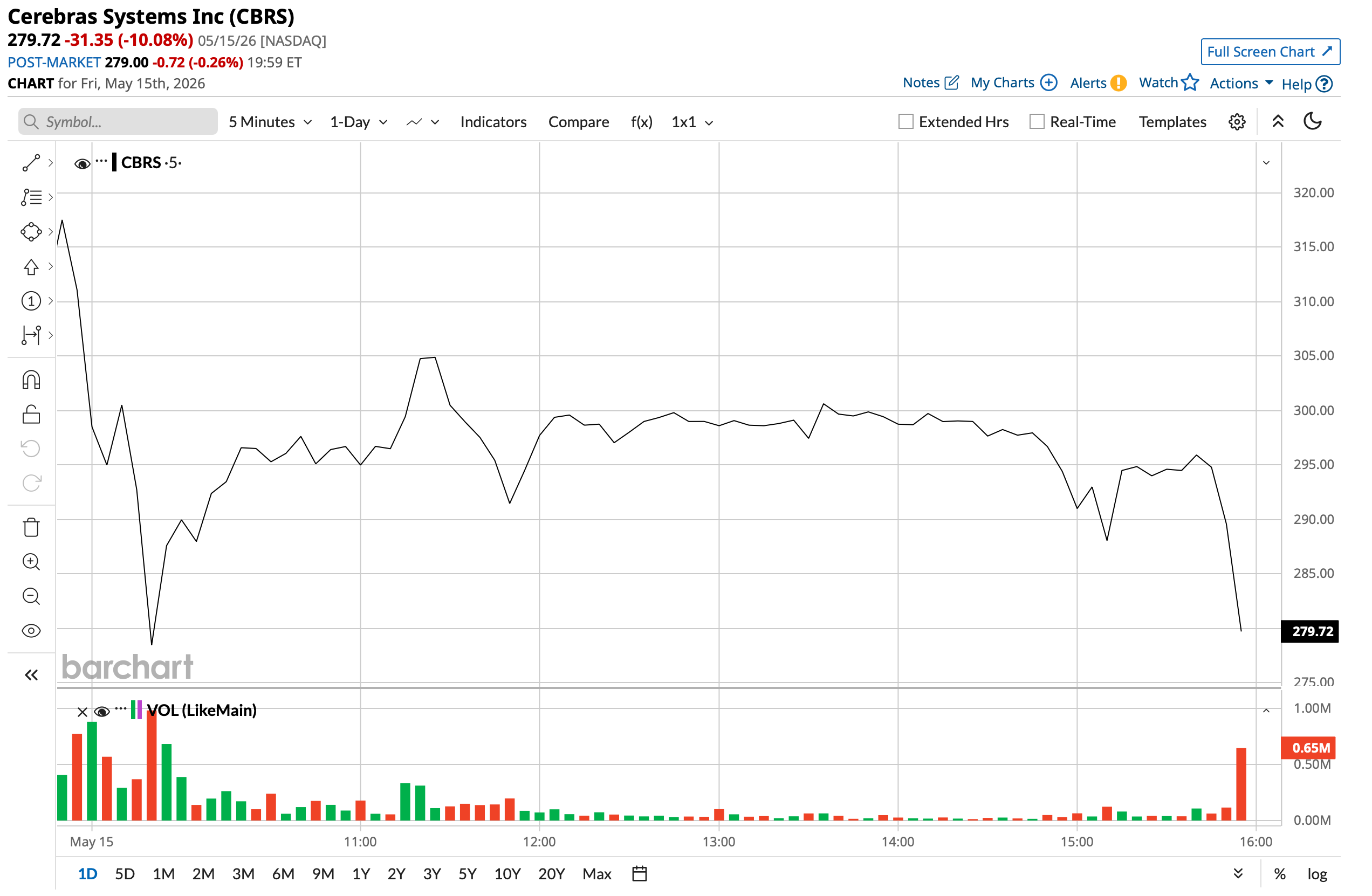
As far as market debuts go, Cerebras Systems (CBRS) can be thought of as the first big showing of 2026. With giants like SpaceX and OpenAI looking to list on the exchanges with their own blockbuster initial public offerings (IPOs) sooner than later, Cerebras' own debut may be forgotten by the time they list. Still, with shares almost doubling from the IPO price of $185 on the first day of trading, CBRS stock is the talk of the town right now.
That is where Cathie Wood comes in. As a fresh name associated with the artificial intelligence (AI) trade, Cerebras stock naturally grabbed the infamous investor's attention. Let's take a closer look.
More Top Stocks Daily: Go behind Wall Street’s hottest headlines with Barchart’s Active Investor newsletter.
 www.barchart.com
 Cathie Wood Buys More Than 100,000 Shares of Cerebras
Cathie Wood bought 105,616 shares of Cerebras Systems on May 14 through two of her Ark Invest exchange-traded funds, the ARK Innovation ETF (ARKK) and ARK Next Generation Internet ETF (ARKW). These purchases were made the same day that CBRS stock debuted. But Wood did not stop there; she also added another 149,716 shares on May 15. Together, these trades mean that Wood owns shares worth more than $77 million, based on current prices.
Now, Cerebras is in exalted company alongside majors like Tesla (TSLA), Palantir Technologies (PLTR), Advanced Micro Devices (AMD), and Robinhood (HOOD) as part of Wood's portfolio.
About Cerebras Systems
Founded in 2015, Cerebras Systems is an AI infrastructure company that develops accelerators, supercomputing systems, wafer-scale processors, and large-scale inference/training infrastructure. The company is also increasingly offering inference-as-a-service (IaaS) and AI cloud services.
The company's market capitalization currently sits near $65 billion. So, what drove Wood — and many others – to flock to CBRS stock?
Cerebras Is a Big Thing. So Is Its Chip.
For years now, chip sizes have been shrinking. While the last decade has seen chip sizes become more and more compact — from 7-nanometer to 5nm, 3nm, and now planned 2nm — Cerebras' latest Wafer-Scale Engine-3 (WSE-3) is one massive chip. It's reportedly roughly the size of a dinner plate, thus going the complete opposite direction in terms of size. Due to this, Cerebras claims its systems are about 15 to 20 times faster for inference than other GPU-based solutions.
The broader market took notice of this claim when the company announced a $20 billion agreement with OpenAI in January, covering the deployment of 750 megawatts of Cerebras' high-speed AI compute. This announcement was followed in March by a separate deal with Amazon's (AMZN) AWS, the financial terms of which have not yet been disclosed.
As inference continues to emerge as the defining competitive battleground for AI model deployment, Cerebras and its full-stack product offering are shaping up to be a force that established players can no longer afford to overlook.
Central to that positioning is what Cerebras has built at the hardware level — specifically the largest commercial chip ever produced in the history of the computing industry. The company achieves this through a process it calls wafer-scale integration, which dedicates an entire silicon wafer to a single chip rather than cutting it into the smaller individual units via conventional manufacturing. The technical obstacles involved in executing this are substantial. Large chips risk melting the motherboards they connect to, conventional packaging materials can fracture the chips themselves, and traditional cooling approaches offer no practical solution at this scale. Cerebras has had to engineer its way around each of these constraints to bring its product to market.
WSE-3 is the engine at the core of Cerebras' platform. It carries 44 gigabytes of on-chip SRAM, which translates directly into dramatically faster data transfer rates than competing architectures can support. The chip is built to handle large-scale AI models and run them at speeds that leave rival silicon well behind. Cerebras has publicly claimed that its chips deliver up to 21 times the performance of Nvidia's (NVDA) DGX B200 Blackwell GPU, a benchmark that positions it as a direct challenge to Nvidia's dominance in AI compute, particularly as the market shifts its emphasis from training-oriented workloads toward inference-optimized deployments.
Conversely, the software layer reinforces the hardware story. Cerebras has developed an OpenAI-compatible API with enterprise-grade tiers, SOC 2 compliance, and broad support across major development frameworks. A particularly meaningful proof point arrived in February 2026 when OpenAI made its Codex Spark model, running entirely on Cerebras infrastructure, available in a research preview. That deployment demonstrated that Cerebras' inference platform can operate at the reliability and throughput levels demanded by a user base of ChatGPT Pro scale.
Taken together, these elements translate into a product proposition built around lower data transfer latency and a fundamentally different architectural philosophy. The decision to pursue a single large wafer rather than clustering multiple smaller chips gives Cerebras a differentiated position in the market — one that is difficult to replicate and increasingly well-suited to the direction the AI compute industry is heading.
Rising Revenue With the Caveat of Concentration Risk
Cerebras' financials portray a steady picture of growth. Fiscal 2025 revenue grew 76% from the previous year to about $510 million. While hardware revenue jumped to $358.4 million from $211.9 million in 2024, cloud revenue climbed to $151.6 million from $78.3 million.
Moreover, Cerebras saw net income of $237.8 million in 2025 compared to a loss of $481.6 million in 2024. However, this can be attributed to the other income component of $390.7 million, which was -$378.2 million in the prior year.
Further, revenue concentration risk remains, as about 24% of total revenues in 2025 — and a whopping 85% in 2024 — came from G42, an AI company based in the United Arab Emirates (UAE). G42 is essential to the UAE's AI strategy. However, flare-ups in the Middle East makes this revenue stream potentally vulnerable. With that said, the deals with OpenAI and AWS could not have come at a better time for Cerebras Systems.
Net cash from operating activities, meanwhile, turned into net cash used in operations in 2025. While last year saw the company report net cash used in operations of $10.1 million, the same was an inflow of about $452 million in 2024. Still, this is not necessarily alarming, as the company closed 2025 with a cash balance of $701.7 million, which is not far away from its total liabilities of $971.3 million.
Final Thoughts
Can Cerebras be to the inference era what Nvidia was to the training era? Well, the signals are there. In fact, Nvidia itself reportedly wanted to acquire Cerebras, althought it was rebuffed in favor of private funding.
WSE-3 appears to be ahead of Nvidia's chips in terms of inference at the moment. However, the real test lies in doing this at scale, where Nvidia is a leader. Moreover, diversification of revenue streams will be crucial for the company along with expanding margins and consistent profitability.
Cerebras has the offerings, but it has to deliver on scale.
On the date of publication, Pathikrit Bose did not have (either directly or indirectly) positions in any of the securities mentioned in this article. All information and data in this article is solely for informational purposes. For more information please view the Barchart Disclosure Policy here.
More news from Barchart
Seagate Stock Plunges on Executive Warnings. Why Lead Times Matter so Much for STX Here. Cathie Wood Joins the Cerebras Bandwagon With More Than 100,000 Shares. Wait for It to Deliver Before You Buy In, Too. Dominion, NextEra Merge to Create a $67 Billion Electric Behemoth. History Tells Us This Is a Cautionary Tale. AMD’s AI CPU Opportunity Is Getting Bigger and So Is the AI-Driven ‘Boom’ for AMD Stock