


Industry Overview
The Zacks Oil and Gas - Drilling industry consists of companies that provide rigs (or specialized vehicles) on a contractual basis to explore and develop oil and gas. These operators offer drilling rigs (both land-based/onshore and offshore), equipment, services and workforce to exploration and production companies worldwide. Drilling for hydrocarbons is costly and technically difficult, and its future primarily depends on contracting activity and the total number of available rigs at a given time rather than the price of oil or gas. Within the industry, it's interesting to note that the volatility associated with offshore drilling companies is much higher than that of their onshore counterparts, and their share prices are more correlated to the price of oil. Overall, oil and gas drilling stocks are among the most volatile in the entire equity market.
4 Trends Defining the Oil and Gas - Drilling Industry's Future
Oil Supply Tightness Can Lift Drilling Demand: Oil and gas drilling activity could improve if global supply stays tight. Recent Middle East disruptions have made energy security a bigger concern and could keep oil markets supported. When producers worry about future supply, they often need more wells to maintain or grow output. U.S. shale may benefit because it can respond faster than many global projects. That said, activity may not jump overnight. Customers usually wait for clearer price signals before changing budgets, but the setup is becoming more supportive for drilling demand.
Natural Gas Has a Stronger Long-Term Growth Story: Natural gas is becoming a key demand driver for drillers. LNG exports, new export facilities and rising electricity needs from data centers and AI are all adding to the long-term call on gas. Investors should know that gas wells still need rigs, crews and related drilling services. International gas development, especially in regions like the Middle East and Latin America, also supports activity. In simple terms, if the world needs more gas for power and exports, the drilling industry gets another growth path beyond oil.
Better Rigs and Automation Can Support Higher Pricing: The industry is no longer just about adding more rigs. Operators are drilling deeper wells and longer laterals, which require stronger, more advanced equipment. That favors high-spec rigs, automation and digital tools that can improve safety, speed and well performance. Since the supply of top-tier rigs is limited, drilling contractors may have more room to push pricing higher when demand improves. This is important for investors because better pricing, tied to better technology, can help margins recover even without a huge jump in overall rig counts.
Customer Caution Can Delay the Recovery: The biggest near-term risk is that producers remain careful with spending. Even with higher oil prices, many operators are not rushing to add rigs because price volatility makes planning harder. Public exploration and production companies are especially focused on capital discipline, returns and sticking to budgets. At the same time, the Middle East conflict has added logistics, crew rotation and supply-chain costs for the industry. So, while the backdrop is improving, the recovery may be gradual rather than sharp. For drillers, that means timing remains uncertain.
Zacks Industry Rank Indicates Positive Outlook
The Zacks Oil and Gas - Drilling industry is a nine-stock group within the broader Zacks Oil - Energy sector. It currently carries a Zacks Industry Rank #70, which places it in the top 29% of 245 Zacks industries.
The group’s Zacks Industry Rank, which is basically the average of the Zacks Rank of all the member stocks, indicates fairly strong near-term prospects. Our research shows that the top 50% of the Zacks-ranked industries outperforms the bottom 50% by a factor of more than 2 to 1.
Considering the encouraging dynamics of the industry, we will present a few stocks that you may want to consider for your portfolio. But it’s worth taking a look at the industry’s shareholder returns and current valuation first.
Industry Outperforms Sector & S&P 500
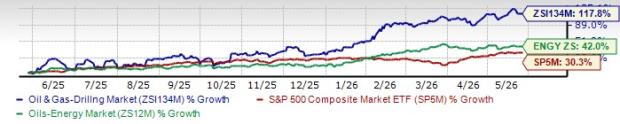
The Zacks Oil and Gas - Drilling industry has fared better than the broader Zacks Oil – Energy sector as well as the Zacks S&P 500 composite over the past year.
The industry has gone up 117.8% over this period compared with the broader sector’s increase of 42% and the S&P 500’s gain of 30.3%.
One-Year Price Performance
Industry's Current Valuation
Since oil and gas drilling companies are debt-laden, it makes sense to value them based on the EV/EBITDA (Enterprise Value/ Earnings before Interest, Tax, Depreciation and Amortization) ratio. This is because the valuation metric takes into account not only equity but also the level of debt. For capital-intensive companies, EV/EBITDA is a better valuation metric because it is not influenced by changing capital structures and ignores the effect of non-cash expenses.
On the basis of the trailing 12-month enterprise value-to-EBITDA (EV/EBITDA), the industry is currently trading at 14.35X, lower than the S&P 500’s 18.65X. It is, however, above the sector’s trailing 12-month EV/EBITDA of 7.03X.
Over the past five years, the industry has traded as high as 24.81X, as low as 4.16X, with a median of 13.75X, as the chart below shows.
Trailing 12-Month Enterprise Value-to-EBITDA (EV/EBITDA) Ratio (Past Five Years)


3 Oil and Gas - Drilling Stocks to Watch
Patterson-UTI Energy: Patterson-UTI is an integrated oilfield services company focused on drilling, completion and drilling products markets. Its platform combines contract drilling, hydraulic fracturing, wireline, cementing, natural gas fueling, directional services and drill bits, supported by digital tools that help improve wellsite efficiency. The Zacks Rank #2 (Buy) company operates 137 Tier-1 super-spec rigs and 2.7 million hydraulic horsepower of completion capacity.
You can see the complete list of today’s Zacks #1 Rank stocks here.
With cash flow spread across drilling services, completion services and drilling products, Patterson-UTI positions itself as a balanced leader in U.S. shale. It is investing in upgraded rigs, natural gas-powered fleets and data-driven operations while maintaining a strong balance sheet and an investment-grade credit profile. The company also emphasizes shareholder returns and long-term sustainability.
Patterson-UTI has a market capitalization of $4.7 billion. Over the past 60 days, the Zacks Consensus Estimate for the firm’s 2026 earnings has moved up 40.6%. PTEN stock has surged 116% in a year.
Price and Consensus: PTEN

Nabors Industries: It is a global provider of advanced drilling technology and services, operating in more than 20 countries. Nabors combines drilling operations, rig equipment and digital solutions to improve performance, safety and efficiency. Its vertically integrated model allows it to design automated rig technologies and deliver specialized services directly through its fleet. Nabors is a leading provider of high-specification rigs in the United States and deploys fit-for-purpose rigs across key international markets.
The Zacks #2 Ranked company is also focused on innovation, sustainability and reducing debt. Nabors’ recent moves include acquiring Parker Wellbore, divesting Quail Tools and refinancing debt to extend maturities. These steps strengthen its balance sheet while supporting long-term growth and energy transition goals.
Nabors has a market capitalization of $1.6 billion. The Zacks Consensus Estimate for 2026 earnings for the firm indicates 71.2% growth. NBR stock has gained 304% in a year.
Price and Consensus: NBR

Helmerich & Payne: Helmerich & Payne is a global drilling solutions company focused on onshore, offshore and international markets. It operates more than 200 land rigs, with a broad geographic reach and portfolio flexibility to serve rising drilling activity. The Zacks Rank #3 (Hold) company is also a technology leader, running advanced onshore rigs and expanding customer-led FlexRobotics deployments.
In fiscal second-quarter 2026, HP delivered resilient results in a changing energy market, supported by North America performance, offshore execution and steady international operations. It is also sharpening its portfolio, reducing debt and keeping capital spending disciplined. With $1.1 billion in liquidity and a long dividend record, Helmerich & Payne remains focused on long-term shareholder value.
The firm has a market capitalization of $4 billion. The Zacks Consensus Estimate for fiscal 2026 revenues for Helmerich & Payne indicates 5.1% growth. HP stock has surged 164.8% in a year.
Price and Consensus: HP

Beyond Nvidia: AI's Second Wave Is Here
The AI revolution has already minted millionaires. But the stocks everyone knows about aren't likely to keep delivering the biggest profits. AI’s second wave is moving from infrastructure to implementation and these companies are at the forefront of this transition, positioned to become what Amazon and Google were to the internet era.
See Stocks Now >>Want the latest recommendations from Zacks Investment Research? Today, you can download 7 Best Stocks for the Next 30 Days. Click to get this free report
Patterson-UTI Energy, Inc. (PTEN): Free Stock Analysis Report
Nabors Industries Ltd. (NBR): Free Stock Analysis Report
Helmerich & Payne, Inc. (HP): Free Stock Analysis Report
This article originally published on Zacks Investment Research (zacks.com).