

Bristol Myers Squibb BMY reported phase III SUCCESSOR-2 results of CELMoD (cereblon E3 ligase modulation) mezigdomide.
These results were presented at the 2026 American Society of Clinical Oncology (ASCO) Annual Meeting.
SUCCESSOR-2 is an inferential, seamless phase II/III, multicenter, randomized, open-label study evaluating the efficacy and safety of mezigdomide in combination with carfilzomib and dexamethasone (MeziKd) versus carfilzomib and dexamethasone (Kd) in patients with relapsed or refractory multiple myeloma (RRMM).
Mezigdomide is an oral CELMoD therapy developed using BMY’s targeted protein degradation platform.
More on BMY’s SUCCESSOR-2 Results
Results showed MeziKd demonstrated a clinically meaningful and statistically significant improvement in progression-free survival (PFS), representing a 52% reduction in the risk of disease progression or death compared with Kd.
The data revealed significant PFS benefits observed across both second- and third-line patients, including those with high-risk disease. The MeziKd regimen delivered markedly higher response rates, with an overall response rate of 80.2% versus 53.4% and complete response rates of 26.7% versus 8.9% for the control arm. Median overall survival has not yet been reached.
While the safety profile was consistent with prior experience, higher rates of Grade 3-4 adverse events, particularly neutropenia and infections, were reported.
BMY plans to share the results with health authorities.
BMY and Partner BNTX Present Data on Pumitamig
BMY and partner BioNTech BNTX reported encouraging interim phase II results from the ROSETTA Lung-02 study evaluating pumitamig (BNT327/BMS-986545) plus chemotherapy as a first-line treatment for advanced non-small cell lung cancer (NSCLC) at the ASCO.
Pumitamig is an investigational bispecific immunomodulator, jointly developed by BNTX and BMY, designed to cooperatively bind to PD-L1 and VEGF-A.
The phase II part of the ROSETTA Lung-02 study evaluated pumitamig in two dose levels, in combination with chemotherapy.
The investigational PD-L1xVEGF-A bispecific immunomodulator pumitamig plus chemotherapy showed robust and consistent antitumor activity in first-line NSCLC at both evaluated dose levels, with higher confirmed objective response rates at the lower dose of 63.6% in the non-squamous and 72.7% in the squamous subtypes.
Pumitamig plus chemotherapy demonstrated a manageable safety profile with a low discontinuation rate.
BioNTech and BMY are pursuing an extensive development strategy for pumitamig across multiple NSCLC settings. In addition to the ongoing global ROSETTA Lung-02 study, which is currently recruiting for the phase III part of the study, two additional global phase III studies are actively enrolling, targeting both unresectable stage III disease and first-line PD-L1–high advanced NSCLC. The broad clinical program, coupled with ongoing combination studies involving antibody-drug conjugates and other novel therapies, highlights pumitamig’s potential to become a major oncology franchise and a significant long-term value driver for both companies.
BMY Advancing a Promising Pipeline to Drive Growth
We note that BMY boasts a deep and promising pipeline. Key pipeline candidates with multi-billion-dollar potential are milvexian (Oral factor XIa inhibitor), admilparant (LPA1 antagonist), pumitamig (PD-L1 x VEGF-A bispecific antibody) and iberdomide & mezigdomide (oral CELMoD protein degraders).
The company’s targeted protein degradation platform — built over two decades — also includes investigational approaches such as ligand-directed degraders and degrader antibody conjugates. These programs aim to tackle disease-driving proteins that were previously considered difficult to target with traditional drugs.
The FDA has accepted a new drug application for iberdomide in combination with standard treatment (daratumumab and dexamethasone) for RRMM, granting Breakthrough Therapy Designation and Priority Review, with a target action date of Aug. 17, 2026.
The company, in partnership with Johnson & Johnson, is developing milvexian for atrial fibrillation (AF) and secondary stroke prevention (SSP).
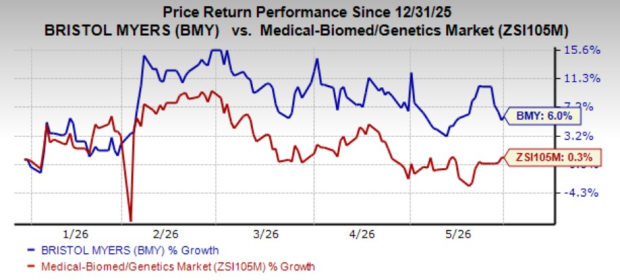
Shares of the company have gained 6% year to date compared with the industry’s growth of 0.3%.
Image Source: Zacks Investment Research
Concurrent with the first-quarter results reported in April, BMY highlighted the growing depth and diversification of its pipeline, with several pivotal phase III readouts expected in the second half of 2026, including milvexian in AF and SSP, Cobenfy in Alzheimer's disease psychosis, and iberdomide PFS data. Positive outcomes from these programs could further de-risk the company's long-term growth outlook, expand its portfolio, and support its goal of launching more than 10 new drugs and 30 lifecycle expansion opportunities by the end of the decade.
Management also emphasized ongoing efforts to improve R&D productivity, streamline clinical development, and strengthen the early and mid-stage pipeline, positioning the company for sustained innovation and future revenue growth as its legacy portfolio continues to be adversely impacted by the continued generic impact on Revlimid, Pomalyst, Sprycel and Abraxane.
BMY’s Zacks Rank & Key Picks
BMY currently carries a Zacks Rank #3 (Hold). Some better-ranked stocks in the biotech sector are Liquidia Corporation LQDA and Immunocore IMCR, each currently sporting a Zacks Rank #1 (Strong Buy). You can see the complete list of today’s Zacks #1 Rank stocks here.
Over the past 30 days, estimates for Liquidia’s 2026 earnings per share have increased to $2.97 from $1.50. Over the same period, EPS estimates for 2027 have risen to $4.81 from $2.91. LQDA shares have gained 79.4% year to date.
Liquidia’s earnings beat estimates in three of the trailing four quarters and missed in the remaining one, with the average surprise being 54.40%.
Over the past 30 days, estimates for Immunocore’s 2026 loss per share have narrowed from a loss of 88 cents to earnings of 6 cents. Over the same period, earnings estimates for 2027 have increased to 87 cents per share from 24 cents per share. IMCR shares have lost 16.8% year to date.
Radical New Technology Could Hand Investors Huge Gains
Quantum Computing is the next technological revolution, and it could be even more advanced than AI.
While some believed the technology was years away, it is already present and moving fast. Large hyperscalers, such as Microsoft, Google, Amazon, Oracle, and even Meta and Tesla, are scrambling to integrate quantum computing into their infrastructure.
Senior Stock Strategist Kevin Cook reveals 7 carefully selected stocks poised to dominate the quantum computing landscape in his report, Beyond AI: The Quantum Leap in Computing Power .
Kevin was among the early experts who recognized NVIDIA's enormous potential back in 2016. Now, he has keyed in on what could be "the next big thing" in quantum computing supremacy. Today, you have a rare chance to position your portfolio at the forefront of this opportunity.
See Top Quantum Stocks Now >>Want the latest recommendations from Zacks Investment Research? Today, you can download 7 Best Stocks for the Next 30 Days. Click to get this free report
Bristol Myers Squibb Company (BMY): Free Stock Analysis Report
Liquidia Corporation (LQDA): Free Stock Analysis Report
BioNTech SE Sponsored ADR (BNTX): Free Stock Analysis Report
Immunocore Holdings PLC Sponsored ADR (IMCR): Free Stock Analysis Report
This article originally published on Zacks Investment Research (zacks.com).